How AI-powered bungling by Florida cops cost a father his freedom and $45,000
Sep 28, 2026 | 2:41 pm ET
Description
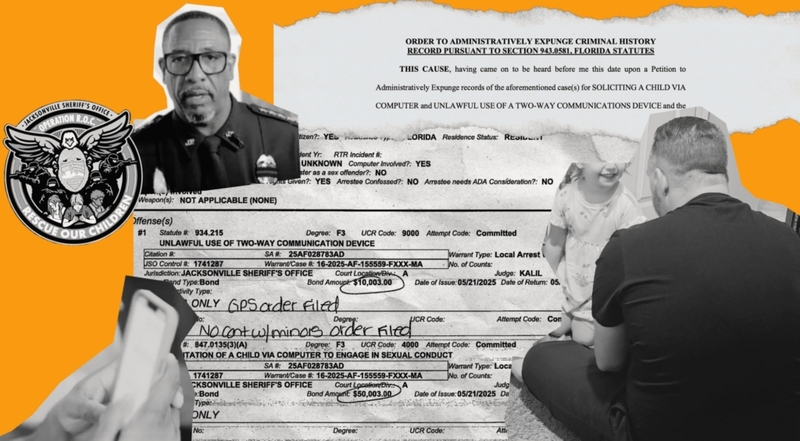
Clockwise from upper left: Jacksonville Sheriff T.K. Waters, whose officers’ botched investigation snared ‘Nick’, an innocent man; a police report that was supposed to be expunged but wasn’t; a judge’s order to expunge the case; ‘Nick’ reuniting with his daughter after a court-ordered separation. (Via The Florida Trib)
This story was originally published by The Florida Trib.
The supermarket assistant manager was working a day shift in Jacksonville when he stepped out of the store’s office and saw two sheriff’s deputies talking with his boss – who then pointed directly at him.
The officers walked over to the man and told him to place his hands behind his back, slapping him in cuffs in front of customers and coworkers. In a humiliating ritual, the assistant manager was marched out the door, hauled downtown for an interrogation, and accused of a despicable crime.
Brushing aside his denials, deputies charged the father of two young children with using the internet to try to entice a 13-year-old girl to have sex with him.
He had done no such thing. Instead, Nick was the latest victim of artificial intelligence-powered law enforcement, which has been misused to arrest the innocent by lazy or bumbling police officers from coast to coast – in this case, cops working for the Jacksonville Sheriff’s Office.
The Trib is withholding Nick’s full name to avoid marring his reputation in the eyes of future employers or others who might run a search on him.
Nick’s arrest came in conjunction with a multi-agency sting called Operation Rescue Our Children, in which cops posing as young children online try to lure pedophiles into sexually charged exchanges and ultimately, in-person meetings, where they are detained and arrested.
Forced to spend the night in jail, Nick was bailed out by his wife, but was ordered by a court to live separately from his children, the youngest of whom was just seven months old at the time. It was a “life-ruining” ordeal for Nick and his family, costing them $45,000 in lost wages and legal fees and traumatizing his kids.
“Somebody needs to be held accountable for what they’re doing to people,” Nick told The Florida Trib in a recent interview at his family’s suburban home, which is full of his young children’s toys and decked out with Halloween decorations.
“When you rush through these things to catch bad guys, you don’t realize you’re catching good guys instead,” he added.
An investigation by The Trib reveals the 38-year-old was arrested, detained, and charged with heinous crimes – all because someone else pulled photos of him off the internet without his knowledge for the purpose of impersonating him and then messaged them to an undercover officer posing as a child during the sting operation.
Relying on artificial intelligence-powered facial recognition tools, officers opted to arrest the man in the photos, Nick, and failed to do the basic investigative work that officers did routinely before AI came along – the digging that would have led them to the actual perpetrator.
The charges Nick faced – soliciting a child via computer and unlawful use of a two-way communications device – are third-degree felonies that carry up to five years in prison.
The Trib’s investigation shows how a justice system meant to promote public safety instead failed an innocent person at nearly every step of the process – and paints a picture of powerful institutions unwilling to answer for their mistakes.
A judge signed off on an arrest warrant based on a threadbare investigation by police. Prosecutors at the Office of the State Attorney for the Fourth Judicial Circuit rubber-stamped the case, too, advancing the charges despite gaping holes in the evidentiary record. And after the charges were dropped and a judge ultimately ordered the case expunged, it took the Duval County Clerk of Courts more than a year to finally scrub Nick’s record from its public database – a step the agency took only after The Trib began asking questions.
It’s not the first time the Jacksonville Sheriff’s Office has arrested the wrong person because of AI-powered misidentification and a lack of investigative rigor – or even the first time the agency had a hand in accusing an innocent person of child sex crimes. Nick’s case is part of a disturbing pattern, at a time when law enforcement is subjecting millions of Americans to warrantless mass surveillance by Flock cameras and other tech, their images filling vast databases that researchers have described as a perpetual line-up of suspects.
Such arrests have profound impacts on the lives and reputations of those falsely accused and take valuable resources away from prosecuting actual perpetrators.
“I’ll never be able to get away from it,” Nick said of his wrongful arrest.
Joe Bodiford, a longtime criminal defense attorney and adjunct professor at the Stetson University College of Law, said Nick’s case “should scare the hell out of all of us.”
“Because any of us could end up in [Nick’s] spot, where all of a sudden, you’re accused of something you didn’t do because somebody’s done something slick on the internet,” Bodiford said.
“This could have happened to anybody, with this level of investigation,” Bodiford added.
‘A tragedy of lost liberty’
It’s been more than a year since prosecutors finally dropped the charges against Nick, and there are still whispers among friends, family and coworkers about what actually happened.
“Any false arrest is a tragedy of lost liberty, livelihood, and trust in the legal system. But to be arrested for a sex crime adds a whole level of stigma,” said Andrew Ferguson, a professor at the George Washington University Law School and an expert on facial recognition, surveillance and policing.
“It is really hard to repair the damage done by this type of false arrest,” Ferguson added.
When officers showed up unannounced that day last May, Nick had no idea why he was being arrested, he told The Trib. He was shaken by his detention and shocked by the charges. Still, he cooperated with investigators, handing over his phone and denying all the accusations.
There is no indication in the court documents that officers carried out any other investigative work before arresting Nick, beyond verifying that he was the person in the photos sent to an undercover cop by an account on a social media dating app called Skout. Investigators told Nick they relied on facial recognition tools to identify him in the pictures, he recalled.
The sheriff’s office, known as JSO, did not respond to a detailed list of questions for this story.
JSO investigators and officers across the state rely on a facial recognition database called FACESNXT, which is maintained by the Pinellas County Sheriff’s Office. Currently, 221 local, state and federal agencies have access to the system, which lets them sort through about 15 million mugshots and about 25 million driver’s license photos that investigators can use to compare against surveillance photos and snapshots of suspects.
Facial recognition technology relies on AI to analyze the characteristics and patterns of human faces and produce a mathematical value to represent them – which can then be compared against other photos to produce a similarity score. Armed with those results, officers have gone to judges to secure arrest warrants, leading at times to cases of mistaken identity and wrongful arrest.
Search results from the FACESNXT database are supposed to be treated strictly as investigative leads for officers to pursue and do not on their own constitute probable cause for an arrest, according to terms of use for the system. Jacksonville Sheriff T.K. Waters himself criticized an overreliance on facial recognition when questioned about a previous wrongful arrest his agency played a role in.
“If you came to me with a facial recognition hit and that was your probable cause, I would probably kick you out of my office because that’s not how it works,” Waters told Action News Jax after the prior mixup.
If Waters’ officers had vetted their lead and obtained digital fingerprints from the suspect’s online account before arresting Nick, they would have found that the actual perpetrator was a man who had pleaded guilty to the same offense just a few years before.
A clear criminal history
Richard Steven Cook had a documented criminal record of trying to solicit children for sex.
Court records show that as early as 2018, the then-28-year-old Jacksonville resident began exchanging explicit messages with an undercover officer whom Cook thought was a 14-year-old girl.
According to court records, investigators identified Cook by running his phone number and the pictures he sent in the chat through law enforcement databases and social media websites.
Cook ultimately pleaded guilty to unlawful use of a two-way communications device in 2019 and was placed on probation for three years.
A year and a half later, Cook was re-arrested for violating the terms of his probation. In court records, Cook admitted that he tried to meet up with someone he thought was a 15-year-old at an elementary school, only to be confronted by two women who were attempting to ensnare would-be child predators.
A judge sent him to prison for 24 months.
Three years after being released, Cook was at it again.
A ‘bad policing’ story
On May 14, 2025, court records show that Cook logged on to the Skout online dating app with the username “Steven,” his middle name, and messaged someone he thought was a 13-year-old named “Megan,” but was actually yet another undercover cop.
In explicit detail, Cook described his desire to have sex with “Megan” and sent two photos of a man with dark brown hair – photos that notably did not match Cook’s Skout profile picture. Cook, when his head is not shaved as in his prison mugshot, has red hair.
When investigators ran a search on the photos of the man with dark brown hair, it led them to Nick, whom officers promptly arrested six days after the online conversation with “Megan” ended.
There is no evidence that investigators sought cell phone data, internet search history or account information for the suspect’s profile before arresting Nick.
If investigators had obtained that information, they would have seen that the email address behind “Steven’s” account belonged to Cook – the same email he was using back in 2018 when he was first arrested for soliciting a minor.
Instead, officers apparently rushed to arrest and charge Nick, who was taken into custody the same day that Sheriff Waters held a press conference to announce the arrests of two dozen men snared in “Operation Rescue Our Children.”
Nick’s arrest occurred after that press announcement, which featured a slickly produced video of officers tackling and detaining various men, some of whom showed up for what they thought would be a rendezvous with an underage victim.
“It’s disgusting,” Waters said of the alleged crimes during the press conference.
“We’re not going to stand for it,” he added. “That’s why these detectives work so hard. And we’re going to continue to work these cases, to make sure we get these people off our streets. Hopefully put them away forever.”
Locked in the interrogation room with him that day last May, investigators confronted Nick with the messages and photos the suspect sent, and Nick pointed out that the account’s profile picture clearly showed someone else – Cook, who was a former friend.
It was Nick who told the officers that Cook had been arrested a few years prior for the same offense, information the investigators could have easily accessed with a few keystrokes in law enforcement databases had they bothered to check.
The two photos of himself, Nick explained, could have easily been taken from his social media accounts, as he and Cook remained friends on Facebook.
“This is not a bad technology story. This is a bad policing story,” said Ferguson, the GWU law professor, who reviewed court documents at The Trib’s request.
“This was not a sophisticated criminal actor,” Ferguson said of Cook, “and there is no way just scraping a photo from Facebook should lead to a wrongful arrest. The fact that police did not do basic confirmation of the other digital clues is not simply embarrassing but frightening.”
A father separated from his young children
Despite Nick’s revelations during the interrogation, the officers told him he had to spend the night in jail because a judge had signed a warrant for his arrest.
Nick’s arrest – in the name of protecting children – resulted in his court-ordered separation from his own two small kids.
A judge barred him from having any contact with the children for a month and a half – not even a phone call or video chat. And for nearly three months, he wasn’t able to reside at his family’s home, staying with his mother-in-law instead.
The month and a half that Nick was separated from his wife Rebekah and their two kids is time they will never get back. While their younger daughter was just an infant, their older daughter was three at the time – old enough to tell her mom just how much she missed her dad.
Nick resorted to recording videos of himself reading children’s books for Rebekah to share at bedtime.
“She asked me every day why she couldn’t see her dad,” Rebekah said, choking back tears. “And so we were explaining to her that somebody did something really mean to Daddy. And Daddy can’t see us right now because of it.”
The Trib is also withholding Rebekah’s last name to protect the family’s privacy.
“That was honestly the hardest part about all of it,” Rebekah said. “I didn’t know how to support her … when my whole world blew up.”
“Her entire world exploded, too,” Rebekah added.
Now reunited with her father, the little girl, who turns five next month, still talks about that time and gets anxious when her dad is running late from work or has to leave home early, Rebekah said.
Beyond the trauma of the family’s separation, Nick and Rebekah are also still paying off the financial cost of his lost freedom. The rent they couldn’t pay while Nick was suspended from his job. The $105 a week for the court-ordered ankle monitor that tracked his every move. The extra childcare costs for their kids while the couple worked on Nick’s case.
“I can’t make sense of any of it,” Nick said of his family’s debacle. “I hope it doesn’t happen to anybody else, that’s for sure.”
‘How did this happen?’
While Nick fought his charges, investigators took their time building the case against Cook, who was able to live his life freely for nearly five more months as officers methodically collected the digital evidence that was so flagrantly absent from Nick’s case.
Court records show that the day after Nick’s arrest, investigators issued the first of a string of subpoenas for account information behind the suspect’s online profile, which confirmed it belonged to Cook. He was still living at the same address where JSO officers had arrested him back in 2018.
Officers confronted Cook at his home on July 31, 2025, and he confessed to propositioning someone he thought was a young girl and admitted to using photos of other people – including his ex-friend Nick.
“Cook advised that the photos were of his former friends,” his arrest report reads, “which he utilized in the chat because they were better looking than him.”
Even that admission apparently wasn’t enough for JSO to take Cook into custody. But the next day, prosecutors finally dropped the charges against Nick. On Aug. 4, 2025, a judge ordered Nick’s case expunged because the arrest was made “contrary to law or by mistake.”
But records for the case – as well as Nick’s home address, cellphone number, and place of work – remained publicly available on the Duval courts website for more than a year after the judge ordered the records expunged.
Meanwhile, the names of the officers responsible for Nick’s ordeal were redacted – preventing the public from holding them accountable for the botched arrest.
“That’s not fair at all,” Nick said. “Everybody that was involved in the process should be named, too. I had to go through all this. Shouldn’t you?”
A spokesperson for the Clerk of Courts acknowledged its failure to properly expunge the case, but did not answer questions about why it remained publicly available for so long.
The State Attorney’s Office likewise did not answer questions on whether a formal acknowledgment or apology was made to Nick, saying: “There is no record in our system of this case.”
“The public needs to know: How did this happen?” said Bodiford, the adjunct professor at Stetson Law. “Why did it take so long to correct?”
Broken promises
Nick and Rebekah said they did receive one apology – and a string of broken promises.
After the charges were dropped, the couple was finally able to retrieve Nick’s phone and have his ankle monitor cut off. A sheriff’s officer who met them to close out the case expressed regret for what the officer described as the poor police work and mishandling of the investigation.
The lead detective on the case was placed on administrative leave pending termination, the couple was told. (JSO did not respond to questions about the officer’s status, but public records show that as of earlier this month, she had applied for a deferred retirement program that would allow her to continue working for the agency while drawing on retirement benefits.)
The officer who expressed sympathy that day Nick got his ankle monitor removed also made promises, the couple said, that the agency would pursue identity theft-related charges against Cook for misusing Nick’s photos. That officers would keep them informed about the status of Cook’s case. That the couple would be able to present victim impact statements at his sentencing.
None of that happened, they told The Trib.
“We never heard from them again,” Rebekah said. “Never. Not once. We didn’t even get notified when Steven got arrested.”
It wasn’t until Oct. 17, 2025, that JSO finally took Cook into custody, almost five months to the day after officers had wrongfully arrested Nick.
Earlier this year, Cook pleaded guilty to soliciting a child via computer and unlawful use of a two-way communications device. He was sentenced to 40 months in prison, a term he is currently serving.
Nick and Rebekah were not there to testify at the sentencing.
‘We won’t be the last’
More than a year after Nick was taken away, he and his family remain forever changed.
They get shaky at just the sight of a uniformed officer. They still wonder about what people whisper behind their backs. They don’t post photos on social media.
And they still have so many unanswered questions about what was done to them – questions that the sheriff’s office has repeatedly refused to answer.
Ken Jefferson, a retired officer who spent more than two decades at JSO, said the agency needs to own up to its failures.
“At the very least, an apology should be given, number one. Because it’s been proven that this person had nothing to do with it,” Jefferson said.
“You’ve got to be held accountable for not following up, for not doing your due diligence right then, to try to bring closure to this case as expeditiously as you can,” Jefferson added.
With no indication that the officers have learned from their mistreatment of her husband, Rebekah can’t shake the feeling that her family won’t be the only ones to fall victim to this kind of injustice.
“I know we aren’t the first ones,” Rebekah said. “And I’m sure we won’t be the last.”
Florida Trib reporter Trinity Webster-Bass contributed to this story.
Kate Payne is The Florida Trib’s state government reporter. She can be reached at [email protected]
Funding for this article was provided by the Organized Crime and Corruption Reporting Project (OCCRP).
Tallahassee, FL