Budget cuts, looming deadlines put family caregivers in a ‘complete tailspin’
May 26, 2026 | 5:00 am ET

Description
Hundreds of Marylanders rally against cuts to services for those with developmental disabilities during the 2026 legislative session. (Photo by Danielle J. Brown/Maryland Matters)
Advocates for people with developmental disabilities warn that upcoming rule changes and wage cuts this summer will be detrimental – particularly for those who self-direct their Medicaid services and have family members help with care.
“The entire self-directed community right now is in a complete tailspin and are overwhelmed,” according to Carin Smith of the Concerned Citizens for Self-Direction Advocacy Group. “Stressed, anxiety — they don’t know what they’re going to do.”
Smith’s comments follow several webinars hosted by the Maryland Department of Health this month seeking public input on how the state can better implement new restrictions and wage reductions required under the state budget approved this year.
That budget includes broad rate reductions and wage cuts across the board. But he self-directed community feels that new restrictions on how family members can provide care for their loved ones with developmental disabilities will be particularly challenging, especially as the workforce for these services faces a shortage.
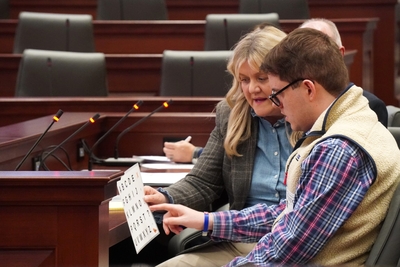
That’s the worry for Tracie Feron, a Baltimore County resident who testified against the budget cuts this session with her son, Connor.
“When these wages are cut, who is going to be there besides family as staff?” Feron said. “We can’t just hire anybody to come in with his complex needs, and with the cuts from last year, it is already a strain on this community to find qualified people.”
With many of these changes taking place over the summer, advocates worry that there will not be enough time to comply, according to a Friday statement from the Self-Directed Advocacy Network of Maryland, Inc.
“SDAN is deeply concerned that the short implementation timeline does not provide enough time for providers and participants to successfully complete the required process and maintain uninterrupted services,” the statement said. “As a result, many individuals risk losing critical supports beginning July 1.
“SDAN is urging the State of Maryland to consider the severity and real-life impact of these sudden changes on people with developmental disabilities who depend on stable, uninterrupted services every day,” the statement said.
It’s the second year in a row that the Moore administration and lawmakers slashed DDA funding to offset what state officials say is unsustainable cost growth at the agency. Last year, the state cut $164 million from the DDA budget.
The General Assembly this year cut $126 million in state funding to the DDA, which oversees the Medicaid waiver that helps provide services to people with significant medical or behavioral needs due to their disabilities. Once federal matching dollars are factored in, the cuts total more than $250 million.
People with the Medicaid waiver, or a designated guardian, are able to “self-direct” their care, hiring and firing their own support staff, rather than joining a community provider. About 3,900 people in Maryland self-direct their Medicaid services.
Right now, people self-directing their care can hire family members to provide services just as they would someone outside the family – and pay the same wage. But family members who are employed under the Medicaid waiver will be particularly affected by some of the cuts.
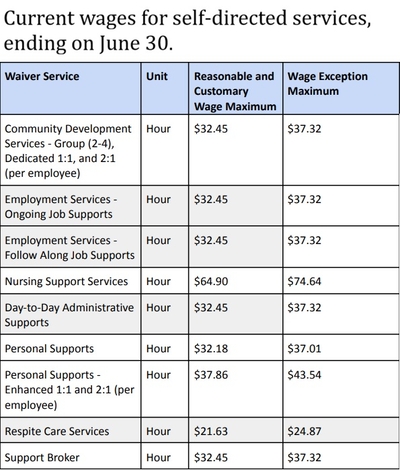
There is also a process called “wage exceptions” which let people in certain circumstances pay their staff more. For example, one of categories of services, called “personal support,” currently has a maximum wage of $32.45 per hour, but that can grow to $37.01 an hour with a wage exception. Providers in certain counties can get an additional wage boost.
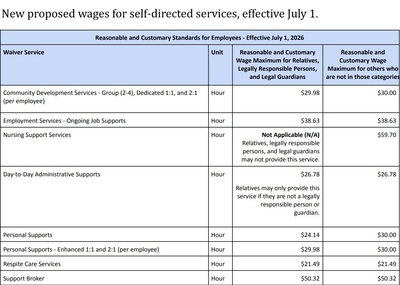
The new budget eliminates the wage exception process, capping pay for personal supports at $30 an hour for non-relatives, and $24.14 an hour for family members working as “personal supports.”
Those wage reductions and others will begin July 1.
Advocates worry that the wage cuts for nonrelatives will lead to people leaving the field entirely, at a time when support services already face a workforce shortage. That would mean that more family members would have to step in for less pay – except the new budget also restricts the hours family members can get paid for their services.
Under the new rule, an individual family member taking care of a loved one could only be paid for 40 hours a week, and the maximum number that all family members could be paid for is 60 hours a week. That new rule, if approved by federal officials, will take effect on Sept. 1.
How those hours are distributed is up to the waiver recipient. It could split between two family members who work 30 hours each, three members who work 20 hours a week, one parent who works 40 hours while the other works 20, and so on.
Nonrelative providers will need to make up the difference, which will be hard if more workers choose to leave disabilities services for a job that pays more.
“We are jeopardizing the health and safety of these individuals by allocating dollars, state and federal match dollars based on their need – and then not giving them the services to support the need,” Feron said.
The new restriction will need approval from the Centers for Medicare and Medicaid Services, along with other changes under the proposed waiver amendment that will usher in the budget cuts.
Shari Dexter, also with Concerned Citizens for Self-Direction, said that advocates are contacting CMS as well as state officials to urge a reconsideration of the cuts, noting that family members who provide self-directed services have made significant life decisions based on the current wages.
“There are parents who gave up their jobs,” Dexter said. “And now they’re taking a pay cut. And especially when you have a participant who lives with you — you’re not getting payment for your house, you’re not getting payment for electricity. People still have real daily needs of supporting the participant with clothing, with food … all those things.
“Regardless of whether you’re shopping at Target or you’re going to the gas pump, all of these things have gotten more expensive,” she said.
But even after hearing public comments from the self-directed community, state health officials stand by the need to cut from the DDA, to contain “unsustainable” program growth.
“Costs for this federal Medicaid waiver program have grown by over $920 million in State General Funds over the last five years, representing an increase of more than 144%,” the Maryland Department of Health said in a written statement Friday. “The FY 2027 budget passed by the Maryland General Assembly includes sustainability measures to slow cost growth and align Maryland’s program more closely with federal guidance and best practices.
“DDA is committed to working with participants and families, providers, case managers, and advocates to ensure all needed, eligible services are available for participants,” the statement said.
Annapolis, MD