Boston appeals court rejects RI child advocate’s emergency relief petition
May 20, 2026 | 6:09 pm ET

Description
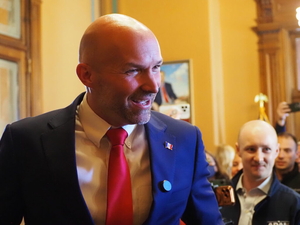
The First U.S. Circuit Court of Appeals rejected the Rhode Island Office of Child Advocate’s petition for emergency relief, clearing the way for the release of medical records for transgender youth treated at Rhode Island Hospital. (Photo by Alexander Castro/Rhode Island Current)
The U.S. Court of Appeals for the First Circuit refused Tuesday night to block the initial transfer of transgender youth-related records from Rhode Island Hospital to a Texas federal court.
The records will be held in the custody of the court and unavailable to the public, according to an order from U.S. District Court for the Northern District of Texas Chief Judge Reed O’Connor.
The records were subpoenaed by the U.S. Department of Justice last July as part of an ongoing, nationwide investigation into potentially fraudulent labelling and billing practices involving hormone therapy and other pharmaceutical treatments for gender dysphoria.
Rhode Island Hospital intends to release records to comply with Texas judge’s midnight deadline
“While we are disappointed in this result, this decision is not the end of our fight to protect Rhode Island children’s medical privacy,” Kevin Love Hubbard, an attorney with the Lawyers’ Committee of RI and the Rhode Island’s Office of the Child Advocate’s representative in the case, said in a text message to Rhode Island Current Wednesday. “We know that even if the DOJ is not receiving these records now, the uncertainty generated by this ongoing legal battle has been harmful.”
Child Advocate Katelyn Medeiros, whose office represents youth in state care plus kids who receive behavioral health services through the state’s child welfare agency, filed an emergency motion in an appeal in the First Circuit in Boston Tuesday, hoping to avert the transfer before the midnight deadline set by O’Connor.
The petition came after Medeiros’s legal team successfully acquired a ruling that would strike down the subpoena last week in Rhode Island U.S. District Court. But after that ruling, on May 18, O’Connor ordered that even with the subpoena quashed, the records would need to be sent to his district, and held in the court’s custody, or in camera, and inaccessible to the government or anyone outside the court for the time being.
The Child Advocate’s legal team argued that even an abbreviated sharing of these records would constitute harm to the youths’ privacy.
The three judges on the appellate court were unconvinced.
“The Child Advocate contends that providing the records to anyone, even to a court, represents an irreparable harm given ‘the psychological and institutional costs of compelled production of sensitive medical records even when redacted,” the opinion by Circuit Judges Gustavo A. Gelpí, Lara E. Montecalvo, and Joshua Dunlap read. “The Child Advocate cites no authority for the proposition that providing anonymized records to a court — particularly one that has assured the parties that the records will not be disseminated unless and until the parties’ appeals are resolved — could constitute irreparable harm.”
Circuit Judge Dunlap backed up the main opinion with a separate, concurring one.
The May 18 Texas order, the appellate judges noted, “does not require…production to, and review by, an adverse party.” That was one sticking point and part of why Rhode Island Hospital moved sluggishly to release the records when it feared violation of privacy rights should the DOJ receive unrestricted and direct access to select information in the requested caches.
The DOJ’s subpoena requested five categories of especially sensitive patient information, like diagnostic, treatment and family histories.
A spokesperson for Brown University Health, the parent healthcare organization of Rhode Island Hospital, said in an unsigned email Wednesday that there was no patient identifying information in the information it shared with the court.
“With the DOJ, for the first time with respect to the subpoena issued to Rhode Island Hospital, unequivocally agreeing on the record that it would accept records from the hospital that do not contain sensitive personal health information, no production to the court — not yesterday’s and none in the future — will include patient identifying information,” the spokesperson wrote.
Rhode Island Hospital first shared with Rhode Island Current shortly before 6:30 p.m. Tuesday that it was sending an initial batch of documents to the Texas court.
A filing Tuesday in the Texas court from Rhode Island Hospital noted that the “production of records, and necessarily compliance with the Court’s May 18 Order requiring in camera production, will take a period of months,” due to “the volume of the data to be collected, and the time-consuming and costly nature of the review process, which will divert RIH personnel from their daily responsibilities.”
The hospital expects that the next batch of records will be shared on May 29.
Hubbard agreed that “the anonymization and de-identification does reduce the risk” involved with the hospital sharing the documents, although he noted that the government’s intentions — especially its willingness to accept anonymized data — were unclear when the Child Advocate first moved to act.
“It only became clear that the government was accepting that after we filed our emergency motion, when they represented to the First Circuit there was less harm because of the anonymization,” Hubbard said. “The First Circuit relied on that, and the fact that DOJ will not be able to access the records pending the appeal, for its finding that there was no irreparable injury for the patients.”
Hubbard said that, to his understanding, the documents the hospital shared Tuesday night were “not medical records” and were “non-privileged documents responsive to other parts of the subpoena.” They were not in the five contended categories of medical records central to the litigation, Hubbard said.
More to come
But, as Hubbard suggested, the fight does not appear to be over, and on several levels at that.
Rhode Island Hospital’s acceptance of the anonymity condition is similar to compromises the DOJ offered other subpoenaed hospitals in its nationwide efforts.
Karen Loewy, senior counsel and director of constitutional law practice at Lambda Legal, said in an emailed statement Wednesday that the records are part of a larger grab by the DOJ.
“DOJ’s goal here is to end the provision of gender affirming medical care to adolescents — full stop — whether through intimidation of the hospitals, threatening their funding, going after their providers, or scaring patients into not seeking care in the first place,” Loewy wrote. “Sowing distrust between providers and the transgender young people who need their care is all part of the plan.”
Shannon Minter, legal director of the National Center for LGBTQ Rights, agreed in a phone interview Wednesday.
“This is this administration weaponizing the criminal subpoena system to just grossly invade the most sensitive private confidential information,” Minter said. “The harm here is so grave. The betrayal of patient confidentiality is so extreme that they should have taken every possible measure to fight it.”
An unsigned comment from DOJ Wednesday read: “This Department of Justice will use every legal and law enforcement tool available to protect innocent children from being mutilated under the guise of ‘care.’”
The harm here is so grave. The betrayal of patient confidentiality is so extreme that they should have taken every possible measure to fight it.
For the appellate court judges, meanwhile, they had to “set aside a host of procedural problems,” in their ruling’s words, to even arrive at a decision. Was it right to grant an injunction “that would order the Hospital not to turn responsive records over to anyone,” or could the Child Advocate even “obtain an injunction against the Hospital that would subject the Hospital to mutually irreconcilable orders”?
The appeals court did not determine those answers, and relied on what it saw as a lack of irreparable harm to settle the score.
In his separate, concurring opinion, Circuit Judge Dunlap — an appointee of President Donald Trump who took his seat on the First Circuit in November 2025 — identified deeper problems he saw with the child advocate’s argument.
“The Child Advocate claims that she is not asking us to ‘review, vacate, or direct any action by the Texas court,’ and instead is only requesting that we enjoin the Hospital from turning over materials to the Northern District of Texas,” Dunlap wrote. “But that argument is little more than sophistry.”
The judge was also concerned with Rhode Island’s U.S. District Judge Mary McElroy’s May 14 order that squished the DOJ’s administrative subpoena, partly because it failed to engage with “the government’s theory that the Hospital caused the distribution of drugs that are misbranded for off-label uses or conspired with manufacturers or distributors to misbrand such drugs.”
“Assuming these theories are valid, the district court’s improper purpose reasoning would fall away,” Dunlap wrote. “There are therefore serious questions about the merits of the district court’s decision.”

Providence, RI