Bill creating ‘drug-free homeless service zones’ moves forward; changes planned
Feb 11, 2026 | 3:08 pm ET
Description
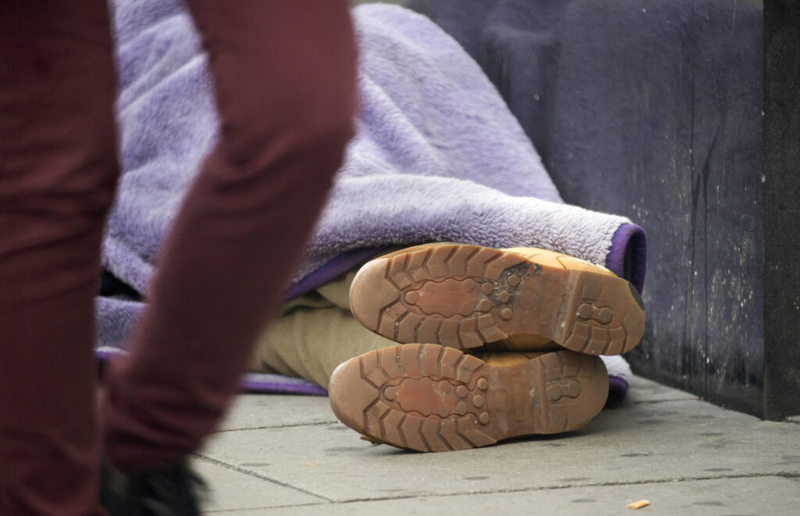
Advocates for unhoused people raised concerns about proposed legislation that would penalize service providers if someone commits a drug offense within a "drug-free homeless service zone." (Photo by Kypros/Getty Images)
An Iowa House subcommittee advanced legislation that would establish “drug-free homeless service zones,” with stiffer penalties for drug-related crimes in the area.
Republicans said they plan to make changes to some issues of concern raised by advocates, like restrictions on prescription medicine and drug use in nearby facilities.
House Study Bill 705 is the latest policy proposal brought forward with support from the Cicero Institute. The Austin, Texas-based nonprofit has promoted legislation discussed during previous sessions creating criminal penalties for unauthorized camping, sleeping or long-term shelter on public property. The previous proposal also would have established a state-funded grant system for local governments to create parking lots, camping facilities and shelters to serve unhoused populations in their area.
This year’s bill does not contain these measures, but raises one of the suggestions included in the previous proposals as a standalone bill — the establishment of “drug-free zones” at shelters and other homelessness support facilities in the state.
Dennis Tibben, speaking on behalf of the Cicero Institute, said the measure was modeled after the the “drug-free school zones that have been in place in Iowa since the 1980s.” The measure would prohibit people from “intentionally or knowingly” selling or distributing controlled substances within a 300-foot zone of the facility. People charged with drug-related crimes in these zones would be subject to the same punishments as outside the areas while adding an additional year of jail time and removing the option for deferred judgment, sentencing, probation or work release.
Advocates raise concerns about penalizing service providers
Many advocates speaking on behalf of organizations providing these services said their facilities already have drug-free policies in place — but said their larger concern was about the bill’s proposed penalties for service providers. The measure said a person operating or with “authority to enforce the policies and requirements” of a facility-based drug-free zone that “allows” an individual to possess or use a controlled substance on the facility premises would be subject to an aggravated misdemeanor charge.
Facility operators found in violation of this measure would be ineligible to apply for homelessness assistance grants from the state for three years following their conviction.
Several speakers said the restrictions put forward in the measure would put an unreasonable burden on service providers and facilities, who would be held liable if people seeking support are using or possessing drugs without their knowledge.
Zebulon Beilke-McCallum with the Iowa Coalition against Domestic Violence, representing 25 victim service providers across the state, said the shelters in their network are already drug-free, but said people seeking services are not required to be drug-free to access support. “Think about situations in which both (parties) may have been using illicit drugs that contribute to a violent or domestic violence incident that causes them to need to flee to our services,” he said.
Beilke-McCallum also pointed to situations like people seeking shelter and support who are coming from states like Illinois, where cannabis is legal.
“We don’t know what they’re bringing, we don’t know what they’re experiencing, we just want to provide a safe and healing space for them,” Beilke-McCallum said. “And so holding shelter programs accountable in those instances where they’re trying to provide the safety and security for victims doesn’t make sense.”
Shelby Ridley, director of programs at Primary Health Care, said the organization’s homelessness service facility is a part of a larger health center, which includes a pharmacy. As the bill creates penalties related to “controlled substances” — including legal prescriptions — Ridley said facilities like theirs would face major problems in implementing these measures.
Tibben said there were “drafting errors” in the legislation, and said it would be amended to ensure the bill only referred to illicit drug use — not controlled substances that a person is possessing and taking for legal, medical purposes. He also said the Cicero Institute is proposing making changes to some of the bill’s language requiring signs marking facilities as a “drug-free homeless service zone,” saying the requirement as written could cause problems for some service providers like domestic violence shelters that have the “need for some additional privacy.”
But Ridley said the bill’s penalties for illicit drug possession or use still would create problems for many providers.
“As a service provider, we’re already under-resourced, so we don’t have staff to align more capacity, resources to be able to figure out what people have on them, and how they enter our building,” Ridley said. “… Providing more barriers to clients to access services — what we know is that when they think that there might be a criminalization charge coming with it, they’re less likely to engage with us, which means we actually have more visible unsheltered homelessness.”
Zones may include nearby homes, businesses
Angie Arthur, executive director of Homeward Iowa, a homelessness planning organization in Polk County, said there were numerous issues with the bill, saying the measure was “proposed by national think tank that isn’t familiar with the Iowa system, nor is it trying to work with providers in the state to create a positive solution.”
In addition to the issues with people using substances in a facility without operators’ knowledge, Arthur said many Iowa facilities are within 300 feet of private residences, businesses or other facilities. That means if individuals are convicted or charged for drug use within the “zone” of a homeless service provider, the provider could be subject to criminal charges or face the loss of public funds, she said.
“For example, a shelter in Council Bluffs has a strip club within 300 feet,” Arthur said “So how would they have control of that type of (establishment) — or any establishment, whether it’s a private residence or a business — to be able to control the use of substances within there?”
Rep. Jason Gearhart, R-Strawberry Point, said though he supported moving the measure forward to “keep the conversation moving,” he said he would consider an additional amendment limiting the “zone” to within a service provider’s facility, business structure or campus to ensure they aren’t punished for crimes happening nearby or inside other businesses.
Rep. Bill Gustoff, R-Des Moines, also said he was signing off on the measure to continue the discussion, but said, “I think it was a well-intended bill, but … we would need to watch for the law of unintended consequences” going forward.
Des Moines, IA