Bill Cassidy has taken political risks to get funding for Louisiana. Will voters care?
May 08, 2026 | 5:00 am ET
Description
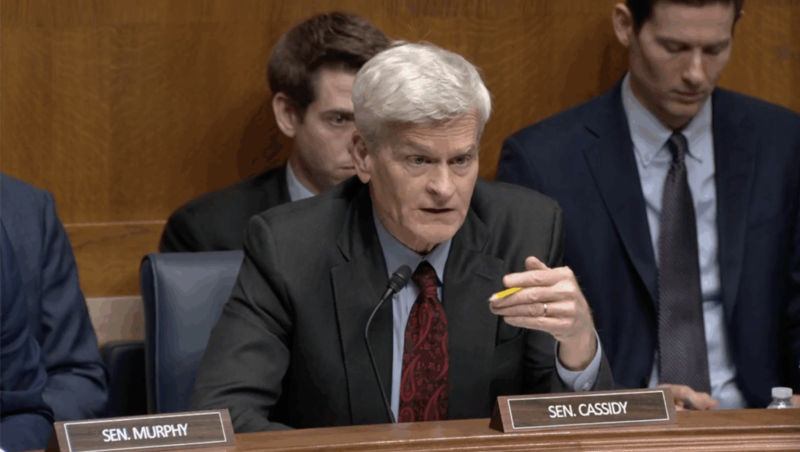
U.S. Sen. Bill Cassidy, R-La., is in a tough reelection campaign against two Republican candidates, U.S. Rep. Julia Letlow, of Baton Rouge, and state Treasurer John Fleming of Minden. The Republican primary election is May 16. (Screenshot from U.S. Senate committee livestream)
Sheriff Steven McCain was leading rescue efforts during widespread flooding in rural Grant Parish in central Louisiana in March 2016 when he got a late-night phone call.
The person on the other end was U.S. Sen. Bill Cassidy, the embattled Republican facing reelection this month.
Cassidy had heard McCain was having trouble getting the parish’s boats in place for rescue missions. The boats’ motors were too low for McCain’s staff to move them across flooded asphalt roads.
The senator said he would send McCain some airboats, which are easier to navigate in shallow waters. By 5:00 the next morning, six airboats had arrived in Grant Parish from all over South Louisiana, McCain said.
“I understand from a political standpoint, we are very miniscule,” said McCain, whose parish with 22,000 residents is one of the least populated in Louisiana. “But that doesn’t mean the concerns of the people that live here are not important. He and his office have always listened to the concerns that we have.”
McCain said Cassidy also found $1 million to help Grant Parish complete its first public sewer system and steered hundreds of thousands of dollars to his community to upgrade the local 911 system.
Grant Parish’s experience reflects those of several other communities across Louisiana with Cassidy over his almost 12 years as a U.S. senator. He’s described as being easy to work with, competent and very interested in assisting when there’s a need.
“I think, with his thoroughness and his attention to detail, he is exactly the type of person we need in Washington,” Louisiana Senate President Cameron Henry, R-Metairie, said.
“He helps with everything, like really everything,” Henry added.
It remains to be seen whether that reputation for helpfulness has reached Louisiana voters, however. Cassidy coasted to reelection six years ago but is fighting for his political life against two other Republicans, U.S. Rep. Julia Letlow of Baton Rouge and state Treasurer John Fleming of Minden, in the upcoming May 16 party primary election.
Trump votes
Cassidy’s GOP opposition largely stems from his vote to convict President Donald Trump in his impeachment trial on charges of inciting the Jan. 6, 2021, attack on the U.S. Capitol.
His vote against Trump came just three months after Cassidy had won his own reelection. At the time, former President Joe Biden had just been sworn into office and a successful Trump comeback to the White House wasn’t readily apparent.
Cassidy was also very angry about the Jan. 6 riot as it was happening. He repeatedly referred to it as “an act of sedition,” in an interview on the day it took place.
“It is what happens in third-world countries,” the senator said at the time.
“[Trump] should say this is wrong, this is criminal, an action of sedition and people should go home,” Cassidy went on to say while still on lockdown after being evacuated from the Capitol.
Unfortunately for Cassidy, the Jan. 6 attacks didn’t do much to quell Trump’s popularity back home. The president won 60% of Louisiana’s vote in 2024. Cassidy’s vote to convict has mostly put a target on his back, particularly after Trump-aligned Gov. Jeff Landry took office in 2024.
One of the first things Landry did when he became governor was create a semi-closed primary election system. It empowered Trump supporters in this year’s U.S. Senate race because registered Democrats can no longer vote in the primary race with Cassidy included.
Staring down a MAGA-dominated primary, Cassidy tried to repair his relationship with Trump, at least publicly, after the president took office again last year. The senator, a medical doctor and vaccine proponent, cast the deciding vote for Robert F. Kennedy Jr., a vaccine skeptic, to become Trump’s health secretary.
But that show of support for Trump didn’t stop the president from endorsing one of Cassidy’s opponents, Letlow, in the Senate race.
Cassidy said he doesn’t regret his votes to convict Trump or confirm Kennedy.
“You know, I’m a doctor. You make a decision based upon the facts that are before you. You make that decision and you move on,” he said in an interview last week.
However, the vote for Kennedy might have alienated Democrats, moderate voters and anti-Trump Republicans who could have otherwise supported Cassidy.
It was also counter to Cassidy’s deeply held beliefs. In his first Senate campaign, Cassidy had bragged about hepatitis B and flu vaccination campaigns he started for school children in East Baton Rouge Parish as a gastroenterologist.
Billions for Louisiana
Instead of those two controversial decisions, Cassidy is hoping Louisiana voters pay attention to another high-profile vote he took.
He was the only GOP member in Louisiana’s congressional delegation to vote in favor of Biden’s $1.2 trillion infrastructure plan. As one of just 19 Republicans who crossed over to vote with Democrats to support the bill, Cassidy was able to negotiate for some additional funding for Louisiana in the legislation, he said.
The spending package included funding for roads, bridges, airports, ports, orphan oil well remediation, power grid hardening and rural broadband internet expansion. Some specific projects that received money included the Morganza-to-the-Gulf hurricane protection system and Lake Pontchartrain restoration efforts.
Cassidy faced blowback from Republicans for signing onto the Biden initiative, particularly after Trump, out of office at the time, encouraged Republicans to vote against the infrastructure package.
But the senator is proud of his involvement with the bill, saying it was overwhelmingly good for Louisiana.
“Congress puts a certain amount of money in the middle of the table, and senators and representatives fight for it,” Cassidy told a group of firefighters gathered in Baton Rouge last month. “Now if it is going to go someplace in the country, I want it to go someplace in Louisiana. It’s going to be spent. Why not spend it here?”
Part of being an effective senator is having the fortitude to make tough votes, he said.
“It takes courage to vote for things when people are going to criticize you,” Cassidy said in an interview with reporters last week. “I’ve shown that courage.”
Former U.S. Rep. Charles Boustany, a Republican who represented the Lafayette area from 2005-17, said he admires Cassidy’s independent streak. A senator who has a willingness to put their vote up for grabs is in a much better position to get funding and projects for his state, he said.
“He has shown that he will stand on principle, even if it is contrary to the president or the party, and I think that is important for a U.S. senator,” said Boustany, who served in the U.S. House of Representatives alongside Cassidy.
“On the infrastructure bill, he tried to position himself to get as much as he could for the state,” Boustany said. “I would have done the same thing.”
Some elected officials who have criticized Cassidy for working with Democrats also haven’t shied away from promoting local projects and initiatives paid for by the Biden infrastructure bill.
For example, in late 2025, Landry sent out a news release celebrating Louisiana’s receipt of $1.3 billion in broadband funding to increase internet access in rural areas. The governor didn’t mention that money for the program came from the Biden infrastructure plan Cassidy helped pass in 2021.
“Now the people who criticize me are showing up for the ribbon cutting, trying to claim credit for that which they opposed and which I negotiated,” Cassidy said last week.
The position Cassidy finds himself in is similar to that of his predecessor, Democrat Mary Landrieu.
In 2014, Landrieu tried to persuade voters to give her another term in the U.S. Senate by emphasizing the billions in federal funding she had secured for Louisiana after hurricanes Katrina and Rita.
It didn’t work. Cassidy beat Landrieu 56% to 44%, in part by hammering her on a single controversial vote she cast. She helped pass the Affordable Care Act, known as Obamacare and very unpopular with conservative Louisiana voters at the time.
Cassidy is struggling in the Senate race because he has also taken controversial votes and isn’t viewed to be conservative enough.
“It’s not because he hasn’t produced for Louisiana,” Henry, Louisiana’s Senate President, said.
Baton Rouge, LA