For better or worse, Supreme Court takes up same-sex marriage debate
Dec 22, 2021 | 10:26 am ET
The U.S. Supreme Court will hear argument Tuesday morning in what many have called the landmark civil rights case of our time, considering in Obergefell v. Hodges whether states must allow same-sex couples to marry.
It’s been nearly two years since the Court last addressed the same-sex marriage issue, ruling in in U.S. v. Windsor that provisions of the federal Defense of Marriage Act which defined marriage as only between a man and a woman were unconstitutional.
At the time, DOMA conflicted with the laws of 11 states which permitted same-sex marriages.
But following that 5-4 decision — written by Justice Anthony Kennedy, a swingman in the current case as well — state barriers to marriage equality fell with remarkable speed.
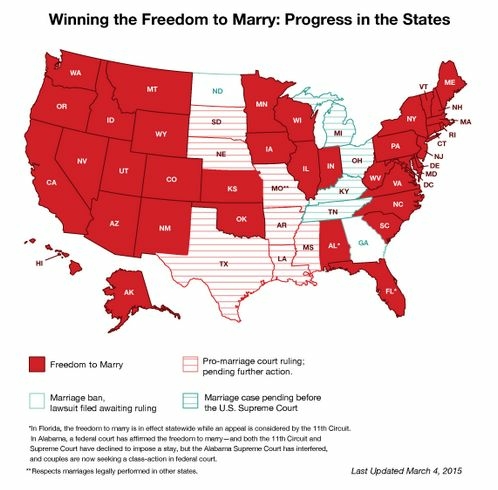
Virtually every state is now operating under a law permitting same-sex marriages or under a federal court decision requiring such marriages, as shown in the map below.
The Court in Windsor fell short, though, of deciding whether the U.S. Constitution requires states to allow same-sex couples to marry.
That question will now be squarely before the justices on Tuesday morning, as will the question of whether the Constitution likewise requires states to recognize the marriages of same-sex couples who were legally married in another state.
Challengers at the high court
The Obergefell case out of Ohio is one of four consolidated cases the justices will consider together on Tuesday, the others coming from Tennessee, Michigan, and Kentucky.
Like the plaintiffs in the North Carolina cases, the couples in the cases before the high court are seeking the right to marry, with all of the personal dignity, rights and benefits attendant to marriage – from sharing health insurance coverage to attaining legal status as parents to their children to recovering spousal benefits at the time of death.
For Ohio residents James Obergefell and John Arthur, it’s a matter of being able to appear as “married” on their death certificates. The couple had been together for 20 years when the Supreme Court decided Windsor. Arthur suffered from ALS, so shortly after the decision they flew by private jet to Maryland to get married. They then quickly returned to Ohio and filed a lawsuit to have their marriage recognized, hoping to be able to be buried together in a cemetery open only to family members. The trial court ruled that Arthur, who died in October 2013, could be listed as “married” on his death certificate. The state of Ohio appealed that ruling.
Tennessee residents Valeria Tanco and Sophy Jesty, both veterinarians, were legally married in New York but moved to take teaching positions at the University of Tennessee. Tennessee does not recognize same-sex marriages validly performed in other states, so the couple filed suit challenging state law to have their marriage recognized and to confirm both of their rights as parents to their daughter.
Michigan residents April DeBoer and Jayne Rowse have four adopted, special-needs children. Because Michigan bans same-sex marriage and doesn’t allow unmarried couples to adopt, DeBoer and Rowse each have legal custody of just two of the children. Hoping to prevent a situation where the family could be split apart if something was to happen to one of them, they filed suit against the state in 2012.
Kentucky residents Greg Bourke and Michael DeLeon, together for more than 30 years, were legally married in Canada in 2004 and have two adopted teenagers. Because Kentucky doesn’t recognize their marriage, only one of them can be the legal parent for those children. In 2013, they filed suit against the state challenging Kentucky’s gay marriage ban.
Where things stand in North Carolina
Four cases challenging the North Carolina’s same-sex marriage bans are pending in federal courts here.
- Fisher-Borne v. Smith, initially filed in Greensboro in 2012 as a challenge by six families headed by same-sex couples to North Carolina’s ban on second parent adoptions. In July 2013 the couples amended their complaint to add a claim challenging the state’s statutory and constitutional bans on gay marriage.
- Gerber v. Cooper, also filed in Greensboro by ACLU-NC in April 2014 on behalf of three married, same-sex couples seeking state recognition of their marriages.
- General Synod of the United Church of Christ v. Cooper, filed in federal court in Charlotte on behalf of same-sex couples, national religious denominations and Episcopalian, Jewish and Baptist clergy from across North Carolina. The same-sex couples are seeking the freedom to marry and the clergy are seeking the religious freedom to perform wedding ceremonies for such couples.
- McCrory v. Cooper, filed in March in federal court in Asheville by two women who’ve been together for more than 25 years and were legally married in New York in 2013.
Court proceedings in each of those moved forward while a similar challenge to a Virginia gay marriage ban, Bostic v. Schaefer, was likewise working its way through federal court in that state. In February 2014 the district court there held that the state ban violated the Equal Protection and Due Process Clauses of the U.S. Constitution.
And in July 2014, the Fourth U.S. Circuit Court of Appeals in Richmond affirmed that decision.
Days later, state Attorney General Roy Cooper announced that his office would no longer defend the marriage ban here, saying that the appeals court had settled the law for North Carolina and other states in the circuit and that “it was time to stop making arguments we’ll lose.”
After the U.S. Supreme Court refused to review the Bostic case in October 2014, the courts here entered judgment in favor of the challengers, overturning the bans and allowing same-sex marriages to go forward in North Carolina.
But the fight didn’t end there.
Despite judgments having been entered in favor of the couples, state legislative leaders Thom Tillis and Phil Berger pushed to intervene in the lawsuits so they could pursue the appeals Cooper would not – which the judge in two of the cases allowed.
The two lawmakers then initiated an appeal in the Fourth Circuit, but shortly after sought to bypass that court and get their appeals directly before the U.S. Supreme Court, which had by January 2015 agreed to review the cases now before them on Tuesday.
The state lawmakers’ request for review — which raises the substantive issues already before the high court — has been pending but no action has been taken on it by the Court
Friends of the court
More than a hundred friend-of-the court briefs have been filed with the Court by individuals and groups in support or opposition of marriage equality, reflecting the intense national interest in the cases.
Many come from like-minded organizations, but there are some surprises:
- A group of more than 300 Republican and conservative leaders have filed a brief in support of same-sex marriage, arguing that marriage is a conservative value strengthened by allowing civil marriage for all couples.
- Hundreds of American companies, including 40 of the Fortune 100 companies, filed a brief in favor of same-sex marriage arguing that the variances in state marriage laws cost them money and make the provision of benefits difficult to manage.
- Hundreds of mayors – including Mark Kleinschmidt from Chapel Hill, Lydia Lavelle from Carrboro, Daryl Moss, from Creedmoor and Tom Stevens from Hillsborough — and an additional 40 cities filed a brief arguing that marriage equality strengthens cities. The brief also includes the U.S. Conference of Mayors, the National League of Cities, and the International Municipal Lawyers Association.
Other amicus of briefs of interest for North Carolina residents in support of marriage equality:
- Brief for 167 Members of the U.S. House of Representatives and 44 U.S. Senators in Support of Petitioners (N.C. Reps. Alma Adams and David Price)
- Brief for Constitutional Law Scholars Ashutosh Bhagwat, Lee Bollinger, Erwin Chemerinsky, Walter Dellinger, Michael C. Dorf, Lee Epstein, Daniel Farber, Barry Friedman, John C. Jeffries, Jr., Lawrence Lessig, William Marshall, Frank Michelman, Jane S. Schacter, Suzanna Sherry, Geoffrey R. Stone, David Strauss, Laurence Tribe, and William Van Alstyne in Support of Petitioners (Walter Dellinger, Duke Law; William Marshall, UNC Law)
- Brief for Family Law Scholars in Support of Petitioners(Kathryn Webb Bradley, Duke Law; Holning Lau, UNC Law)
- Brief for Foreign and Comparative Law Experts Harold Hongju Koh, Thomas Buergenthal, Sarah H. Cleveland, Laurence R. Helfer, Ryan Goodman, and Sujit Choudhry in Support of Petitioners(Laurence Helfer, Duke)
Amicus briefs of interest for North Carolina residents in opposition to marriage equality:
- Brief for 57 Members of U.S. Congress in Support of Respondents (Reps. Walter Jones, Jr., Virginia Foxx, David Rouzer, Richard Hudson, Mark Meadows)
- Brief for 100 Scholars of Marriage in Support of Respondents (Randolph Matthews, Wake Forest School of Medicine; Ben Silliman, N.C. State)
Raleigh, NC