Arkansas Explained: What’s happening with state tax cuts?
May 04, 2026 | 1:00 pm ET
Description
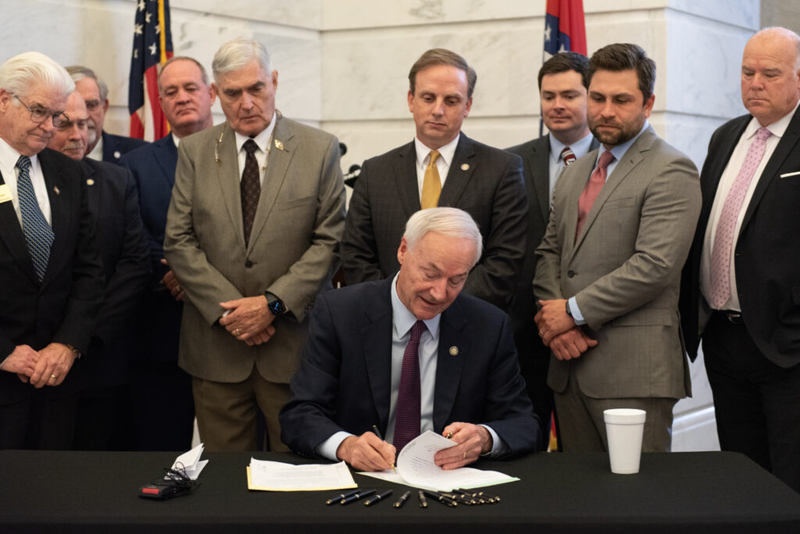
Gov. Asa Hutchinson signs into law 2021 legislation that cut income taxes as legislative leaders watch. (Photo courtesy of the Arkansas governor's office)
Arkansas lawmakers returned to the Capitol Monday to begin the work of carrying out the governor’s tax cutting agenda during what’s expected to be a three-day special session.
Republican Gov. Sarah Huckabee Sanders last week announced the focus of the session will be lowering the state’s individual income and corporate tax rates.
Legislation for the tax cuts sailed through committees Monday afternoon, despite members of the public speaking against it. If lawmakers give final approval to the measure this week, it will mark the fourth round of tax cuts since Sanders took office in 2023.
Here’s what you need to know about the proposed tax cuts:
Why are state lawmakers cutting taxes?
While seeking the governorship in 2022, Sanders campaigned on phasing out the state’s income tax. Sanders has said she remains committed to that goal if it can be done responsibly.
What have Arkansas income tax cuts looked like over the last decade?
Sanders’ predecessor, Republican Gov. Asa Hutchinson, supported one of the largest income tax cuts in state history.
Arkansas’ top income tax rate was cut from 7% to 4.9% under Hutchinson, who served two terms after being elected governor in 2014. Other income tax cuts during his tenure benefited low- and middle-income Arkansans.
Lawmakers lowered the top individual income rate to 4.7% during the 2023 legislative session and then to 4.4% during a special session later that year. They also cut the top corporate income tax rate from 5.1% to 4.8%.
During another special session in June 2024, the Legislature trimmed the top income tax rate to 3.9% and the top corporate income tax rate to 4.3%.
How much is the governor proposing cutting taxes now?
Sanders has asked the Legislature to cut the top individual income tax rate from 3.9% to 3.7% retroactive to Jan. 1, 2026, and the corporate tax rate from 4.3% to 4.1% effective Jan. 1, 2027.
Who will be affected by the cuts?
Approximately 1.1 million individual income taxpayers with a net taxable income of $26,400 and above would receive a tax reduction, according to the Arkansas Department of Finance and Administration.
About 7,800 corporations with a net taxable income greater than $11,000 would also receive a tax reduction.
Additionally, all electing pass-through entities would receive a tax deduction. A pass-through entity is a structure that allows business owners to file and pay taxes for business revenue via their individual income taxes rather than corporate taxes.
What’s the fiscal impact of these cuts?
The tax cuts would result in a reduction of $191.8 million in general revenue in the fiscal year that begins July 1, according to finance department estimates.
The state would see a $144.8 million reduction in general revenue during the following fiscal years.
What’s the debate around tax cuts?
Proponents of the tax cuts say it’s important to put more money back into the wallets of working Arkansans, and that years of record surpluses indicate the state is in the financial position to absorb the cuts.
Critics argue the tax cuts don’t benefit middle class- or working-class people, and less tax revenue means fewer funds for beneficial programs and services.
Advocates have also warned it’s a risky time to cut revenue as Arkansas and other states face the impact of federal cuts through the One Big Beautiful Bill Act.
Fewer taxpayer dollars for services is a concern for both Democratic and Republican lawmakers who have questioned the growing cost of the state’s school voucher program, a major policy priority for Sanders.
Will these tax cuts pass?
Identical bills filed for the tax cuts last week will require 51 votes in the House and 18 votes in the Senate for approval.
The legislation appears likely to pass with 29 Republican co-sponsors in the Senate and 74 Republican co-sponsors in the House.
- 6:26 pmThis story was updated to reflect action taken by lawmakers Monday afternoon.
Little Rock