Arkansas Explained: What are the incentives for West Memphis’ possible superproject?
May 04, 2026 | 6:00 am ET
Description
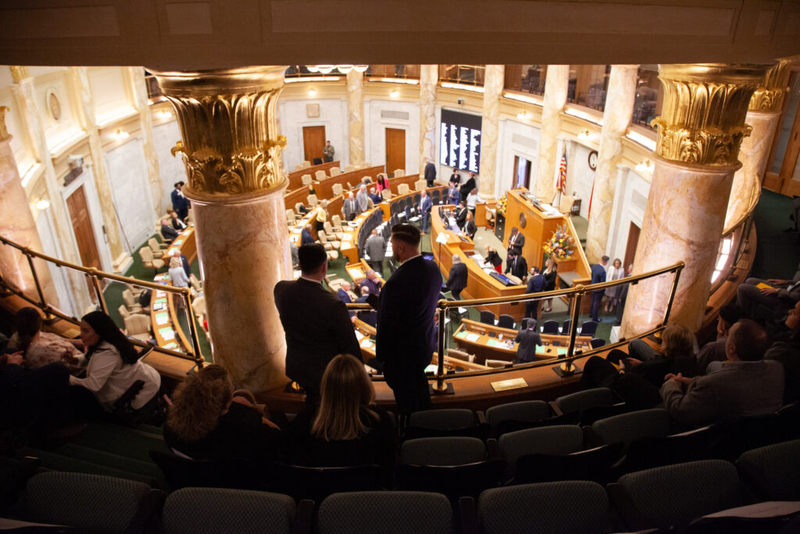
Members of the House of Representatives talk before the State of the State address at the Arkansas State Capitol in Little Rock, Arkansas on Wednesday, April 8, 2026. (Photo Katie Adkins/Arkansas Advocate)
An incentive fund that was created nearly two decades ago to lure business to Arkansas is playing a key role in efforts to land a new manufacturing facility in West Memphis.
The $6.7 billion budget Arkansas lawmakers approved last week includes plans to tap up to $300 million from the state’s surplus to land a deal with the unnamed company.
The money would go into something called the Quick Action Closing Fund, and it’s an economic development tool that’s been embraced — and debated —_ by Democrats and Republicans since its inception.
Here’s a look at the fund, the West Memphis project and the incentive package:
What is the Quick Action Closing Fund?
The Quick Action Closing Fund is an incentive fund that’s used to help pay for major businesses that Arkansas is trying to lure to the state or hoping to expand.
Typically the money pays for infrastructure needs related to a project but can also go toward other areas such as equipment or training.
The fund, which has been funded using surplus money over the years, was first proposed by former Gov. Mike Beebe before he took office in 2007.
Beebe, a Democrat, proposed the fund during his 2006 campaign for governor and the proposal came after Arkansas had missed out on several major economic development projects, including auto manufacturing plants. It started out as a $50 million fund when enacted in 2007.
Beebe’s successors, former Gov. Asa Hutchinson and current Gov. Sarah Huckabee Sanders, both Republicans, have continued using the fund for various projects.
Agreements for projects receiving the funds include custom requirements for job creation and average wages, and are tested on an annual basis for an agreed-upon time period, according to the Arkansas Economic Development Commission.
How often has Arkansas used the fund?
The Quick Action money has been one of the most frequently used by the state since it was created. More than $365 million has been transferred to the fund since 2007, not counting the money for the West Memphis project, according to the state Department of Finance and Administration.
Other projects that have received money from the fund include Big River Steel in Osceola, which received $50 million for site preparation in 2022, Hewlett Packard, which received $10 million in 2010 for a Conway facility, and Trex, which received $10 million for a Little Rock plant in 2021.
The agreements between the state and recipients include clawback provisions that require a certain amount to be paid back if any of the requirements aren’t met. Following layoffs at the facility in 2013, HP repaid $459,000 of the Quick Action money it received.
What’s the project the state is courting this time?
Officials and lawmakers have offered few details about the superproject being courted or the company behind it due to a nondisclosure agreement.
Speaker Brian Evans has said several states are in the running for landing the deal.
Under the state budget approved last week, the proposal is identified as an “advanced manufacturing, non-data center.” Tech giant Google unveiled a multi-billion data center in the West Memphis area that’s already under construction.
Evans has estimated the project would create 4,000 jobs at the outset, with an additional 2,000 after it’s completed.
What have supporters and opponents said?
Though lawmakers approved the budget bill that included the economic development incentives, the idea of offering millions to lure a private business faced resistance from some House Republicans.
Opponents have said they don’t think the state should be in the business of handing out taxpayer funds to private businesses, and questioned the effectiveness of such incentives.
“I think the government generally makes for a lousy venture capitalist,” Republican Rep. David Ray said during debate on the House floor.
Supporters, however, say such investments are needed to attract jobs, especially in parts of the state that have struggled economically.
“This will advance the state, put people to work and it’s a good deal,” Republican Rep. Howard Beaty said.
Little Rock