Arizona leads nation in child deaths by parents in custody cases. A new bill aims to change that.
May 20, 2026 | 10:15 am ET
Description
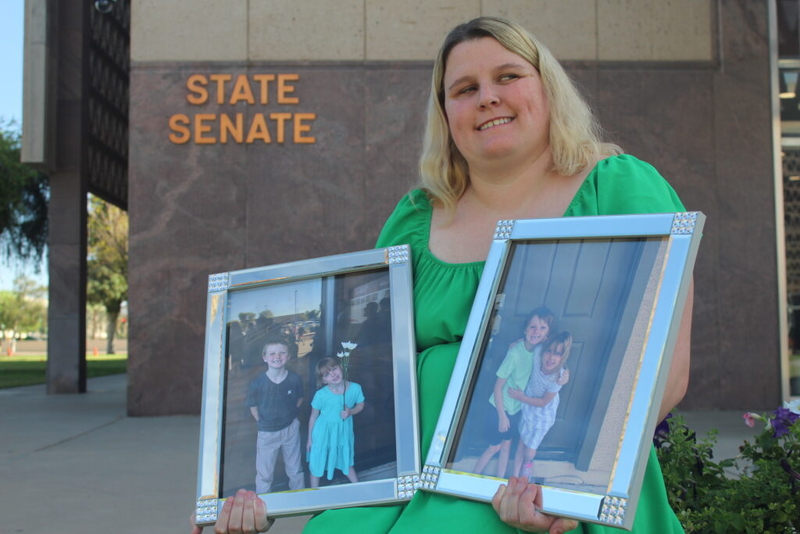
Hope Hooton holds photos of her children, Alec and Lydia, who were killed two years ago by their father. She hopes new legislation, named the Alec and Lydia Act, will be the first step to reforming the family court system to prevent tragedies from striking other families. (Photo by Rebecca Gloria Gomez/Arizona Mirror)
Alec Agape Mater and Lydia Alyssa Mater weren’t at school on Monday, May 20, 2024.
Lydia had turned six the week prior. She had excelled in kindergarten and teachers said she was already at first-grade level. Alec was about to finish second grade. At the upcoming graduation ceremony, he was to be recognized for reading a hundred books over the past year; he would also share a poem he’d written and memorized.
Mother’s Day had recently passed. Hope Hooton and Brock Mater were two months away from finalizing their divorce.
From suicide threats to murder-suicide
The prior October, in response to Hope’s seeking separation, Brock threatened suicide. “Okay, if that’s what you want, come and get the kids because I am going to kill myself in front of them,” Brock said, according to Hope’s memoir, which was released this March. From a park near their home, Hope called 911.
According to a Surprise Police Department call log, the dispatcher noted “male is trying to tell her to come home…he is saying she gave him the phone…but calltaker [sic] could hear what sounded like him taking it.” Brock “[admitted] that he did make 666 statements but…he didn’t mean it,” the log continued, referring to the police radio code for suicide threats.
For the next few days, Hope, Alec and Lydia stayed at a hotel, per the police’s recommendation. Hope filed for and was granted an order of protection on October 11; she requested her children be included as protected persons, but a judge denied the request.
On Oct. 16, 2023, Hope dropped Alec and Lydia off at school. That day, she received text and voicemail messages from Brock that concerned her. She “knew something was wrong,” so she went to the police.
While at the station, she felt she should check on the children. She called their school and learned that Brock had checked them out before noon. Hope asked the police to intervene, but since Brock was their parent, they said there was nothing they could do.
Hope and Brock communicated and decided that Brock would return the children to school the next day.
That evening, Brock called 911 on himself. In the welfare check log, it noted the responding officer had “a long conversation with Brock” and learned he “believes his kids are to be sacrificed by him.”
Hope received a phone call from police for her to come pick up the kids from the hotel where Brock had been staying since being served with the protective order. She noticed, as the kids had, too, that Brock had opted to remove some of the children’s favorite toys from the marital home, including their bicycles and Alec’s Pikachu pillow. Brock had also taken Alec’s nebulizer, which he used to mitigate asthma.
Brock agreed to be taken to a psychiatric facility where he would stay for nine days and be diagnosed with bipolar disorder.
The following day, Hope applied for and was granted a temporary emergency order from the family court. The order gave her full legal decision-making authority and parenting time, with four hours weekly supervised visitation for Brock.
On Nov. 7, 2023, Hope and Brock appeared before Judge Michael Valenzuela to review the temporary orders. According to his biography, Valenzuela had been assigned to the family court department in 2022; from 2010 to 2016 he had been an assistant attorney general with the Child and Family Protection Division.
Hope’s request was that Brock be granted only supervised custody, for the time being, until he was fully evaluated. For evidence, Hope submitted the protective order granted by the police, a letter from a neighbor who had observed Brock coming to the marital home — breaking the protective order — and text exchanges between her and Brock.
Each litigant was allocated 15 minutes for testimony. “I’m judging your credibility, in part, by your ability to give one-word answers,” said Valenzuela.
Through his cross-examination of Brock, Hope’s lawyer suggested that the children had not been safe the evening Brock called 911. Brock replied that the children had not been harmed, since they were asleep.
Two days later, Valenzuela issued temporary orders calling for Hope and Brock to have joint legal decision-making authority and equal parenting time.
In the orders, Valenzuela wrote that Hope “learned from law enforcement that (Brock) was having suicidal and homicidal ideations…Father experienced a mental health break, which is highly concerning for the Court. But Father called the police, and the children’s safety was ensured.”
Six months later, Brock shot and killed Alec and Lydia before turning the gun on himself.
Judge training and caseloads
Judge Valenzuela and Family Court Presiding Judge Rhonda Fisk did not respond to multiple requests for comment. One question that had been posed was regarding what domestic violence training, if any, judges receive.
Maricopa County Superior Court spokeswoman Tasya Peterson replied on their behalf, saying in a statement that “there is no specific requirement in Court policy or in the Arizona Code of Judicial Administration mandating domestic violence training within a defined timeframe or as a standalone certification.”
“However, domestic violence is a topic that is regularly addressed within broader judicial education programming, and judges have access to and do participate in training covering these issues as part of their ongoing professional development,” Peterson added.
According to a Judicial Branch Trends Analysis report that the Maricopa County courts published, which analyzed data collected over 2012-2022, the Maricopa County family court has an average of 78,089 cases each year (58,928 new filings and 19,161 pending). With 29 judges and 15 commissioners, an individual working in the court, tasked with adjudicating sometimes complex family matters, may have an average caseload of 1,775 annually.
Current Arizona custody statutes
In Arizona, custody orders are guided by the language and principles codified in state law. Like most states, Arizona’s custody orders are meant to be created “in accordance with the best interests of the child.” The law includes a recognition that “domestic violence [is] contrary to the best interests of the child” and that the “safety and well-being of the child and of the victim” should be “of primary importance.”
Many parents in Arizona and elsewhere have protested that family court judges have not followed this guidance. Abuse survivors claim they have been forced by family court orders to co-parent with an abusive, controlling ex-partner — exposing their children and themselves to continued abuse and sometimes, as in Lydia and Alec’s case, murder at the hands of a parent.
The Center for Judicial Excellence tracked child deaths in the context of separation from 2018 to 2024. Arizona, with 38 children killed by a parent or guardian, ranks No. 1 per capita for child fatalities.

Arizona Ad Hoc Committee Inception
In 2024, several parents contacted Arizona legislators, voicing their concerns with the family court.
In an interview with Arizona Mirror, state Rep. Rachel Keshel, R-Tucson, recalled meeting with a grandmother who was trying to help her daughter maintain contact with her six-year-old child. The grandparents had spent $4 million on prolonged custody litigation, paying for various roles that had been assigned to their case.
Keshel said she walked away concluding that some judges were putting children with abusive parents, allowing abusers to continue a campaign of control over their former spouses and harm their children.
Rep. Lisa Fink, R-Glendale, had previous exposure to the family court with her work banning reunification camps. Prior to the ban, which became law in 2024, family court judges could order children to be sent to camps which purported to repair broken familial relationships. Children sent to such camps spoke of being forced into contact with a parent who abused them.
Based on her continuing conversations with parents, Fink concluded there were systemic problems across the family court. As she and other legislators began to look into what was happening, she said they “got some pushback.”
“So, we said we’re going lay it out there…and see what’s going on,” Fink said.
The result was the Joint Legislative Ad Hoc Committee on Family Court Orders. Fink was assigned to sit on the committee, which was co-chaired by Keshel and Sen. Mark Finchem, R-Prescott.
Professor Joan Meier, director of the National Family Violence Law Center at George Washington University, has been researching how family courts respond to domestic violence allegations for years. Meier described the Arizona hearings as “cutting-edge.”
“For legislators to take the time to listen to parents who have experienced disastrous adjudications in the state’s courts (which have harmed) their children is rare and important,” she said.
The committee held a series of hearings between April and August 2025, during which numerous parents, children, grandparents, extended family members, scholars and advocates came to speak about their experiences with and knowledge of the family courts. Representatives from relevant oversight entities also gave presentations, including the Arizona Department of Child Safety and the Arizona Commission on Judicial Conduct.
The committee originally scheduled a four-hour meeting to collect public testimony, but too many people signed up to share their stories within the allotted time, so additional hearings were held. In the end, the panel met and heard testimony for more than 40 hours. Parents from other states also came to speak, calling on their home states to conduct a similar review.
Arizona lawmakers said they were contacted by a dozen legislators from across the country to learn about the state’s efforts at family court reform, including Idaho, which subsequently organized a Child Custody and Domestic Relations Task Force. Idaho lawmakers also collected public testimony on the family courts. Measures to amend family court statutes are similarly making their way through the Idaho legislature.
Parents who came to speak at the Arizona ad hoc committee hearings shared how they had flagged concerns of abuse to the family court judge, and still received custody orders that put their children in volatile situations.
One mother, Mary Dalton, described presenting evidence of domestic abuse in her custody case, including kidnapping and attempted rape, only to be told by the judge in the final divorce decree that those experiences didn’t qualify as “significant” domestic abuse. The father was granted unsupervised, 50/50 custody. He was later found guilty of one count of kidnapping and four counts of sexual assault and sentenced to 28 years in prison.
Ad hoc committee executive findings
After the hearings, the committee released a report lamenting that Arizona family courts had abandoned “the pole star ‘best interests of the child.’” Hope’s case was cited as illustrating the stakes “with devastating clarity…after repeated warnings to the court were ignored.”
The report concluded that the family court system has exercised inadequate oversight of professionals and lacks robust accountability mechanisms. It also stated that protocols have not put children first, and that judicial immunity has shielded negligence from consequence.
A collection of bills were introduced for the 2026 legislative session, meant to address the harms that families had described. Several passed the Senate only to stall in the House of Representatives, where they never were considered. One bill provided an option for a jury trial for contentious custody cases. Another sought to make family court judges mandatory reporters. Senate Bill 1329 would have allowed a parent to bring a civil action against someone appointed to their case if they had behaved unethically.
The Alec and Lydia Act
One bill that looks likely to pass is House Bill 2995, the Alec and Lydia Act. The proposal cleared the state House of Representatives unanimously and won preliminary approval after a debate in the Senate. It still must pass a vote of the full Senate and then return to the House for a final vote before it can be sent to the governor.
The bill, if it is signed into law by Gov. Katie Hobbs, would overhaul the state law governing legal decision-making and parenting time, placing child and survivor safety first. It prioritizes domestic violence findings over competing presumptions — such as the law that parenting time should be “maximized” for both parents, which generally means a 50/50 split.
The Alec and Lydia Act would prompt judges to consider whether “frequent and continuing contact” with both parents is automatically considered to be in the best interests of the child. Among the changes it makes are requiring judges to not award legal decision-making or unsupervised parenting time to a parent who has committed domestic violence.
And the bill expands what qualifies as domestic violence, bringing “coercive control” into Arizona statutes for the first time. Coercive control has been defined as a form of abuse wherein the primary aim of the abuser is to isolate, degrade and deprive a person of their physical security and sense of self-respect, putting the victim in a state of terrorized entrapment. The term was popularized by Evan Stark in his book “Coercive Control: How Men Entrap Women in Personal Life.” Stark advocated for moving beyond the “injury model” of domestic violence and looking at the corrosive, sometimes subtle patterns that underpin the cycle of domination.
Current Arizona law lists two illustrations of what a judge could look for, in trying to assess whether a case presented domestic violence: intentionally or recklessly causing “serious physical injury” or sexual assault, or placing someone in “reasonable” fear of “imminent serious physical injury.”
That means judges focus on signs of physical harm. While abuse can include bodily harm, there are myriad other methods of abuse — emotional/psychological, verbal, economic — that may not incur physical markers. Outlining coercive control in statute can equip judges with more tools to recognize harmful and dangerous dynamics.
The bill would require detailed written findings for custody orders, which would likely offer abuse survivors the option to push back against orders that did not prioritize child safety.
Have you presented evidence of abuse and/or coercive control to the family courts, but legal decision making and/or parenting time was still awarded to the abusive party? Reach out to Arizona Mirror Editor-in-Chief Jim Small and share your story: [email protected]
This story was supported with reporting assistance from Freelance Investigative Reporters and Editors (FIRE) and funding by the Fund for Investigative Journalism.
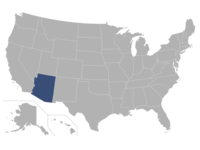
Phoenix, AZ