Angie Craig defends immigration vote in the face of Democrats’ fury over Operation Metro Surge
Jul 27, 2026 | 8:13 am ET

Description
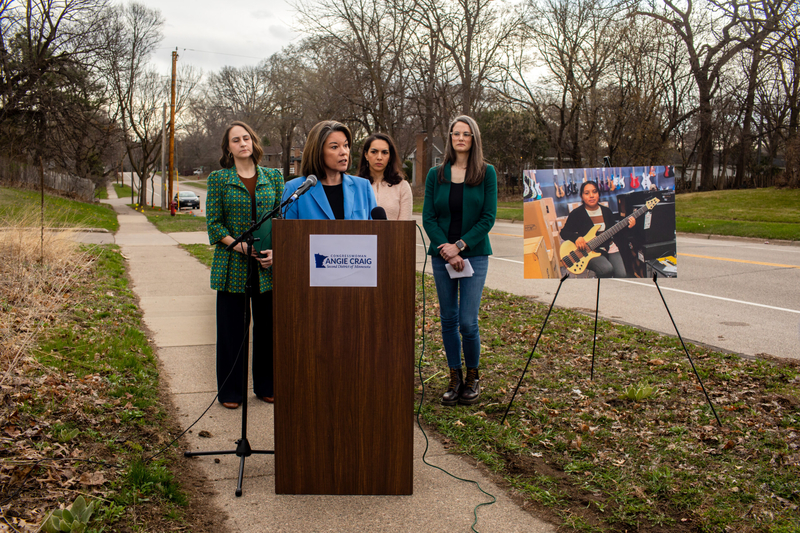
Rep. Angie Craig talks to Haven Watch volunteers as a black SUV drives by after she conducted an inspection in the Henry Whipple Federal Building in Minneapolis to conduct an inspection Thursday, April 9, 2026. (Photo by Nicole Neri/Minnesota Reformer)
U.S. Rep. Angie Craig regrets that she didn’t see it coming: thousands of masked federal agents flooding American streets, arresting law-abiding immigrants without warrants and packing them in disease-ridden detention centers.
If she had, she said she would not have voted for the Laken Riley Act, the first piece of legislation President Donald Trump signed in his second term, mandating the detention of undocumented immigrants accused of theft, assault of law enforcement and certain other crimes.
That vote has become perhaps her greatest liability in her tough Democratic primary for U.S. Senate against Lt. Gov. Peggy Flanagan — another thing Craig didn’t see coming — as she seeks the support of voters disgusted by Trump’s violent immigration crackdown in Minnesota that left two Americans dead.
Craig is now campaigning on her record fighting Trump and standing up to U.S. Immigration and Customs Enforcement by helping introduce articles of impeachment against former Homeland Security Secretary Kristi Noem, conducting oversight of ICE facilities and trying to free detained constituents.
“My regret to give them a f***ing inch does drive my commitment to making sure that the Trump administration pays for what they’ve done,” Craig said in an interview with the Reformer. “I will spend the rest of my career ensuring that my immigrant neighbors are able to be part of the fabric of America.”
But Flanagan and a wave of high-profile progressive surrogates — including Sens. Bernie Sanders and Tina Smith — say the Laken Riley vote isn’t an anomaly. It’s part of a pattern of Craig voting for self-preservation over principles, for the corporate and special interest donors pumping millions into her campaign over the working people she promises to fight for.
“AIPAC, crypto, health insurance companies, billionaires, and special interests … these powerful interests are coming together behind Angie Craig,” Flanagan said at a recent rally headlined by Sanders. “It begs the question: Who is she fighting for?”
Swing votes from a swing district
Craig, whose face betrays an almost constant intensity, can point to a biography and political career of fighting, scrapping — and winning. She grew up with a single mother in a rural Arkansas trailer park, put herself through college and rose to become an executive at a major medical device company.
She fought for custody of her first son in the late 1990s in Tennessee when gay parents couldn’t both be recognized as the adoptive parents. She won, helping pave the way for other gay parents in the state. She raised four sons and in 2018 became the first openly lesbian mother elected to Congress — beating an incumbent Republican who had just several years earlier openly opposed same-sex marriage and mused that gay parents could be harmful to children.

Craig has been ranked among the 20% most bipartisan lawmakers by the nonpartisan Lugar Center, based on how often she has co-sponsored legislation with Republicans, a fact she’s touted to hold her seat in the competitive 2nd Congressional District.
Craig has also voted with Democrats the vast majority of the time — 96% this term, according to UCLA’s Voteview — although Flanagan frames it as voting with Trump more than any other Minnesota Democrat given the high party fidelity in Congress.
Despite the campaign’s acrimony, Craig and Flanagan agree on almost everything — if not in degree, then at least in direction: banning corporate money in elections, expanding the Supreme Court, allowing Medicare to negotiate drug prices, making it easier for workers to unionize, providing undocumented immigrants a path to legal status, eliminating taxes on Social Security.
But the rarer votes in which she broke with Democrats are now coming back to haunt her — an unusual position for someone seeking statewide office, which often requires candidates to move to the middle to appeal to more voters.
“As a swing-district Democrat, I tried really hard to represent the people in my district, and as a U.S. senator, I would have a broader audience to consider,” Craig said.
Formidable fundraiser or corporate captive?
She’s been able to market herself to Democrats statewide with one of the most impressive fundraising performances in state history, and the help of outside groups spending on her behalf — a double-edged sword given the widespread mistrust of corporate influence among Minnesota Democrats.
The primary could be the most expensive in state history. Craig has raised $12 million for her campaign compared with Flanagan’s $6 million. The main super PAC backing Craig, North Star Dawn, has spent more than $18 million in support of her campaign with spending by other groups likely to bring the total over $20 million. The main PAC backing Flanagan, the Democratic Lieutenant Governors Association, has spent about $2 million to support Flanagan with ads attacking Craig.
Flanagan’s criticism over campaign contributions aims to turn one of Craig’s assets — a formidable war chest to beat a Republican in the general election like the well-known and well-funded Michele Tafoya — into another liability in the primary.
Flanagan points to Craig’s vote for the GENIUS Act, widely seen as a victory for the volatile cryptocurrency industry, after a crypto-aligned super PAC spent about $1 million backing her 2024 congressional campaign.
Craig says that as ranking member of the House Agriculture Committee, which oversees the Commodity Futures Trading Commission, she had no choice but “to be involved in this space.” She said she supports stricter guardrails, but that doing nothing was “not an answer.”
Flanagan also points to Craig’s votes to send weapons to Israel and the hundreds of thousands of dollars in support her congressional campaigns have received from the American Israel Public Affairs Committee — now a scarlet letter among many Democrats. While Craig said she hasn’t taken money from the group in her Senate race, AIPAC did hold about a dozen campaign events for her since she announced her bid last year, according to MinnPost.
Most recently she voted against a proposal to cut $3.3 billion in aid to Israel. She was the only Minnesota Democrat to vote against it, with Reps. Betty McCollum and Kelly Morrison voting present. Craig said it was an overly broad amendment that would have also cut humanitarian aid to Palestinians, and on principle, she doesn’t vote present.
“I’ve never voted ‘present’ one time in Congress … you look at the bill and you make the tough decision,” Craig said.

Craig, who has also been a vocal critic of Israeli Prime Minister Benjamin Netanyahu, said the United States must “reexamine” its relationship with the state of Israel. She criticized the lack of aid to Gaza and Israeli settler violence in the West Bank.
‘Times changed real fast’
Given the fresh memories of Operation Metro Surge, voters’ belief in the sincerity of Craig’s March mea culpa over her immigration vote may be what determines the election. Craig’s vote for the Laken Riley Act wasn’t surprising in January 2025, given her swing district status and the 2024 election results. She was among 46 Democrats in the House and 12 in the Senate to do so — though the only from Minnesota.
At the time, Democrats were once again agonizing over a loss that put Trump and Republicans in control of government, a defeat attributed in part to the migrant crisis in major cities like New York and the perception that the Biden administration had allowed the immigration system to spin out of control.
The attempted rape and brutal murder of 22-year-old Laken Riley by an undocumented immigrant while she was out for a morning run in Georgia crystallized for many people the sense of chaos.
The man had been apprehended at the border but released into the country. According to ICE, he was then arrested in New York on a charge of endangering a child and released — an assertion disputed by New York police — before traveling to Georgia where he was cited on a shoplifting charge.
“There was very much a feeling that Democrats had gone too far in allowing open borders,” Craig said.
And then came the masked agents, the military-like occupation of Chicago and the Twin Cities, the widespread arrest of immigrants without warrants and the explosion of detention centers run by for-profit contractors with a population now surpassing 65,000, up from about 39,000 when Trump took office.
“Times changed real fast with the Trump administration … they said they would go after the worst of the worst. They didn’t go after the worst of the worst,” Craig said.
Craig noted the bill didn’t say anything about deportation, and argues the president’s deportation machine has been lawless and didn’t require the Laken Riley Act. To justify detaining immigrants who entered the country illegally — whether or not they have criminal records, and no matter how long they’ve lived here — the Trump administration asserted a new interpretation of a 1996 law that has sharply divided the federal courts.
While the vote has made her a pariah among some Democrats even after her apology, there are plenty who feel she has been judged too harshly.
St. Paul Mayor Kaohly Her, who came to the United States as a Hmong refugee when she was 3 years old, has endorsed Craig for Senate. At a news conference where Craig announced she would not seek the party endorsement, Her urged voters to look at Craig’s entire career.
Craig co-sponsored legislation to provide a pathway to citizenship for people brought to the U.S. illegally as children, known as Dreamers, and to limit the president’s authority to block noncitizens from entering the country in response to Trump’s travel bans.
“It’s easy to point out some of the votes that people take that we can criticize, but we don’t lift up the things that they do that are right,” Her said.
Public sentiment has swung quickly against the Trump administration’s immigration policies. The share of Americans who disapprove of the way Trump is handling immigration increased from about 42% in January 2025 to 54% in July 2026, according to polling averages by Silver Bulletin. Two-thirds of Minnesotans said tactics by ICE and Border Patrol agents went too far, according to an NBC News/KARE 11/Star Tribune poll.
Notably, polling data show the public’s support for strong border security has held up. Craig, long a border hawk, has not shied away from that position.
“I refuse to believe that we can’t be a nation of strong borders and a nation of immigrants,” Craig said.

Saint Paul, MN