Amount of public testimony on bills is growing, but who’s writing it?
May 22, 2026 | 5:00 am ET
Description
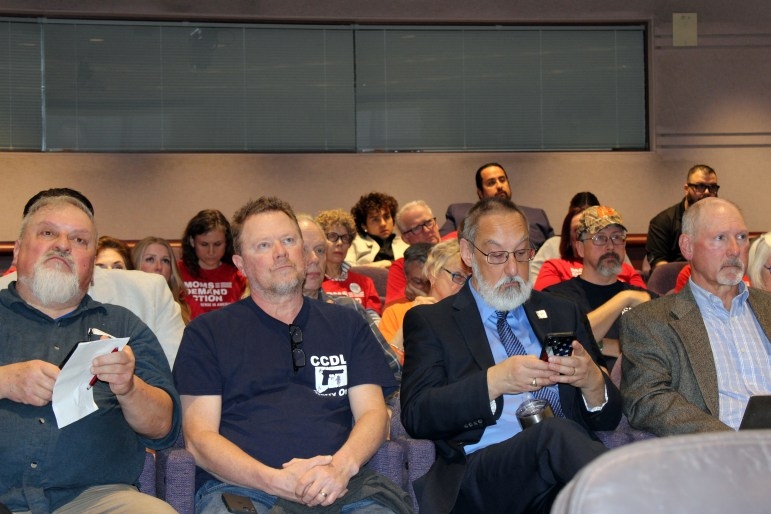
Photo courtesy of CT Mirror
The amount of public testimony — signed and anonymous — submitted on proposed Connecticut bills has risen sharply in recent years, but the reasons why are murky.
More than 43,800 pieces of written testimony were submitted during the 2026 legislative session, nearly a 250% increase compared to 2016. But this year, almost 8,000 of these submissions were anonymous, and much of the testimony was directed at bills addressing hot-button issues.
Bills dealing with homeschooling, vaccines and gun regulations received more than 2,000 pieces of written testimony each, according to the Connecticut General Assembly. While this year saw abnormally high counts of written testimony overall, these numbers have been climbing for decades.
Seth Warner, an assistant professor in the University of Connecticut’s Department of Political Science, said the increase might not be a result of individual civic engagement.
“It’s nice to have this Schoolhouse Rock image of people sitting down at the kitchen table and seeing what the Connecticut legislature is doing and finding a bill that they think is interesting and writing testimony out of a sense of civic duty,” Warner said. “But I would say that the vast majority of 43,000 pieces of written testimony are based on some sort of organized political activity.”
But since more and more testimony is submitted anonymously, it is difficult to determine specific factors behind the increase. Last year, nearly 18% of all testimony submitted was anonymous, according to a CT Mirror analysis.
Anonymous testimony spiked
An online testimony submission form allows people to add their name, title and organization. But none are required, and there is a box users can select that autofills the name fields as “Anonymous.”
The online form to submit testimony was implemented in 2022, according to the Office of Legislative Management. But written testimony has been accepted via email since 2007 and can also be sent in through the mail. Anonymous testimony has always been allowed, according to OLM, but the online form makes it easier to submit.
In 2017, only 11 of the 23,000 pieces of written testimony were anonymously submitted. But that number has increased since then, breaking 100 for the first time in 2021. This year, 7,878 pieces of written testimony, or 18% of everything submitted, was from anonymous sources. (This number does not include testimony submitted under pseudonyms so is likely an undercount.)
This is a marked increase compared to 2025, which was an increase from the year prior. And those involved in the legislature noticed.
“I saw a lot of anonymous testimonies submitted. It’s fine that somebody has expressed an opinion, but I don’t know if that’s a chat bot sending in 57 pieces of testimony,” House Majority Leader Rep. Jason Rojas, D-East Hartford, said. “When it doesn’t have a name, that’s a challenge too, and I think that has had the effect of inflating the overall numbers that we get.”
It is difficult to determine which pieces of testimony are written by chat bots or researched using AI. But Warner believes the tool could be a contributing factor to overall submission increases.
“That’s not to say that the AI has written the testimony but somebody felt like they had a position but wasn’t quite sure how to articulate themselves,” Warner said. “It could be a waypoint between having the idea and being able to put pen to paper, digitally speaking.”
“In my role as Majority Leader, I read all bills that come out,” Rojas said. “I’ll often go look at testimony just to find experts, find people whose voices I trust, and I’ve been noticing just a lot of anonymous testimony being submitted.”
Rep. Cristin McCarthy Vahey, D-Fairfield, heard and read testimony on H.B. 5044, which protects vaccine accessibility.
The bill received 1,098 pieces of anonymous testimony, nearly 29% of all written testimony on the bill and the highest count of any bill introduced during the 2026 session.
“Just clicking through actually took a pretty significant amount of time just because there are thousands of pieces of testimony,” Vahey said. “I believe that I read them all … there were so many anonymous pieces of testimony when I was clicking through, I was wanting to make sure that I wasn’t repeating.”
National political organization
In Connecticut, a bill allowing municipalities to ban the sale of cats, dogs and rabbits in pet stores received 1,261 pieces of written testimony — the seventh-most of all bills in 2026. Nearly 75% of this was submitted anonymously.
The American Kennel Club, the world’s largest and oldest nonprofit dog registry, sent out a legislative alert on the bill, urging people to submit written testimony opposing the bill. Another group, Don’t Ban Pets, issued a similar release.
Many experts believe the increase in testimony can be attributed to national interest groups increasing their involvement in state politics, a trend supported by recent research.
“There are these nationalized interest groups that are sending these canned messages out and having their people who are members of the interest group send out that message back to the legislature,” Sawyer Rogers, a political science Ph.D. student at the University of Massachusetts, said.
In recent years, bills dealing with topics that have become more politicized at the national level — including guns, vaccines, immigration and homeschooling — have seen more testimony, and more of it anonymous.
Social media efforts contribute to the trend, Rogers said.
“It’s become easier, if you are on social media, just because things have become more politicalized, people might be sharing more things,” Rogers said. “It might not just be the big national interest groups. It also could be legislators and more state or localized groups.”
Local political groups organize testimony
Each year, the Rev. Jocelyn Gardner Spencer’s organization reaches out to its members to identify major issues in the Greater Hartford community.
“We start with gathering stories,” Spencer, who is the lead organizer of Greater Hartford Interfaith Action Alliance, said. “[We] invite people to share the stories of their lives, the things that are keeping them up at night, the systems and situations that they’re struggling with, what’s getting in the way of their family’s ability to flourish the way that they want to, what’s wrong in their community that needs to be made right.”
GHIAA comprises 53 congregations around Hartford and has been active since 2019. Spencer said the organization follows a “very grassroots” process to identify and eventually act on these issues.
“Once we identify what it is that we’re working on, sometimes that’s legislative … then we train and organize folks to submit testimony as part of the public hearing process,” Spencer said.
For issues brought up in the legislature, GHIAA creates testimony guides explaining the issue and how the relevant bill responds to it. The organization also offers training on writing and submitting testimony.
Members from the organization submitted written testimony on multiple bills this year, including bills dealing with immigrant protections.
Other associations, unions and employers across Connecticut organize people to testify on relevant bills. Warner said he was asked twice to testify at the Capitol last session, by both his employer, UConn, and his faculty union.
“You can imagine that a lot of folks are part of volunteer organizations, professional organizations, what have you, that might have some business before the legislature,” Warner said. “It’s not terribly costly to write up a paragraph saying why you support your organization’s position on something.”
Written testimony is one of the simplest forms of civic engagement offered by the state. Many people testify over Zoom or in person, but public hearings are long and timing is unpredictable. Those testifying in person may wait for hours before they get to state their position on legislation.
So, when someone is asked to write testimony or is made aware of a bill that could impact them or their group, written testimony is the easiest route for people to voice their opinions.
Impact and changes
But anonymous and out-of-state testimony is becoming a burden for those in the legislature.
Rojas said he cares “a lot more” about the voices of Connecticut residents. But with the volume and anonymity of testimony, it is hard to determine who is a resident.
“You could certainly make your way through it all to try to find the identity and the location of the person submitting it, but that creates a barrier for legislators to actually hear from their constituents,” Rojas said.
Rojas said some legislators have floated the idea of limiting out-of-state testimony. But he worries voices of experts and researchers from other states could get cut off.
And for anonymous testimony, Rojas said, he hasn’t thought much about limiting it.
“Folks have definitely been like, ‘Why are we accepting anonymous testimony?'” Rojas said. “I’d want to think about, is there a downside to limiting it, banning it? Can we even do that? I don’t know.”
Hartford, CT