Amid surge in immigration arrests, RI federal judge OKs out-of-state lawyers to represent detainees
Apr 15, 2026 | 5:26 pm ET
Description
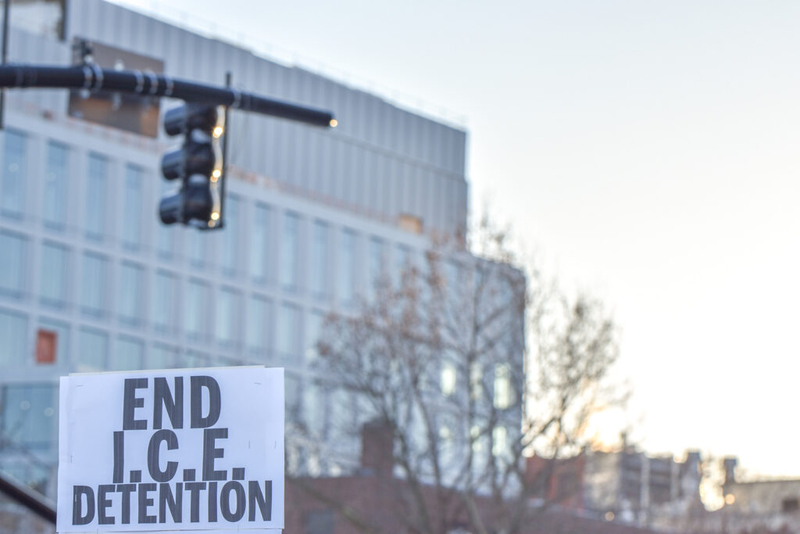
Rhode Island’s federal court will allow out-of-state attorneys to represent immigration detainees pro bono without joining its bar following a request by legal groups amid a surge in habeas corpus petitions. (Photo by Christopher Shea/Rhode Island Current)
Rhode Island’s federal court is now allowing out-of-state attorneys to represent immigration detainees pro bono without joining the court’s bar for the next year in response to a surge in habeas corpus petitions against the Trump administration.
The general order issued Monday by Chief Judge John J. McConnell Jr. follows a March 30 petition by three attorney groups asking the U.S. District Court for the District of Rhode Island to temporarily suspend its rule requiring local counsel for cases brought by lawyers not admitted to the federal bar challenging federal immigration detentions.
“This was a discreet barrier that, if the court removed it, could improve access to justice,” Amy Romero, chief legal counsel for the Lawyers’ Committee for Rhode Island, said in an interview Wednesday. “I’m very excited that our federal court has adopted this order. I’m hoping other districts take note of this.”
Romero’s group was among the three that requested the change along with the Habeas Project of New England and Mass Deportation Defense, whose legal director is Sara Miron Bloom, who served as acting U.S. Attorney for the District of Rhode Island from February 2025 to March 2026. Bloom did not immediately respond to a request for comment, nor did Christy Rodriguez of the Habeas Project of New England.
Todd Pomerleau, co-founder of Mass Deportation Defense, called McConnell’s policy change a big relief in trying to help clients detained by U.S. Immigration and Customs Enforcement (ICE).
“So many of the cases we do these days are pro bono and it gets difficult finding lawyers in different states to help you,” he said. “It’s almost like trading baseball cards.”
Habeas corpus is the legal procedure used by people who believe they are being unlawfully detained to petition for their release in court. In turn, the federal government must justify why that individual is being held.
“It’s used very frequently by all kinds of people,” Peter Margulies, a law professor at Roger Williams University School of Law, said in an interview. “It’s about getting a court to order your release from detention and there’s a great need for that.
Since the start of the second Trump administration last year, Rhode Island’s federal courthouse has received 135 habeas corpus petitions, according to data provided by the court. Nearly 90% of those filings challenged federal immigration decisions.
That includes 59 immigration-related detention challenges made so far in 2026 — the same amount filed during the entirety of 2025. Rhode Island’s federal court saw a total of five habeas cases — with only one immigration-related detention challenge — made in 2024, according to the Providence Journal.
“This all comes from a dramatic surge in arrests and detention by the Trump administration,” Margulies said. “Past administrations have focused arrests on immigrants who have committed crimes and people at the border, but this administration has dramatically expanded its focus.”
In their petition, the groups said most Rhode Island immigration attorneys willing to take habeas cases pro bono have already done so, absorbing as many cases as their practices and pro bono commitments can bear,” as arrests by U.S. Immigration and Customs Enforcement (ICE) continue to rise in the region.
Habeas corpus filings must be made in the jurisdiction in which an individual is being detained. Many of the suspected undocumented immigrants arrested by ICE officers in New England are brought to the quasi-public Donald W. Wyatt Detention Facility in Central Falls.
“As long as we have the beds, people are brought here,” Romero said.
Because many of those arrests involve out-of-state detainees, the attorneys handling their asylum and citizenship cases often are not admitted to Rhode Island’s federal bar. Immigration legal cases are heard in three courthouses in New England: Boston, Chelmsford, Massachusetts; and Hartford, Connecticut.
Out-of-state attorneys often must rely on organizations like the Lawyers’ Committee for Rhode Island to take the lead on behalf of their clients. That’s been the case for Cindy Salazar, a Pawtucket-based immigration attorney licensed in Massachusetts, who has more than a dozen pending habeas petitions in Rhode Island’s federal court.
“The fact that I don’t have a Rhode Island license should not preclude me from continuing to represent [my clients] zealously as much as I can,” Salazar said in an interview. “Other attorneys that come in still need to rely on us, still need to talk to me, because I’m the one who has had the case for years.”
For the next year, she can now make the filings and handle them pro bono in Providence from the moment a client is held at the Wyatt Detention Center.
“This makes it one step easier for attorneys like myself to represent their clients everywhere,” Salazar said. “Due process is extremely important for our clients.”
Romero said she’s relieved to know her own caseload will be reduced for the next year, noting she’s had to juggle dozens of detention challenges along with other legal challenges against the Trump administration
“Any time I’m doing a habeas case that means I’m not doing something else,” she said. “And there’s a lot to do.”
Providence, RI