All living North Dakota governors, past and present, gather in Medora for presidential library
Jul 03, 2026 | 7:38 pm ET
Description
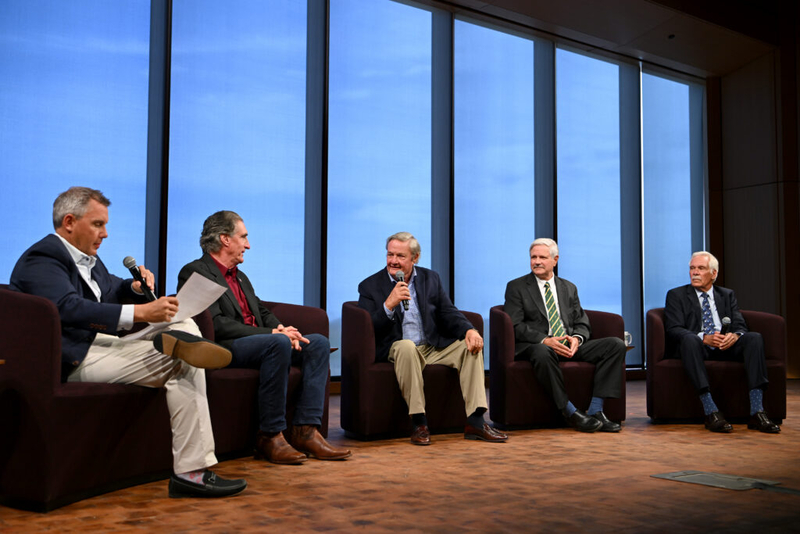
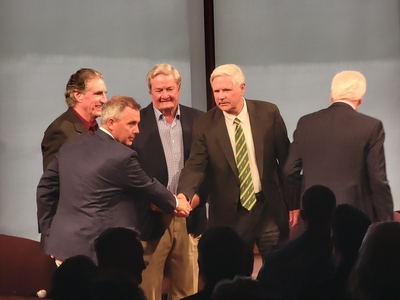
From the left, Gov. Kelly Armstrong, U.S. Interior Secretary Doug Burgum, former Gov. Jack Dalrymple, U.S. Sen. John Hoeven and former Gov. Ed Schafer speak during a panel discussion featuring five North Dakota governors at the Theodore Roosevelt Presidential Library on July 3, 2026, in Medora. (Photo by Bryan Bedder/Getty Images for Theodore Roosevelt Presidential Library)
MEDORA – The leaders of North Dakota’s government for the last 34 years made history Friday by gathering in Medora to celebrate the opening of the Theodore Roosevelt Presidential Library.
Five governors of North Dakota in one place is a rare occurrence. In attendance were former Govs. Ed Schafer, 1992-2000; John Hoeven, 2000-2010; Jack Dalrymple, 2010-2016; Doug Burgum, 2016-2024; and Gov. Kelly Armstrong, in office since the end of 2024.
“Hands down the best possible job is being governor,” Hoeven said. “A lot of it is being able to set the agenda to create initiatives and then follow through.”
Sens. Gillibrand, Cramer agree Theodore Roosevelt Presidential Library can heal grief, divisions
Hoeven now represents the state as a U.S. senator, and Burgum is the country’s Interior Department secretary.
It has likely been a quarter century since the last time at least five governors of the state shared a stage. Six were present in 2001 for the 20th anniversary of the North Dakota Heritage Center in Bismarck according to the State Archives, including: Hoeven, Schafer, and former Govs. George Sinner, 1984-1992; Allen Olson, 1980-1984, Art Link, 1972-1980; and Bill Guy, 1960-1972. Four gathered in Bismarck ahead of the demolition of the old governor’s residence in 2017.
“We can say for sure that this is the most governors that have ever been on the stage at the same time in Medora,” Armstrong said.
Every governor present in Medora on Friday played a role in making the Theodore Roosevelt Presidential Library possible.
Schafer said he remembers standing on a bluff overlooking Medora in 1952, when he was 6 years old, and hearing his father, Harold Schafer, sharing his concern that what made Medora special was in danger of disappearing.
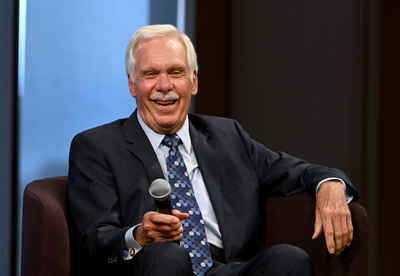
“It was kind of melancholy about that independent way of life, the cowboys on the prairie, the honor and work that you did on the prairie, how it shapes the character and individual values of people,” Schafer said. “That’s what he was kind of concerned with disappearing because this was a place that really had the opportunity to generate those things in other people.”
The governors said it was Schafer, ushering in a business-friendly climate as governor during the economic doldrums of the 1990s, and his family’s promotion of tourism that made it possible to contemplate a $450 million presidential library making its home in a town with a population of fewer than 200.
“It takes a team to get things done,” Hoeven said. “We all got a little piece of it.”
Several of the governors on stage gave Burgum the lion’s share of the praise for making the library possible in its current form.
“This place as it exists, and what we are in today, doesn’t happen without Gov. Burgum,” Armstrong said.
The Interior secretary said he and others decided to take a gamble and upscale the very concept into something memorable.
“This whole thing was like TR,” Burgum said. “It was bold. It was audacious. It was impossible.”
Burgum said he knew they had an opportunity to “build a lasting cultural institution” that could inspire visitors the way the Badlands inspired Roosevelt in the 1880s.
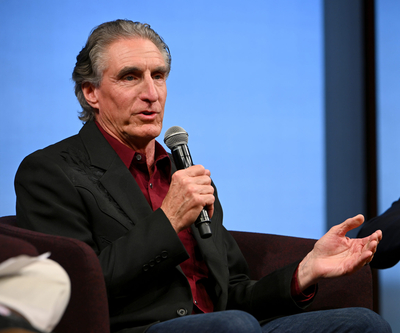
“We also knew that we had an opportunity to not just look in the past but have a place where people could come and be inspired about how they could play a role in citizenship, leadership, and conservation,” Burgum said. “How they could be in the arena, not be a critic on the side.”
Dalrymple said people chuckled at first when Burgum, before he became governor, “stuck his neck out” and declared he would make the presidential library happen.
“All of a sudden I’m saying to people, ‘You don’t know Doug Burgum that well, do you?’” Dalrymple said. “This guy creates software companies out of thin air.”
Burgum was governor when the decision was made to relocate the development of the library from Dickinson to Medora, when the Legislature agreed to back it with a $50 million taxpayer-funded endowment to jumpstart fundraising, and throughout much of the construction process.
“This is a milestone. It’s not a finish line. It’s a starting line,” Burgum said. “Everybody on the stage, and everybody inside, has had a hand in helping this institution come to life. But remember, let’s celebrate this incredible beginning, this incredible milestone, but let’s all recommit ourselves to how great we can make this.”
One thing all five men have in common is they have all run on the Republican Party ticket and have collectively overseen a growing dominance of the party throughout state government.
“Special nod to Ed Schafer because he was the first guy that broke through as a Republican governor,” Burgum said.
Schafer ran on a campaign of “Schafer means business” and said he tried to get the government out of the way and create a business friendly climate for the economy to thrive.
“We were able to really bring North Dakota out of the doldrums and into a fun, exciting, happy, moving forward place, because we put people in the equation, not government,” he said.
The five men on stage led the Republican Party as it transformed North Dakota’s political landscape and contributed to making it so the most important election arguably occurs in June rather than November.
But Dalrymple said he was most proud of his bipartisanship, first as a state lawmaker, later as lieutenant governor and finally as governor. He said building relationships and working with another political party on policy is a “tremendous advantage,” and he lamented the loss of that tradition in the country’s current politics.
“What’s happened is really a tragedy,” Dalrymple said, “maybe the biggest problem facing our nation right now.”
North Dakota Monitor reporter Jacob Orledge can be reached at [email protected].
Bismarck, ND