Alaska Gov. Dunleavy vetoes second education funding bill, repeats calls for policy changes
May 19, 2025 | 5:40 pm ET
Description
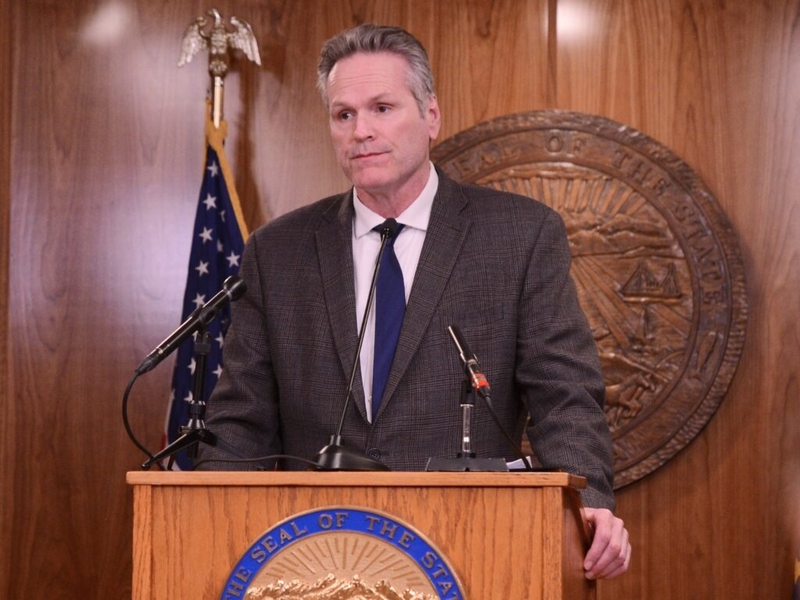
Alaska Gov. Mike Dunleavy talks to reporters during a news conference on Monday, May 19, 2025. (Photo by James Brooks/Alaska Beacon)
Alaska Gov. Mike Dunleavy vetoed an education funding bill for the second time this year, prompting legislators to move on an immediate override vote scheduled for Tuesday.
Lawmakers on Monday expressed more confidence that the veto override would be successful.
Lawmakers passed House Bill 57 in late April, which would permanently increase the base student allocation, the core of the state’s per-student funding formula, by $700 per student, or $183 million across the state per year. In 2024, lawmakers approved a one-time, $680 per-student increase, making the new formula a small year-over-year bump — one that’s less than inflation over the past year.
The bill would have also added some policy changes lawmakers described as compromises with Dunleavy’s priorities, including changing the charter school application process, directing school districts to develop policies to restrict cell phones, funding reading improvement grants, and expanding career and technical training programs.
However, Dunleavy repeatedly criticized the bill — including in a private meeting with superintendents earlier this month — and maintained that he would not approve an education funding increase without more policy changes, particularly related to charter schools and homeschool programs.
“Once the money goes in, I’m taking bets, there’ll be no serious discussion about policy, because that’s been the history of this discussion in the state of Alaska,” Dunleavy said at a news conference on Monday afternoon. He cited his experience as a former superintendent and school board president.
He said his policy priorities from last year, as well as this year, were left out of the bill: grants for teacher retention and open enrollment statewide. He also rejected a provision of the bill that linked one of his priorities — grants for districts showing improvement in reading proficiency — to a separate bill that would introduce a new tax on some internet businesses. He had also advocated for increasing per student funding for homeschool programs.
“It was never an argument that the schools need money,” Dunleavy said. “Absolutely, that’s a primary function of the state. But the question is, what form does that money come into the schools? And what do you do with that money?”
He cited Alaska’s low standardized test scores, and fourth and eighth grade students ranking 51 out of 54 U.S. jurisdictions in three of four categories in the “Nation’s Report Card” last year. “It’s really concerning,” he said.
When asked to address school districts and students now facing budget deficits and school closures, Dunleavy downplayed concerns and pointed to declining enrollment.
“Usually you close a school when there’s few students in the school, or not enough students to justify keeping an entire school open, so you move them to another school. That’s what happens when you’re in a demographic decline, like the state is… the entire United States is in demographic decline. So this is happening all over the country,” he said.
When asked to address districts grappling with cuts to programs and staff, and budget uncertainty next year, he argued many are facing difficult times statewide.
“It could have been a better year for all of us. But again, parents that are trying to get their kids into charter schools are going to have to just wait. Parents that want their kids to really learn how to read, the reading incentive grants probably could help, but they’ll have to wait. Parents that want to send their kids to another public school because it would work better for their child, they’re going to have to wait,” he said, referring to open enrollment in the state.
In an opinion column posted by the Anchorage Daily News before the veto, Dunleavy referred to advocates of the bill as an “education cabal.”
Lawmakers are set to vote on whether to override the veto on Tuesday, and “that’s their prerogative,” he said, and that his administration will be introducing his policy priorities again next year.
Lawmakers react to Governor’s second veto
Legislators reacted to the veto announcement on Monday afternoon.
“Well, (I’m) not shocked that he vetoed the bill, but just utterly shocked that our schools would be left hanging like this,” said House Speaker, Bryce Edgmon, I-Dillingham, adding that the override vote will proceed Tuesday morning as planned. “I hope the votes are there. Our schools need relief. They need it soon.”
Edgmon said the legislation was a compromise bill of many different policy priorities sought by majority and minority caucuses and the governor, along with a smaller increase of $700 to the BSA when some lawmakers wanted more. “And so now it all comes to head in a very dramatic joint session at the very end of session, and I have no words to say at this point.
“I can’t believe a governor could be so oblivious to the needs of our schools,” he said.
Rep. Rebecca Himschoot, I-Sitka and co-chair of the House Education Committee, questioned Dunleavy’s claim that there was no evidence that raising per-student funding would improve educational outcomes. “We know for sure that not helping our schools right now will also not improve outcomes,” she said.
Himschoot also questioned the focus on outcomes. “What are the outcomes we’re measuring? Is it test scores? Is it the availability of thinking? Is it the option to have fine arts and sports? Is it the possibility of a smaller class size… the outcomes that I just talked about aren’t possible with how we’re funding schools right now,” she said.
Rep Chuck Kopp, R-Anchorage, pointed to the proposed funding in House Bill 57 still leaving school districts in severe budget deficits. “We still have schools that are closing, and we still have classrooms that are over even the highest recommended limits, in schools where teachers simply don’t have the capacity to absorb normal student learning needs, much less special education needs in the classroom,” he said.
Kopp also expressed hope for a veto override, and said he was surprised at Dunleavy’s explanation. “I’m very surprised at the administration’s statement that increased funding for our schools won’t do anything to improve educational outcomes. I would just respond that saying starving our schools also will not produce increased educational outcomes.”
Rep. Justin Ruffridge, R-Soldotna, disagreed with the governor. “It was the wrong decision to make, but it’s his decision to make. We get to make decisions, too,” he said, and that he plans to vote for an override. “I think people have been hearing from their constituents over and over and over again that education funding and outcomes are important to them. It’s the No. 1 priority. That’s why many of us are here,” he said.
Sen. Loki Tobin, D-Anchorage, agreed. “I’m confident we have the votes to override the governor’s veto of a very common sense, bipartisan and collaborative piece of legislation.”
Sen. Shelley Hughes, R-Wasilla, sided with the governor. She said the majority was given notice in time to compromise.
“He gave ample, fair, consistent, repeated notice that if the scales weren’t righted, if the policy pieces that were missing — and the funding that was missing to secure the reading incentives and CTE (career and technical education) weren’t added, this would happen,” she said. “So it’s absolutely no surprise.”
Hughes said that while there may be the votes in the Legislature to override the veto, Dunleavy may veto an attached revenue bill, Senate Bill 113, and line-item veto the education funding in the annual budget. “I think that it’s likely to be overridden, but what you’re going to end up with isn’t worth a hill of beans,” she said.
Legislature set for second veto override vote
The House and Senate have already scheduled a joint session for 9 a.m. Tuesday to vote on a possible veto override.
The Legislature hasn’t overridden a governor’s veto since 2009, when lawmakers overrode then-Gov. Sarah Palin’s decision to reject some federal aid during the Great Recession. That veto took place after Palin left office. No sitting governor has had a veto overridden since Gov. Tony Knowles in 2002.
An override requires votes from at least 40 of the Legislature’s 60 members, and even if they pass an override vote on Tuesday, that won’t be the final word.
The formula change in House Bill 57 is still subject to the state’s annual budget process. If the formula is a bucket that determines the amount of money available to school districts, the budget determines whether that bucket is full or not.
Dunleavy has indicated that he may veto part of the funding needed to fill the budget, akin to former Gov. Bill Walker’s decision in 2016 to veto part of the funding for the Permanent Fund dividend.
The Alaska Supreme Court upheld the legality of Walker’s action in 2017, and a Dunleavy funding veto likely would be legal under that precedent as well.
A Dunleavy funding veto could be overridden by the Legislature, but doing so would require 45 votes instead of 40.
In addition, a funding veto would take place after the end of the Legislature’s regular session. Lawmakers would be asked to confirm or override the governor’s decision in January, when they next convene in Juneau.
They could call themselves into a special session in order to vote sooner, but there may not be the votes to do so. For example, Sen. Forrest Dunbar, D-Anchorage, will be on duty with the National Guard for much of the rest of the year and is scheduled to be in Poland.
There’s yet another potential obstacle, too. Part of HB 57 is contingent upon the enactment of Senate Bill 113, a change to the state’s corporate income tax for online businesses.
If the governor were to veto that bill, lawmakers would again face a 45-vote threshold to override veto. If the veto is sustained, the sections of HB 57 dealing with reading grants would be eliminated. Again, a vote on overriding or sustaining the governor’s decision isn’t likely until January.
The veto received criticism from some outside of the Legislature.
“It is abundantly clear Governor Dunleavy does not care about Alaska students or public schools,” said Tom Klaameyer, president of NEA-Alaska, in a prepared statement. “To veto not one, but two bills this year to fund education is not only shameful and embarrassing, but it is a blatant disregard of his constitutional duties. Our schools are in critical need of funding; I encourage every legislator to come together to send this governor a message and override his veto.”
This is the third time in two years that Dunleavy has vetoed bills that would have increased the base student allocation. Twice so far, legislators have failed to override him.
In 2024, legislators passed a bill with a $680 BSA increase by a combined tally of 56-3. After Dunleavy vetoed that bill, enough Republican lawmakers flipped on the issue that Dunleavy’s veto was sustained by a single vote.
Earlier this year, legislators passed a bill containing a $1,000 BSA increase. Dunleavy vetoed that bill as well.
HB 57, originally written to restrict public school students’ cellphone use, was subsequently amended to include a BSA increase, reading-improvement grants and some — but not all — of the policy changes Dunleavy requested.
Lawmakers passed HB 57 by a combined vote of 48-11. Since then, as happened last year, some supporters have flipped to opposing the bill. Rep. Sarah Vance, R-Homer, voted to pass the bill but said Monday that she intends to vote to sustain the governor’s veto.
Supporters considered House Bill 57 a bipartisan, compromise bill
In addition to the formula funding increase, the bill includes several policy changes:
- School districts would have to set maximum class sizes;
- People applying to create a new charter school could file their application any time of year;
- If a charter school application is appealed to the state school board, that board would have to act more quickly on the application;
- Local school boards would be able to close charter schools only under specific circumstances;
- School districts must enact policies defining when and where students can use their cellphones;
- The state must track recently graduated high school students’ educational and job performance for up to 20 years in order to gauge the success of state schools;
- The funding formula for vocational-technical education programs was slightly increased;
- The Legislature would create a task force to consider future changes to education policy, including the open enrollment system; and
- School districts that successfully improve students’ reading proficiency would receive grant funding, contingent on the enactment of Senate Bill 113, which adjusts the state’s corporate income tax for online businesses.
The governor had requested the addition of the charter school sections, and reading grants, as well as two things that didn’t make the final cut: Open enrollment provisions that would allow students to switch between schools and school districts, and an increase to homeschool funding above and beyond the increase provided by the higher BSA.
Lawmakers said open enrollment and changes to the state’s funding formula will be subject to discussion by the task force created under HB 57.
Juneau