Alabama lawmakers want to impose death penalty on child rapists, challenging precedent
Aug 01, 2025 | 8:01 am ET
Description
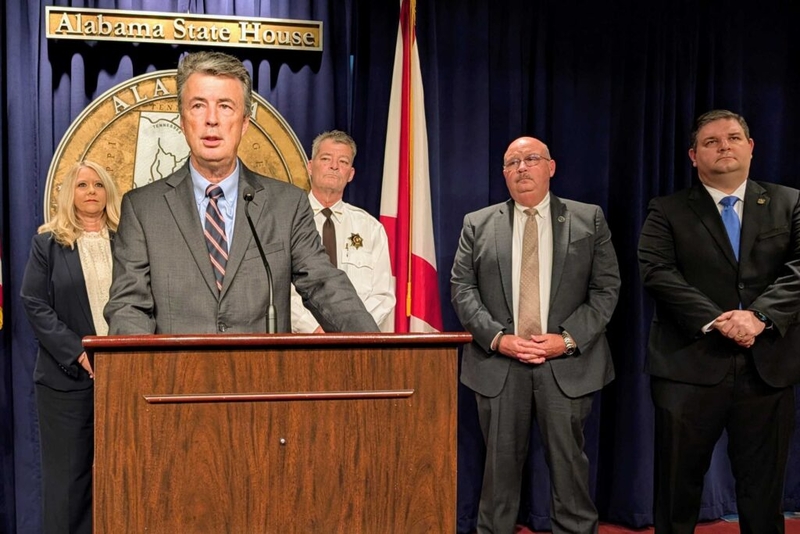
Alabama Attorney General Steve Marshall said in a press conference July, 31,2025 in Montgomery that the state is prepared to challenge a 2008 U.S. Supreme Court ruling that deemed the death penalty unconstitutional for crimes that do not result in the victim's' death. (Alander Rocha/Alabama Reflector)
Alabama lawmakers are preparing to reintroduce a bill that would make the rape or sodomy of a child a capital offense, punishable by death, state officials said in a press conference Thursday.
Rep. Matt Simpson, R-Daphne, one of the bill’s sponsors, said that while it is “unfortunate” that such a bill is “necessary,” the rape of a child is “the worst of the worst of offenses” and therefore “deserves the worst of the worst punishments.”
HB 29, sponsored by Simpson in the 2024 legislative session, would have given adults who rape or commit sodomy against a child under six the death penalty or life in prison without parole, while those under 18 would receive a life sentence. The bill was amended in House committee to extend the punishment to those who commit such crimes against children under 12 and passed the House on an 86-5 vote, but did not make it to the Senate floor for a vote.
Sen. April Weaver, R-Alabaster, who plans to file a similar bill in the Senate, said that the death penalty is meant as a deterrent.
“The death penalty is meant to be a deterrent, and if passing this bill keeps one innocent child from suffering, it will have done its job, and if it sends even one child predator to an early grave, well, that works too,” Weaver said at the press conference.
This legislative push comes after seven people were arrested in Bibb County for their alleged involvement in a child sex trafficking ring. Jody Wade, sheriff in Bibb County, who has been briefed on the bill but had not had a chance to review it, said at the press conference that he wanted to show support for the bill.
“As we work to give a voice to these victims that haven’t been able to have their say as of yet, we just want to take time out to come here and voice our support for this legislation,” Wade said.
Both Simpson and Alabama Attorney General Steve Marshall, who also attended the press conference, said the legislation is in part a direct challenge to a 2008 U.S. Supreme Court decision, known as Kennedy v. Louisiana, that declared the death penalty unconstitutional for crimes against individuals that do not result in the victim’s death. Both said that the legal landscape has changed enough since the 5-4 ruling. Supporters of the bill think the current ourt will be more supportive
“The Supreme Court acted back in 2008 to invalidate the efforts of states to be able to engage in capital punishment for a case in which there was no death, but there’s a time to reevaluate the analysis that the Supreme Court used, as well as the importance that states have placed upon this issue moving forward,” Marshall said.
Simpson added that the court’s decision in 2008 was based on a lack of states with similar laws, a situation he believes is now changing.
“There is a push now to change that, that narrative. There are states that are trying to do it. So, it’s not going to be unusual because others try to do it,” Simpson said.
Simpson pointed to recent legislation in other states, including Florida and Tennessee in 2023 and 2024, and Idaho, Oklahoma, and Arkansas in 2025, as a reason that the Supreme Court might reconsider its 2008 decision. Simpson believes that if Alabama’s bill passes and an individual is charged under it, other states could file amicus briefs in support, which could convince the Supreme Court to reconsider its previous decision.
Marshall said his office is prepared to defend the law and would support other states with similar laws.
“We prepared to do it the moment we have that opportunity,” Marshall said.
Potential effects
Robin Maher, executive director of the Death Penalty Information Center, said in a phone interview after the press conference that such legislation may be counterproductive. She noted the Kennedy decision rested in part on testimony from experts who work with child sexual assault victims. Such a policy, they said, would worsen the problem of underreporting sexual abuse, increase the incentives for child molesters to kill their victims and heighten the trauma that child victims experience in the criminal justice process.
“Those experts said that making this crime death-eligible would only increase the danger to children and result in reduced reporting of child sex abuse by family members,” Maher said.
An amicus brief filed by the National Association of Social Workers and other organizations in the Kennedy case states that the majority of child sexual abuse is committed by family members or close friends. Victims and their families may be hesitant to report abuse due to fear of the consequences for the abuser, a fear that would be significantly increased by a threat of the death penalty, the brief said.
The brief also argued that allowing the death penalty for child rape might lead to more victims being killed, since offenders might be more likely to murder the child to prevent them from testifying, since the punishment for rape and murder would both be death.
“If an offender believes that he will be sentenced to death if convicted of either raping a child or murdering that child, the offender will have every incentive to kill his victim and thus eliminate the primary witness to the crime. The offender will as a result also be more likely to remain free to abuse additional children, in Louisiana and elsewhere,” the amicus brief stated.
Simpson countered that claim in the press conference, saying that perpetrators keep victims alive and commit “that offense repeatedly, multiple times over a length of period of time.”
“They don’t just stop,” Simpson said.
The brief also states that death penalty trials would force child victims to “relive painful events repeatedly.” A study cited in the brief found that testifying repeatedly was associated with “poorer later mental health, including more trauma-related symptoms”. The appeals process can last for years, with one study finding the average time between sentencing and execution to be over 12 years.
Marshall countered those concerns, saying that “kids are strong” and that forcing them to testify is “sadly, what we have to do in a criminal justice system.”
“We’re not creating additional stress for victims because it’s a death-eligible case, those that offend children have created that problem, and the criminal justice system becomes the only vehicle for which we can provide them with relief,” Marshall said.

Montgomery