Alabama House bill would allow probation for incarcerated pregnant women
Feb 12, 2026 | 8:01 am ET
Description
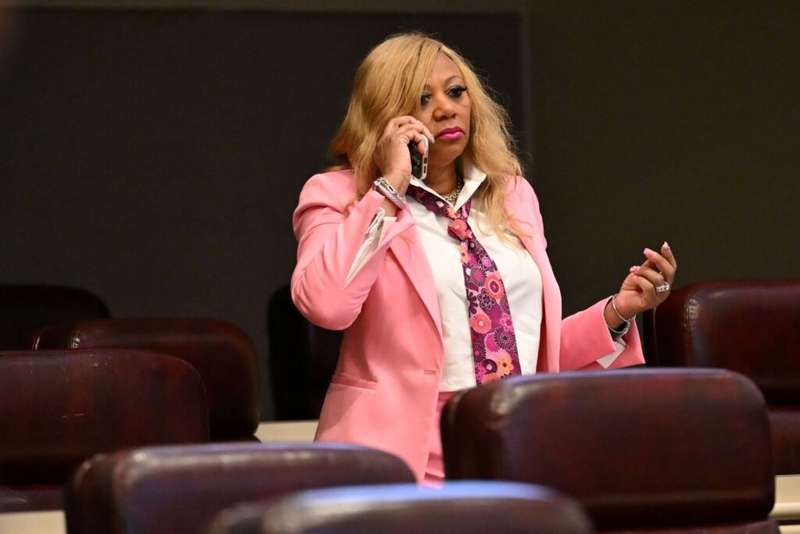
Rep. Rolanda Hollis, D-Birmingham, speaks on the phone in the Alabama House of Representatives on Feb. 3, 2026 at the Alabama Statehouse in Montgomery, Alabama. The House Judiciary Committee passed a bill sponsored by Hollis allowing incarcerated women who are pregnant to be on probation. (Brian Lyman/Alabama Reflector)
The House Judiciary Committee approved legislation on Wednesday that allows women who are incarcerated to remain on probation for several weeks after they give birth.
HB 54, sponsored by Rolanda Hollis, D-Birmingham, allows mothers to defer their sentences and care for their infants who were recently born before they are returned to the corrections facility.
“The bottom line is that HB 54 creates a comprehensive statewide framework to delay incarceration for pregnant and post-partum women while maintaining supervision and public safety,” Hollis told the committee.
At Hollis’ request, the Judiciary Committee delayed consideration of the proposal for several weeks before members approved it on Wednesday. Hollis said that she worked on the legislation with the Alabama Bureau of Pardons and Paroles.
Pardons and Paroles Director Cam Ward said in a statement that the bureau was “happy to provide support” to Hollis on the bill.
“From enhanced capabilities for advanced responsive monitoring to offering mental health and substance use treatment programs – as well as a soon-to-open reentry facility dedicated to women, the Bureau offers a range of services that can support this initiative,” the statement said.
Hollis introduced a substitute to replace the original version. Under the substitute, women must be evaluated to determine whether they are pregnant within three days of their initial medical screening at a correctional facility, unless she declines.
The legislation would authorize a court to place a pregnant woman on supervised release or is confirmed postpartum unless the judge determines there is a documented risk that she is a risk to public safety. The bill states that women who are pregnant or who are postpartum when they are sentenced would receive probation for up to a year after giving birth unless she poses a public safety risk.
That is longer than the 12 weeks that were stated in the original proposal.
Women in the situation will receive credit on their sentence for the time they spent on probation before they are returned to the facility. The bill also requires women to report the loss of a pregnancy to their probation officer or to the court, and mandates that the Alabama Board of Pardons and Paroles to coordinate the terms of the probation with women who are pregnant or who have given birth.
HB 54 also states that women may be charged with a Class D felony, punishable by up to 5 years in prison and a fine of $7,500, if they fail to surrender themselves once their term of their probation ends. This is more severe than the Class A misdemeanor, punishable by up to a year in jail and a $6,000 fine, that was stated in the original bill.
Several groups urged lawmakers to support the bill.
“Although the state does a fairly decent job of maintaining pregnant women, the county jails do not operate on a standardized system, each county jail operates independently,” said Pamela Wynn, founder and president of RestoreHER US America, a policy advocacy re-entry organization, in an interview following the meeting.
Wynn also said that jail and corrections staff are not trained to assist women who are pregnant and it is more costly for facilities to medically care for women who are pregnant.
“We understand that bonding with a baby in the first months of life is a critical time for every child,” Wynn said. “They don’t get that time if they are incarcerated.”
Republicans on the Judiciary Committee had expressed concerns that HB 54 would incentivize women to become pregnant to avoid incarceration.
Rep. Phillip Pettus, R-Killeen, voted against the legislation,saying that 12 months was too long to allow a person to stay on probation. The committee approved versions of the bill in 2024 and 2025, but it did not come to a House vote.
“Hopefully this is a start to help incarcerated women to have help for their kids so that when they return home, they know where their kids are, and make sure they get the health care that is needed,” Hollis said in an interview after the meeting.
Montgomery