Alabama GOP runoff candidates make cases to Shelby County voters
May 27, 2026 | 6:01 am ET
Description
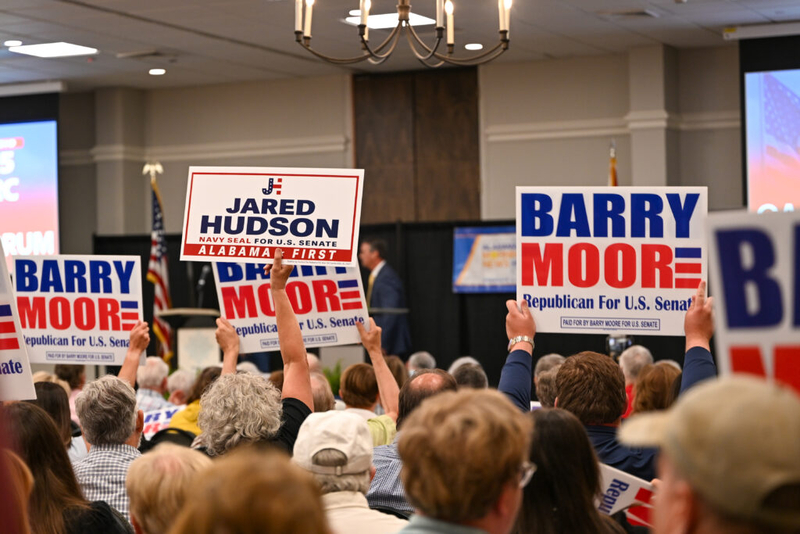
Republican candidates in a primary runoff popse for a photo after a candidate forum on May 26, 2026, at the Pelham Civic Complex in Pelham, Alabama. Candidates made their case to voters for a June 16 runoff election. (Anna Barrett/Alabama Reflector)
PELHAM — Republican candidates in statewide primary runoff elections made their case to Shelby County voters Tuesday night, three weeks before they cast votes for the party’s nomination.
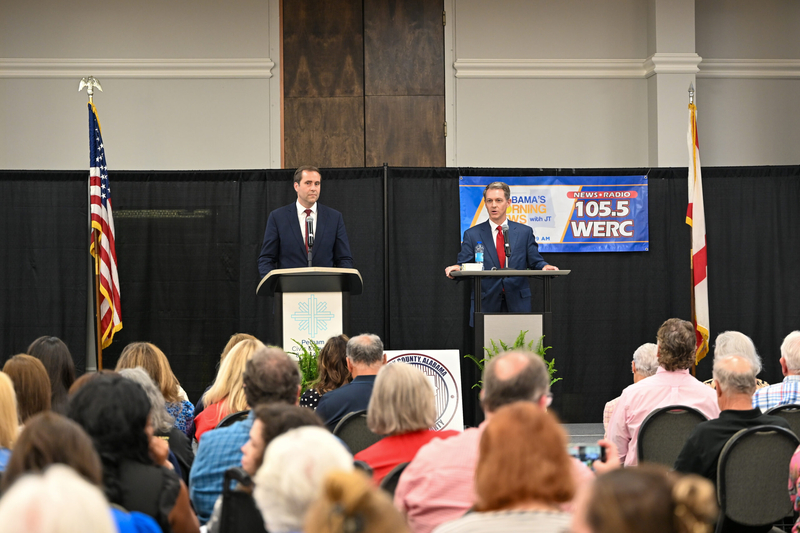
Voters narrowed their choices for attorney general, U.S. Senate, lieutenant governor, commissioner of agriculture and industries, and Place One Public Service Commissioner last week in the primary election. In a forum moderated by Alabama Morning News with JT, candidates were asked three questions from voters.
Attorney General
Voters narrowed their choice for the state’s top law enforcement officer to Deputy Attorney General Katherine Robertson and former Alabama Supreme Court Justice Jay Mitchell last week. Robertson came in first place with 183,340 votes ( 41%) in unofficial returns, while Mitchell had 154,657 votes (34%).
A third candidate, Blount County District Attorney Pamela Casey had 111,690 votes (25%). Casey endorsed Mitchell in the runoff on Tuesday morning for his courtroom experience.
Mitchell Tuesday night accused Robertson of having over $3 million in “dark money,” or outside Alabama contributions like the Virginia-based SuperPAC Frontline Victory Fund, which has contributed over $1 million of Robertson’s $4.8 million campaign funds.
“You’re going to dance with the one who bought you,” Mitchell said. “These dark money show groups that get set up, they do not register or disclose with our Secretary of State’s office. They don’t want you to know who they are, and I would just challenge you: ask yourselves, ‘Who are these people? What do they hide, and what do they possibly want with Alabama’s Attorney General, Alabama’s Attorney General Office?’”
Robertson said the national funding and relationships will help if she is attorney general, and she is proud to have their support.
“You’re going to want an attorney general that has national relationships. You are going to want an attorney general that can walk in on day one and be supported by the other 27 republican AGs. You’re going to want an attorney general that’s plugged in with the conservative legal movement,” Robertson said. “Club for growth, Heritage Action, these groups have been staunch conservatives, and they are supporting me. I’m proud of it.”
Robertson said voters should choose her because she has experience in the Attorney General’s Office.
“We’re going to have two years left, and the most friendly presidential administration this state’s ever going to have,” she said. “We do not have time for on-the-job training.”
Mitchell said that there should be an attorney general with courtroom experience, not just experience in the office.
“I think it starts first and foremost with this: we gotta have an attorney general who has courtroom experience,” Mitchell said. “You’re talking about electing the next attorney general, you’re talking about electing the next head courtroom lawyer of the state, the chief law enforcement officer of the state. We’ve gotta have an AG who has that experience.”
The winner will face Democratic nominee Jeff McLaughlin, an attorney in Guntersville and former state representative, in the general election.
U.S. Senate
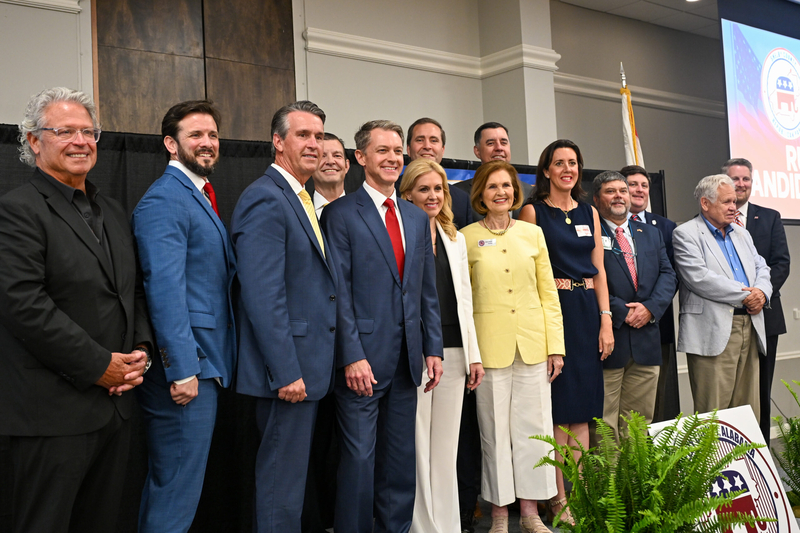
Voters will choose between Navy SEAL Jared Hudson and U.S. Rep. Barry Moore, R-Enterprise, to replace Republican gubernatorial nominee and current U.S. Sen. Tommy Tuberville in Washington in three weeks.
Moore got 188,825 votes, about 40% of votes, and Hudson got 123,533 votes, about 26%. It was not immediately clear on election night if the second candidate would be Hudson or Attorney General Steve Marshall, but Marshall conceded the following day with 118,233 votes, almost 25% of the total votes cast.
Hudson, a first-time candidate, vowed that he would not become “part of the swamp” in Washington.
“Making sure that when you get there, you don’t forget where home is. When you move to D.C., you become D.C., but my wife, my three beautiful little girls will stay right here in Alabama, and home is where your heart is,” he said. “Making sure that you don’t become part of the swamp when you’re taking on the swamp is of the utmost importance, and that’s how you can make a change.”
Moore urged voters to choose the candidate with experience. Moore served in the Alabama House of Representatives from 2010 to 2018 before he was elected to the U.S. House of Representatives in 2021.
“Look at my record, the most conservative member in the Alabama delegation, an ally to the President. The President has endorsed me because he’s seen me in the fire,” Moore said.
The winner of the runoff will face the winner of the Democratic runoff between Everett Wess, an attorney, and Dakarai Larriett, a business owner, in November.
Lieutenant Governor
In an office with little power, the lieutenant governor’s race drew nine candidates across both ballots in the primary. Voters narrowed their choices on the Republican ballot to former Republican Party Chair John Wahl, who got 40.6% of votes, and Secretary of State Wes Allen, who got 38% of votes.
The race has been heated. The Allen campaign is accused of attempting to pay to get Wahl disqualified from the race. In response Tuesday night, Allen said he would have “done it myself.”
“You want somebody in that office who can lead, and there’s nobody better prepared to be lieutenant governor than myself. It’s all about experience,” Allen said.
Wahl’s residency was challenged in January by former state Rep. Gil Isbell, R-Gadsden, for a home Wahl has in Tennessee. Wahl, who is a butterfly farmer and lives in north Alabama, admits to having a second home in Tennessee, but said he has lived in Alabama for the last seven years, as is required for the office by the state constitution.
“I don’t like political games, behind the scenes trying to remove your opponent,” Wahl said. “This race is not about me, this race is not about my opponent, this race is not about Tommy Tuberville. This race is about you, the voters of the state.”
Allen said his experience as a probate judge, state lawmaker and chief election official makes him the most qualified candidate for the second highest office in the state. The main duty of the office is to be available should the governor die, resign or be removed. The lieutenant governor also presides over the State Senate.
“You never know when your name’s going to get called,” Allen said. “I’m asking you for your vote to put somebody in there that has experience being the tip of the spear on these cultural issues and getting things done on behalf of the state of Alabama to make sure we are prosperous, setting up this state for our children and our grandkids to prosper down the road.”
Wahl, who was endorsed by President Donald Trump before he entered the race, said voters should choose him because he is not a career politician.
“Do I have the most government experience? No, but I don’t want to,” Wahl said. “I want to be the conservative outsider, the fighter who goes to Montgomery, who drains the swamp, who brings power back to the people.”
The winner will face Democratic nominee Rep. Philip Ensler of Montgomery in the general election.
Commissioner of Agriculture and Industries
Voters narrowed their choice for the Commissioner of Agriculture and Industries to Corey Hill, mayor of Douglas in Marshall County, who got 150,598 votes, about 35.2%, and Christina McInnis, a fifth-generation farmer in Baldwin County, who got 149,179, about 34.9%. Sen. Jack Williams, R-Wilmer, came in third place with 129,112, about 29.9%.
Hill focused his comments on food safety and expanding Alabama’s agriculture infrastructure, including Sweet Grown Alabama.
“When Alabama is buying food for our schools or hospitals, and our prisons, it needs to be Alabama grown and produced food. We need to pay more if we have to, whenever we budget those,” he said. “We’re going to try to get the Legislature to make that a priority, and that can come to the Sweet Grown program.”
McInnis said that she would cut the “waste, fraud, and abuse” in the state’s supplemental nutritional assistance program (SNAP) – which is administered by the Department of Human Resources, not the Commissioner of Agriculture and Industries.
“We have to really look at what the national security threat is facing our nation, young farmers, China, and putting the train back on the tracks and spending our money the way we should,” she said. “Where our kids are eating healthy, and eating real food, we’re MAHA (Make America Healthy Again) in Alabama, and we’re doing it by putting it into the money of the pockets of our farmers.”
The winner of the June runoff will face Democratic nominee Ron Sparks in the general election. Sparks served as the Commissioner of Agriculture and Industries from 2003 to 2011 and was the Democratic party’s gubernatorial nominee in 2010.
Public Service Commissioner, Place One
Democratic nominee Sheila McNeil will face the winner of a runoff election between incumbent PSC commissioner Chris Beeker and former State Auditor Jim Zeigler. In the primary, Zeigler got 189,724 votes (45%) to Beeker’s 103,835 votes (25%).
According to the U.S. Energy Information Administration, Alabama residents paid 16.18 cents per kilowatt hour in February, the highest rates in the South and up from 15.83 cents a year earlier.
By comparison, Mississippi residents paid an average of 14.72 cents per kilowatt hour; Georgia residents paid an average of 14.13 cents per kilowatt hour and Tennessee residents paid 12.82 cents.
Zeigler promised to launch an investigation into the high rates in Alabama if he is elected.
“I’m going to see why your power rates are higher than other states. I’m going to see why your power rates are higher than the TVA (Tennessee Valley Authority) rates in north Alabama,” he said.
Beeker said that there has been a lot of “buzz words” in the election and the PSC has voted to freeze rates, but Alabama’s energy usage is also high, which he said contributes to high power bills.
According to a study by the University of Kansas using data from the U.S. Energy Information Administration, Alabama ranked 13th in energy consumption in 2023.
“To think that I don’t want a lower power rate is crazy, and we will continue working with the PSC staff to put pressure on Alabama Power to show us ways that they can reduce costs in order for us to lower our rates,” Beeker said.
How to vote
Republican voters, and those who did not vote in the May 19 primary, can choose a runoff candidate on June 16. Polls are open from 7 a.m. to 7 p.m. Polling locations can be found here. Winners will face their respective Democratic nominees on Nov. 3.
Montgomery