AI might change Louisiana culture, but it can’t replace its community
Jul 07, 2026 | 1:47 pm ET
Description
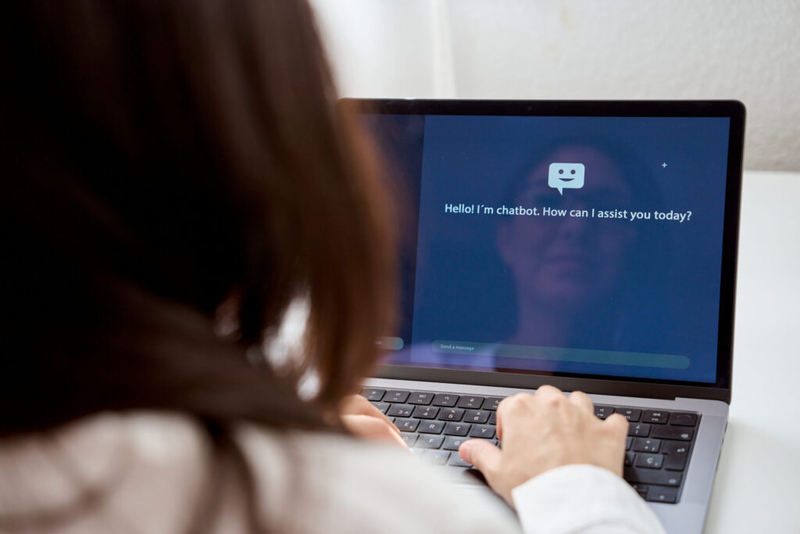
A woman interacts with a chatbot on her laptop. (Photo by David Espejo/Stock at Getty Images)
Our kids can’t sign a check. The GPS led me the wrong way. Just let artificial intelligence write the emails.
Whether spoken with amusement or frustration, these familiar phrases reveal something deeper — cultural habits we took for granted are not being updated, they are quietly being forgotten.
For those of us living in the age of generative AI, we appear to be on the verge of an industrial revolution where AI reshapes the world. We are promised limitless wealth, miracle cures, instant answers, even the provision of drafting thoughts and prayers through a single notification. But in a world that’s racing towards an uncertain future, how often are we informed of what exactly we’re sacrificing in order to get it?
Is AI our assistant or are we becoming its dependent?
In economics, opportunity cost teaches us that in a world of scarcity, we have to sacrifice our work, our time, and the future itself to pursue greater desire. Businesses weigh opportunity costs through investments, logistics, marketing and construction. For the rest of us, however, the consequences of exchange may be less obvious. We risk sacrificing something much harder to measure, our connection to one another.
Every technological breakthrough asks us to make a trade. Automobiles boost our mobility at the cost of reshaping our neighborhoods. Airplanes transport us vast distances, yet they also made distance between families more common. Smartphones gave us constant connection while quietly eroding our contemplation.
AI promises the efficiency of a genie, but are we prepared for what we may lose in exchange? Every innovation deserves an honest conversation — not just the promises of progress, but what’s being lost in the process.
In a state celebrated for embodying Southern hospitality, musical creativity and culinary cuisine, AI is not merely changing what we know or how we work; it is changing Louisiana’s culture.
Emails may be more polished, but they feel hollow. Classroom engagement requires less eye contact, while conversations are passed through algorithms before they reach another person. Louisiana predates the United States of America, and for this reason, tourists flock to our streets for a reminder of what it means to be human.
As a state blessed with tremendous natural resources, Louisiana’s notoriety isn’t restricted to what it manufactures. Instead, we are known for porches where conversations beat a summer’s heat. Second lines that invite strangers to celebrate after a difficult week. Churches that become shelters after hurricanes, and neighborhoods where fish fries and crawfish boils are shared long before they’re photographed.
These are the relationships that separate us from algorithmic echo chambers.
While technology redefines what is possible at an unprecedented scale, communities — including faith-based ones — must determine what is wise. Faith-based organizations have spent centuries engaging in a practice that is becoming increasingly rare in our algorithmic discourse.
Much like houses, churches are more than institutions. They are communities composed of individuals who disagree, gather together, slow down, reflect and gather around a cause greater than themselves. These practices cultivate a desire to serve, a sense of charity reminding us that being human isn’t solely about amassing resources for ourselves but finding commonalities in a world incentivized to divide us.
Our tradition has long been shaped by faith, as parishes are not merely a tool of locality, but a community of the faithful united to remember the past, steward the present and foster the future.
As citizens sovereign over our own decisions, Louisianans do not have to be voracious consumers of product. We have the tools, passed down from generations, to audit innovation. We forged lasting communities of character before recommendation algorithms and personalized feeds shaped what we see, feel and discuss.
AI is changing how we live and work. Whether it strengthens or weakens the communities that define us is a decision no algorithm can determine. That responsibility should always belong to us.
Baton Rouge, LA