After Halong: The ones who stayed
Jun 10, 2026 | 5:10 pm ET
Description
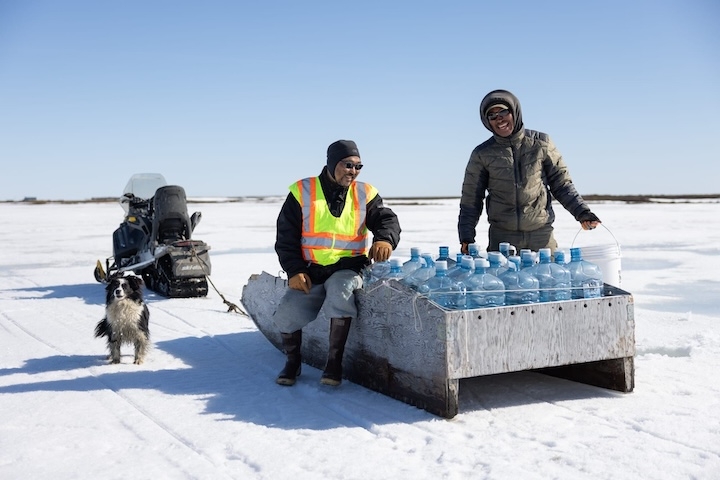
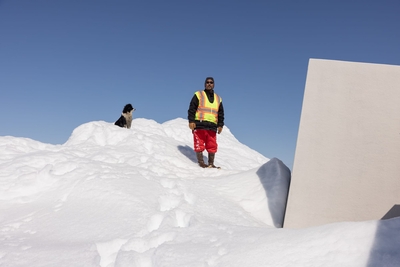
Benjamin Kugtsun, right, gathered melting ice and snow in May from a pond near Kipnuk. His friend and cousin Burt Paul sits at left with his dog Koda. Paul and Kugtsun never left Kipnuk after ex-Typhoon Halong wreaked havoc on the community last fall, and instead decided to stay and rebuild. (Katie Baldwin Basile for Northern Journal)
When ex-Typhoon Halong flooded the Western Alaska village of Kipnuk last fall, a mass evacuation followed.
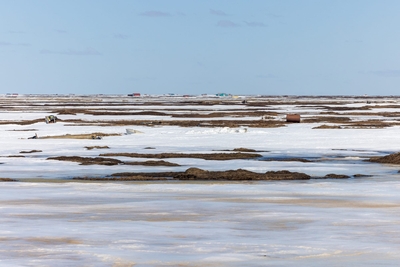
Homes were displaced, with some 90% of the village’s structures destroyed, according to Gov. Mike Dunleavy. Most people made the difficult decision to leave the village.
In the end, 19 people stayed behind, determined to see Kipnuk rebuilt — a tiny fraction of the nearly 1,000 people that tribal leaders say lived in the village before the flooding.
Kipnuk was the hardest hit during the storm, but Halong also caused widespread damage in other communities across Western Alaska, including the village of Kwigillingok.
Burt Paul and Benjamin Kugtsun are two of those who remained in Kipnuk.
Cousins and best friends, the two believe that despite the damage, the village can still serve as an interim home for community members while they wait to relocate to higher ground — a long-term goal that tribal leaders announced in March after a formal vote.
Before Halong hit, Burt was a Yup’ik culture and language teacher at the Chief Paul Memorial School. I visited his classroom May 8 and spoke with him and Benjamin.
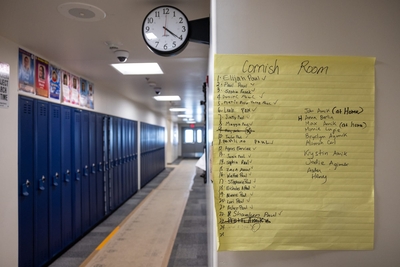
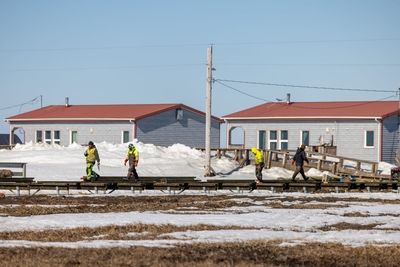
Posters highlighting traditional Yup’ik values and books by regional authors like Elsie Mather and Paul John filled the space, along with a coffee maker, pillows, mattresses and blankets. For the past seven months, the classroom was a dorm room for both men while they worked with contractors to repair homes and village infrastructure.
In this conversation — the first in a series of dispatches on Halong’s survivors — Benjamin and Burt reflect on the difficult night that the storm arrived in October, their lifelong friendship and the reasons they stayed behind.
The discussion has been edited for clarity, and condensed.
Katie Baldwin Basile: Did you ever leave Kipnuk after the typhoon?
Benjamin Kugtsun: No. We stayed here after everybody evacuated, we stayed behind.
Katie: What made you decide to stay?
Benjamin: We hoped that it could be a village again. To this day, everything’s going good. Power. Houses are back. There is (some) electricity in houses. It’s livable, it’s getting there.
We worked on foundations. They’re replacing the insulation that got soaked. They’re working at our house that I’m staying in right now. I just need steps, so that’ll be it.
Katie: What made you decide to stay, Burt?
Burt Paul: It’s my hometown, and there’s many reasons that I wanted to stay. One of the reasons: The village was destroyed. I felt that we needed to take care of the village. For example: caskets (that floated away from the cemetery), cleanup. I could name so many things.
With these guys, the 19 men that were staying behind, I had a spark in the hope of rebuilding. And then help (from the state and contractors) started to arrive.
It’s a very hard start. It felt like a new beginning. That very strong hope, and I didn’t want to leave home. Like everyone else, there’s no place like home.
Katie: You guys are cousins and good friends. When it came time to stay or go, did you decide together?
Benjamin: Yeah, we planned. We planned every day: What’s next? What’s got to be worked on? And it worked. And now we can be smiling every day.
People that evacuated are coming back for work, to make money for their family. Pretty soon, Kipnuk people will come back, and the school will be open for the kids — that’s our goal.
Katie: How did you feel when you heard that the village had voted to permanently relocate?
Benjamin: I voted that I’m not going to relocate. Because relocation is — you’ve got to have meeting after meeting to get funding. It’s hard to get there right now. So I said, I’ll stay home, where there’s an airport, school, post office — while they’re standing.
Burt: I also voted to stay, but that vote is weak. Maybe a quarter of the village wanted to stay. But the relocation time estimate is 10 years. [1]
Before that happens, we need this village to operate, to use it for waiting at home, for the new location.
Because not all the people have steady jobs and driver’s licenses. Living in a city is a lot of change for many people. The evacuees are depending on a lot of help — but that help will not always be there. Pretty soon, one is going to be standing alone. Some may be successful with finding a new job, a new home, but not all. [2]
That’s one of the reasons I keep the village running, so (eventually) they can come home and settle-in.
Katie: What was that night the typhoon hit like for you? What do you remember?
Burt: We knew the wind was strong. And then it shifted to the direction of southwest; it pushed the water towards the land. I know it’s flat in Kipnuk, but the elevation is (normally) just high enough. The regular flood that occurs during the fall time usually does not reach my area.
When I started seeing that (Halong) flood coming in, and how strong the current was, I knew it was going to be high.
We started hearing that houses were floating and drifting away, and some people were texting their whereabouts. Seeing and watching a house float by in the dark. Watching my neighbors float away.
All the debris that hit my house made me worried. A couple of conexes hit, but somehow my house stood up, survived.
When I saw water, I prayed to God to hold and keep my house safe. It was a great disaster that changed people’s feelings about coming back to Kipnuk. Who knows if they will change their minds and come back? Some say, after this year’s fall flood (season), they’ll see, because we cannot tell the future. But standing strong and praying for strength is helping a lot, and people’s prayers all over the world. I believe in that.


Benjamin: I put three twelve-foot-long boards on my house just in case, so when the water got there, the boards would keep it steady, and not float away. It worked.
When it started floating, those three boards were holding the house in place. But once another house drifted and hit our house from behind, we started floating. If I anchored the house, probably it could have stayed where it was. But I wasn’t ready for that.
We started floating away. Next thing, I looked out the kitchen window with a spotlight, I saw a house coming towards us at about three miles an hour. Man, I yelled at my family, hold on to something.
It hit us and it rocked the house. But good thing, it never broke any windows. It was that close to breaking the window — about two to three inches off. So, we are here.
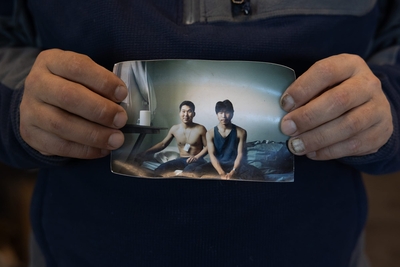
Katie: I’m looking at this photograph of the two of you from when you were much younger, still best friends. Where was the picture that night? And where did you find it?
Benjamin: Oh, the picture of us when we were teens, 18 years old or so.
I had lots of photos that I took out to our old house, because there was no more room and I had to store my stuff. But that old house floated away behind the school where we used to live, and I lost all of the photos.
After the storm, one of the teachers found that picture of us when we were young, on the ground. And when I walked into the school lobby and saw it, I had to take it. And to this day, that picture of us is — we’re still best friends.
Katie: Wow, so this was the only photo of yours that made it through the storm. That’s symbolic, I think, of your friendship.
Benjamin: Now we’re in our 50s or so, still young. We feel like we’re 21.
Katie: Burt, what did you think when you saw that photo?
Burt: It told me that time flies by.
In those younger days, we used to hear from our elders, to expect the unexpected. Because in history, they went through famine, sickness. They went through so much trauma and disaster. I guess this history is ours too.
And they did proceed in success. They would say, you never know what’s coming, but be ready. Be strong. Don’t get comfortable with life’s comforts. Don’t take things for granted.


I always remember those things. Wake up early, all those things that elders used to speak of. And be humble. Sometimes thinking too far ahead eats your mind. Like already thinking of relocating. Maybe that day will come. Maybe not, with the world changing.
Yeah, relocating, starting a new life in a good spot, high spot. We have to adjust with the new location. It’s not far. It’s in the same area, 15 miles away. But infrastructure, I don’t know, it will take 10 to 15 years. A new school, airport, laundromat, maybe a road. We’ve got to think of those things before we relocate. We cannot just build a home and expect to live happily ever after. We’ve got to build the infrastructure first.
Katie: Thank you both. Do you want to add anything else?
Benjamin: I’m going to start making Noah’s Ark… (laughter) That’s a joke.
1. Community relocations take decades and there is no specific federally funded program to support them. For example, the community of Newtok recognized the need to relocate their village due to erosion in the 1980s. The Newtok Native Corp. proposed a land exchange agreement with the U.S. Fish and Wildlife Service in 1996. The land exchange was formally signed in 2003. After sixteen years of fundraising and construction, the first families moved to the new village of Mertarvik in 2019. The final families moved there in 2024, nearly 30 years after the initial land exchange proposal.
2. Roughly 680 community members from Western Alaska were living in temporary housing within Anchorage and surrounding areas as of earlier this spring, according to the Alaska Division of Homeland Security and Emergency Management.
This article was originally published in Northern Journal, a newsletter from Nathaniel Herz. Subscribe at this link.
Juneau