After backlash, Whitmer says EGLE must consider Michigan Supreme Court ruling on Line 5 permits
Sep 09, 2026 | 4:57 pm ET
Description
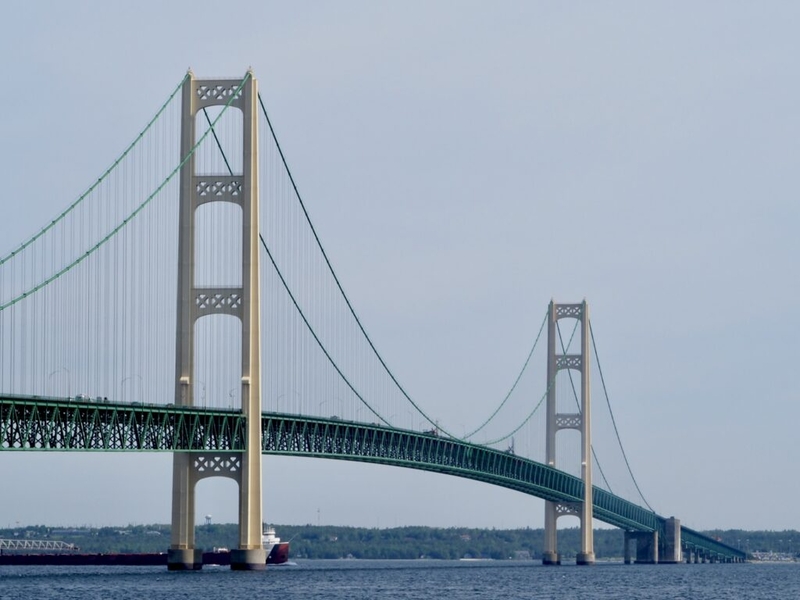
The Mackinac Bridge in the Straits of Mackinac, May 27, 2024 | Susan J. Demas
When the Michigan Department of Environment, Great Lakes and Energy issued a set of permits for the Line 5 tunnel project in July, opponents of the pipeline called it a betrayal — with some laying the blame at Gov. Gretchen Whitmer’s feet.
Now, both Whitmer and EGLE are pushing a harder line against Enbridge Energy as the state’s regulators gear up to re-examine the potential environmental impacts of building the tunnel project, which Enbridge has said would serve to protect the dual pipelines from the type of disaster Whitmer has warned about throughout her career.
The re-examination of the project and its impacts is the product of the Michigan Supreme Court’s decision in late July to toss the Michigan Public Service Commission’s approval of the tunnel project. The high court in a nearly unanimous decision found that the state did not properly examine the environmental harms that might arise from extending the pipeline’s lifespan.
On Wednesday, Whitmer’s office released a statement saying EGLE must examine how the Supreme Court ruling affects its own permitting decisions.
The governor also sent a letter to Enbridge CEO Gregory Ebel, demanding the company stop treating the tunnel project as its only alternative to the dual pipelines, noting that multiple energy supply chain experts had concluded that the market can adapt to a Line 5 shutdown without significant supply shortages or price spikes.
“I am calling on Enbridge to pursue an alternative to both the existing dual pipelines and the tunnel, and to begin that work now,” Whitmer wrote. “Develop a planned, orderly transition that protects Michigan families and businesses and gets oil out of the Straits far sooner. That alternative may not preserve Enbridge’s current market share or be as profitable for your shareholders. But those are not reasons to expose the Great Lakes to another decade of unthinkable risk.”
During her 2018 campaign, Whitmer pledged to take action against the pipeline, which stretches for 4.5 miles through the straits of Mackinac, where Lake Michigan and Lake Huron meet.
However, with fewer than six months left in her tenure as governor, anti-Line 5 advocates argued that Whitmer had softened her stance against the pipeline.
Great Lakes tribal nations and environmental advocates have pushed for a shut down to the pipeline for years over concerns that the pipeline could rupture and contaminate the lakes with crude oil.
Following an anchor strike in 2018 which dented the pipeline in three places, Enbridge reached an agreement with the state, led by Republican Gov. Rick Snyder, to build a utility tunnel to house a new section of the pipeline and permanently shut down the dual pipeline currently operating on the lakebed.
In order to move forward with the construction of the tunnel, Enbridge needs permits from multiple regulatory agencies. While it has received the approval of the U.S. Army Corps of Engineers, the Michigan Supreme Court’s recent action overturned the permit granted by the Michigan Public Service Commission.
In a statement to Michigan Advance, Enbridge spokesperson Ryan Duffy emphasized that the company already has an agreement with the state to build the tunnel.
“Without years of litigation and political intervention, this project would be moving toward completion,” Duffy said.
He noted Enbridge would “continue to stand ready to meet with the Governor to look at ways that protect Michigan’s natural resources while ensuring the continued safe operation of critical energy infrastructure.”
In a statement shared alongside Whitmer’s Wednesday announcement, EGLE Director Phil Roos said the agency had completed a review of the cultural and environmental impacts of the tunnel project and an analysis of alternatives under the scope set by law. That said, given the Supreme Court’s decision, EGLE’s permit may need further review, Roos said.
“Until all those legal questions are resolved, conditions in EGLE’s permit prevent construction of the tunnel entrance from moving forward,” Roos said.
Whitmer’s office, in Wednesday’s news release, said the state is reviewing its options for proceeding in a manner consistent with the Supreme Court’s decision and Michigan law.
Nichole Keway Biber, the Michigan Water Justice Organizer for Clean Water Action and a tribal citizen of the Little Traverse Bay Bands of Odawa Indians, told the Advance on Wednesday that Whitmer’s announcement is a sign that pressure from the people and established law can work in concert to make a difference.
Emily Woodcock, Michigan director for Clean Water Action, also said the Michigan Supreme Court’s decision effectively requires the state to consider the Michigan Environmental Protection Act and the public trust doctrine — the idea that certain natural resources and features like the Great Lakes are preserved for public use — in all its environmental permitting decisions.
“That is so important, not just for the Line 5 fight, but for every single fight moving forward,” Woodcock said. “That is like a game changer for our work.”
David Gover, a managing attorney for the Native American Rights Fund representing the Bay Mills Indian Community, thanked Roos and the governor for hearing the tribal nations and communities opposed to the project alongside the court’s decision.
“EGLE should have never issued these permits and the recent Michigan Supreme Court decision confirms that,” Gover said. “It is imperative that all permitting agencies take the time to review and fully understand the impacts on Tribal Treaty-protected resources, as there is no denying the harm this proposed project would cause to cultural resources, the environment, and the impacted Treaty resources. The Straits of Mackinac are a sacred space, and should be protected from permanent destruction by oil pipelines running through the Straits.”
The Anishinaabe consider the Straits of Mackinac the site of creation, with the EGLE permit noting this “project will have adverse effects on known historic and cultural resources, including their destruction and/or removal These resources are unique and highly significant to the Anishinaabek communities, as well as the State of Michigan.”
The permit requires Enbridge to “mitigate the loss of historic, archaeological, and cultural resources,” a condition Gover previously said would force tribal citizens to unearth their buried ancestors.
In a previous statement to the Advance, Enbridge said past site surveys found no confirmed tribal ancestral burial grounds within the proposed construction areas, but their process “fully accounts for the possibility of discoveries.”
Bay Mills Indian Community President Whitney Gravelle said the state’s announcement is an important step, but emphasized that Michigan needs to listen to tribal nations.
“Our treaty rights are not an afterthought, and our voices should not only be heard when it is convenient,” Gravelle said in a statement. “The Straits are our homeland, not a corridor for a foreign oil company. We do not own the Great Lakes. We are borrowing them from future generations, and it is our responsibility to return them whole. That means moving beyond Line 5 and toward safer alternatives that do not gamble with the heart of the Great Lakes.”
Lansing, MI