Thousands of South Dakota habitat license plates do nothing for habitat, due to two-part process
Sep 09, 2026 | 4:41 pm ET
Description
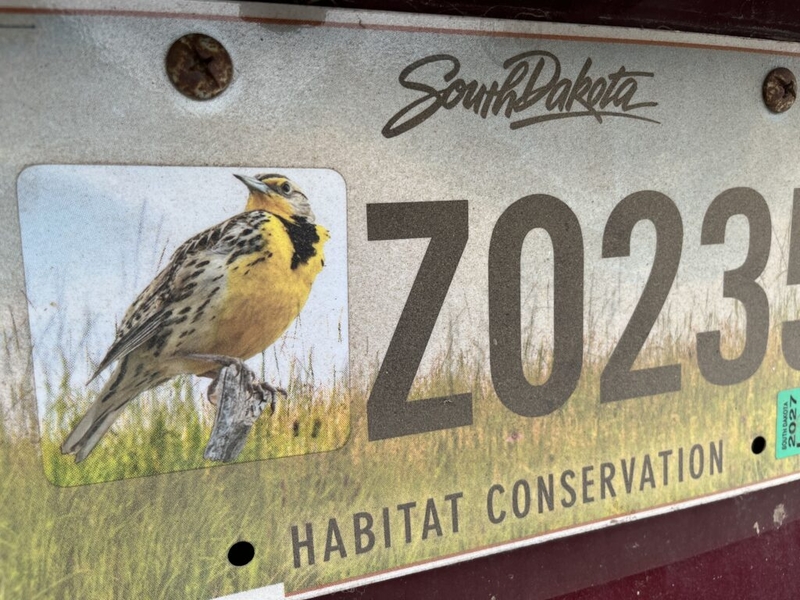
A meadowlark habitat decal is affixed to a South Dakota habitat conservation license plate. The optional decal purchase is what helps to fund habitat conservation, and some people don't take the extra step. (Photo by Makenzie Huber/South Dakota Searchlight)
Thousands of South Dakota drivers who have habitat conservation license plates have not actually made a financial contribution to protect habitat for wildlife.
That’s because unlike some other states, where drivers’ habitat contributions are collected during license-plate transactions, South Dakota dispenses the plates and then asks drivers to separately donate to habitat conservation later by ordering habitat-themed decals and affixing them to the plates.
Some drivers don’t follow through with the optional purchase of the decals. As a result, the state has sold 8,484 more sets of habitat plates than decals, according to data from the state Department of Game, Fish and Parks running from March 2025, when the plates first became available, through last month. That equates to about $415,000 in potential funding for habitat that’s not being collected.
Meanwhile, the state has sold 4,626 sets of decals, generating about $230,000 for habitat conservation.
Jeff Olson is a Black Hills Sportsmen Club board member, co-president of Black Hills Flyfishers, a board member of the South Dakota Wildlife Federation, and a former state Game, Fish and Parks commissioner. He is happy the state started a plate program that puts money toward habitat conservation.
“Yet, I have a hard time understanding why we would require people to purchase these things separately,” Olson said. “It doesn’t make sense.”
Olson said he has a friend who has plates with no decals who told Olson “it is too complicated and people just give up.”
How the process works
South Dakota habitat plates feature a special design with a field of grass and a blue sky, and the phrase “Habitat Conservation” across the bottom. The plate number is offset to the right, allowing space for the optional decal to be affixed on the left.
The plates cost $10 beyond the price of a standard vehicle registration, which covers the cost to make the special plates. Habitat plates are valid for three years.
Drivers can obtain plates in person at their county treasurer’s office or through the mail. Either way, the state Department of Revenue says, drivers are given written notice of the opportunity to separately purchase the habitat decals from the state Department of Game, Fish and Parks.
A set of decals costs $50 — or $30 for motorcycles and all-terrain vehicles — and can be purchased on the Game, Fish and Parks website. The department uses the decal proceeds for habitat conservation work on public and private lands, for projects such as planting native grasses and trees, and doing prescribed burning to control invasive species. Drivers can choose from four decal designs, which the state describes as emblems: a deer, a meadowlark, a pasque flower (the state flower), or a pheasant.
Why is it this way?
Lawmakers authorized the program two years ago, and the state implemented it in March 2025.
Kendra Baucom, a spokesperson for the state Department of Revenue, which works with counties to manage vehicle licensing and registration, told South Dakota Searchlight in a statement that the two-step process is legally necessary due to language in the state constitution.
The decades-old language in Article 11, Section 8 says vehicle license and registration fees “shall be used exclusively for the maintenance, construction and supervision of highways and bridges of this state.”
Baucom said “it would be unconstitutional to tie the sale of the emblems to the sale of the plates, then use the proceeds for habitat conservation purposes.”
“While it might not be convenient to purchase the emblems separately, that is how we can both follow the constitution and provide support for habitat conservation,” Baucom added.
How other states handle habitat plates
Other states have figured out how to streamline the process.
In Minnesota, the purchase of a habitat plate includes a minimum $30 contribution to the state’s Critical Habitat Program at the time of the plate purchase. No additional decal is required. The state’s Department of Public Safety receives the $30 contribution and passes it along to the habitat program fund. The $30 contribution is made annually when drivers renew their registration.
Iowa has a natural resources plate program, which includes a $45 contribution to the program at the time of the plate purchase and annual $25 renewals, with no extra decal purchase required. After the money is deposited into a road tax fund, the state treasurer credits an equivalent amount to the Iowa Resources Enhancement and Protection Fund, used for habitat and wildlife programs.
Searchlight asked South Dakota’s Department of Revenue why it can’t follow the example of those other states.
“Every state constitution is different,” Baucom replied.
Policymakers react
The disconnect between plate sales and decal sales in South Dakota disappoints the two lawmakers who served as primary sponsors of the authorizing legislation in the state House and Senate.
Erin Tobin of Winner, who was serving as a Republican state senator at the time but is no longer in the Legislature, said state officials should revisit the program to determine whether there is a better way to structure the purchases.
“I’m still really proud of this program,” Tobin said. “It gives people who don’t hunt and fish, but care about habitat, an opportunity to participate in the state’s conservation work as well.”
Hunters and anglers contribute to habitat conservation through fees included in the price of their hunting and fishing licenses, and with taxes on equipment.
The House sponsor, Rep. Jessica Bahmuller, R-Alexandria, said South Dakotans would be more likely to complete the decal transaction if they could purchase the plates and decals together. She hopes to address that if she wins reelection in November, she said.
Game, Fish and Parks Commission Chairwoman Stephanie Rissler said the plates themselves, even without decals, provide a benefit.
“Whether someone chooses to display the emblem or not, the plate itself still helps promote the importance of habitat conservation across South Dakota,” Rissler wrote in a statement to Searchlight.

Pierre, SD