Mental health professionals highlight errors in Nebraska assessment for developmentally disabled
Sep 09, 2026 | 5:49 pm ET

Description
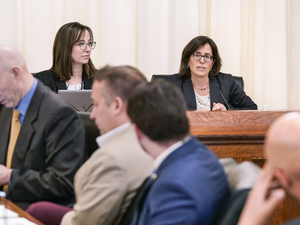
Tony Green, director of the Division of Developmental Disabilities in the Nebraska Department of Health and Human Services, at a meeting of the Nebraska Olmstead Advisory Committee. Dec. 19, 2025. (Zach Wendling/Nebraska Examiner)
LINCOLN — Just over a year after Nebraska launched a new system to assess Nebraskans with intellectual and developmental disabilities seeking Medicaid assistance, a group of parents gathered to inform state officials about the negative impacts the change has had on their families.
Mental health professionals Carol Salber and Tori Sorensen, who are both parents of participants in the system, gave a presentation Wednesday to Nebraska’s Developmental Disabilities Advisory Committee that noted multiple flaws in the state’s interRAI tool.
The interRAI system determines the level of publicly assisted care, services and funding for Nebraskans with developmental disability waivers. Salber and Sorensen’s presentation identified seven errors in how the Nebraska Department of Health and Human Services calculates what each participant receives, which they claimed could dramatically shift the funding and services doled out.
InterRAI uses a Case Mix Index chart to help measure what funding tier a participant should land in based on the complexity of their circumstance. Sorensen said Nebraska officials made several typos copying the Case Mix Index, and some of those errors impact both funding and eligibility of services for participants.
One example in their presentation claimed that the errors could result in a participant receiving nearly $68,000 that they don’t need, while a different participant who is in need would lose out on that same amount.
“If the interRAI is wrong, then I have even more questions about it being a valid test,” Sorensen said. “If Nebraska is wrong, then we need to fix it. Because certain individuals are getting less funding, significantly less funding, just because of a typo.”
DHHS spokesman Jeff Powell said the department would review the concerns shared at Wednesday’s meeting. He noted that assessments that result in a reduced funding tier automatically undergo a secondary review, and he said assessments can be corrected and rescored when concerns are identified.
“DHHS will continue to monitor the system and use the independent review to identify any areas where improvements may be needed,” Powell said in an email.
Sorensen and Salber listed multiple other issues with interRAI, including that the state’s transition to the system altered the funding of 46% of continued participants. According to their presentation, 17% of participants saw their funding decrease by at least one tier.
Salber said this change has resulted in participants with significantly different needs being categorized in the same funding tiers. She gave an example of a participant who took the children’s version of the interRAI assessment and was placed in a basic funding tier. The following year, the same participant completed the adult interRAI assessment and was placed in the advanced tier, despite having no major health changes.
One of the biggest flaws noted at Wednesday’s meeting was that the interRAI system lowered the funding of participants who live at home with their loved ones. Salber said this is considered “informal support” and is used to justify reduced aid.
Multiple parents testified Wednesday that their children’s funding tiers dropped because of this factor, though all said their needs are severe enough to require higher support.
Nancy Enstrom, a 74-year-old mother from Dodge County, said she has kept her 51-year-old daughter alive by caring for her at home, although doctors had told her she wouldn’t survive past infancy. Her daughter’s funding tier decreased after the switch to interRAI, and Enstrom said she was told by state officials that her daughter would be in the advanced tier if she didn’t live at home.
Enstrom said she is suing the state to restore the previous level of support.
“You will not be the people that ruin my daughter’s life,” Enstrom said.
Enstrom said her husband works 80-90 hours a week so she can stay home and care for their daughter. She said she hasn’t made a penny off the aid they have received from the state.
Kathy Rohloff, a mother whose 15-year-old son fell two funding tiers in the switch to interRAI, argued that parents who care for their disabled children at home are more cost-effective for the state. She estimated that housing the same participants at a state institution would be roughly four times more expensive than allowing parents to care for them.
Enstrom agreed, estimating that parents like her and Rohloff have saved Nebraska millions of dollars over the years. Rohloff said parents don’t want to walk away from their children, but argued that the new system encourages that.
DHHS officials announced they put out a competitive bid for third-party contractors to review interRAI usage. Tony Green, DHHS Division of Disability and Aging director, said he doesn’t anticipate receiving the report until next spring.
Mike Browne, vice chair of the committee, asked if DHHS could halt making reductions in funding until after the report. He said he viewed some of the concerns expressed Wednesday as a fairness issue.
“I see a real potential problem, because it looks like you’re dividing into two classes,” Browne said.
Green disagreed with Browne’s perspective, saying regardless of a participant’s guardians, the same review happens for each participant. He said DHHS would not pause its implementation of interRAI, as it would create a budget concern to continue funding increases under the system while pausing any reductions.
- 5:42 pmEditor's Note: This story has been updated to correct DHHS' process for selecting companies to review interRAI usage.
Lincoln, NE