Affordability takes center stage as New Hampshire voters head to the polls
Nov 03, 2026 | 7:08 pm ET
Description
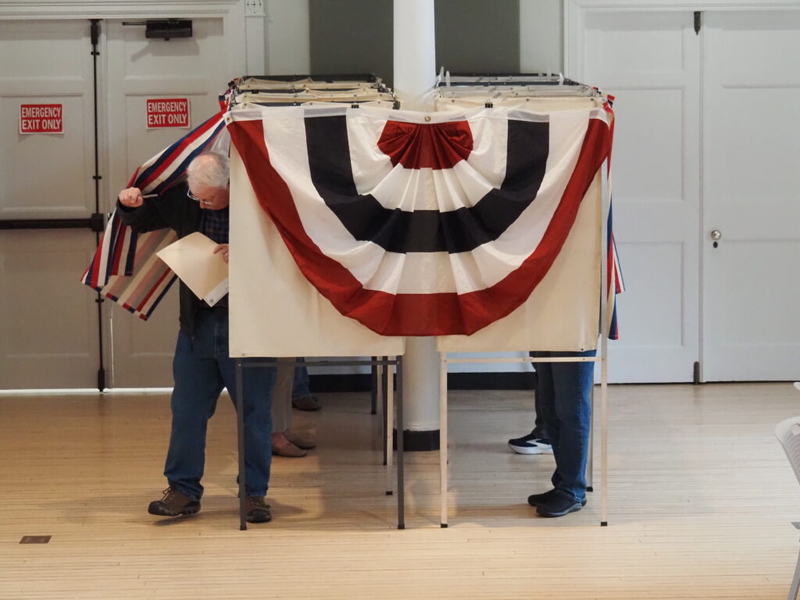
A voter emerges from a voting booth in New London during the November 2026 midterm elections. (Photo by William Skipworth/New Hampshire Bulletin)
There was a common refrain at the New Hampshire polls on Tuesday: frustration with high prices.
The issue of affordability dominated a contentious midterm election cycle marked by clashes over candidates’ relationships to President Donald Trump, the Iran war, and concern over rising costs for childcare, healthcare, groceries and more.
Amid record turnout predicted by Secretary of State David Scanlan last week, voters formed snaking lines in front of schools and city halls. At stake are control of the New Hampshire governor’s office, a U.S. Senate seat, two U.S. House of Representatives seats, and control of the New Hampshire House and Senate.
Also to be determined are two ballot measures: One to eliminate a defunct state official position and another that would cap school districts’ property taxes.
As they filed into the polls earlier today, voters from across the state outlined the concerns and goals shaping their decisions at the ballot box.
Focus on affordability
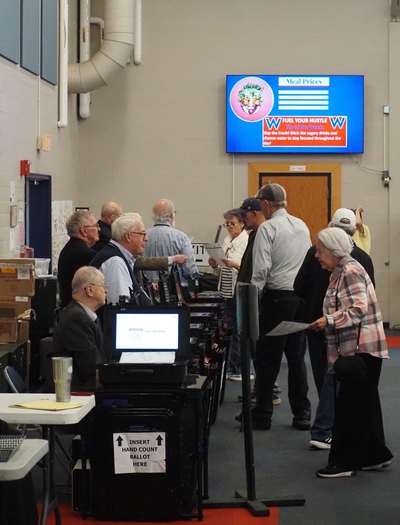
At Winnacunnet High School in Hampton on Tuesday morning, multiple voters identified affordability as the central concern driving them to the polls.
David Burns, a Democrat who said he had lived in Hampton for 25 years, said the rising prices of groceries, healthcare, insurance and gas were among his main concerns. He said he voted for all Democrats in hopes they would lower costs.
“My line of thinking is, the mansions should pay more, and you’ve got to support your schools,” he said.
Also at the polls Tuesday was Robert Gagalis, who said the economy, high taxes and housing costs were his main motivators.
“It’s always an issue,” he said.
John and Jane Romps of Manchester said that in the current economy, they were “OK.” The two retirees said they “couldn’t take any more politics” but were thinking about inflation when they were voting.
Others recognized rising prices but said it did not win them over to Democrats.
In Hooksett, Chris Babelcastro called affordability “a big concern.” But speaking of Democrats, he added: “My belief is they kind of got us into this to begin with.”
Nearby, Mike Weinman also said high prices were a problem, but he did not attribute them to a particular party. He was voting Republican to support Trump’s actions and policies against “diversity, equity and inclusion” efforts. “I think some things over this president’s tenure have changed for the positive,” he said.
Affordability was a motivator for Al Bertocci, of Tilton, who also voted Republican.
“When’s the last time any one of these clowns on either side have gone in a grocery store?” he asked.
Corruption concerns
Bertocci voted straight-ticket Republican because he believes Democrats are taking corrupt kickbacks feeding into an affordability crisis. Still, he said he was frustrated with both parties.
“I just don’t like both parties fighting constantly and getting nothing done,” he said. “They don’t do anything.”
Bertocci, 73, thinks Pappas epitomizes that.
“He hasn’t done jack s—t,” he said of the Democratic Senate candidate. He said Pappas’ husband has been a lobbyist for Uber, Amazon and other companies, but Pappas still voted on bills affecting those companies
Bertocci, a retiree who moved from Massachusetts to Danbury seven years ago and then to Tilton a year ago, said he was a Democrat “for many, many years” but said he believes the party leaders are only in it for themselves these days.
“It’s not our parents’ or grandparents’ Democratic Party anymore,” he said.
Health costs
Two years ago, Scott Stafford split his ticket the New Hampshire way: by voting for Democrats up and down the ballot but choosing Republican Kelly Ayotte for governor.
On Tuesday outside Londonderry High School, Stafford’s ballot was completely marked for Democrats, including Democrat Cinde Warmington for governor. He voted for candidates he said would support older people. Specifically: Medicare.
A Kaiser Family Foundation study found that the average Medicare Advantage beneficiary in the U.S. had a choice of 35 plans for 2027 compared to 39 plans on 2026, ahead of open enrollment in October, as insurers retreat from certain markets amid rising costs. Stafford said he had heard worries about reduced choice from many older friends this year.
“I spoke with the woman that set mine up and — pretty slim pickings here in Rockingham County,” he said. “There’s only very few choices out there this year. Last year was great.”
He added: “This year, I got to get all new doctors.”
Stafford said he isn’t precisely sure how that situation might be improved, but he expects Democrats will have a better plan than Republicans. “I had to make sure I voted all the right people,” he said.
Driven by the tax cap
Voters statewide were also asked a hyperlocal budget question. Question 2 asked voters whether they wanted a two-year tax cap on their school district that would bar school boards from proposing budgets that raise constituents’ school property taxes more than the value of inflation and any new construction in town. If adopted, the cap could be overridden by a 60% vote at the district’s annual meeting.
Should 60% or more of voters approve in any school district, the measure will pass.
Some voters said the tax cap question was an animating reason to vote Tuesday.
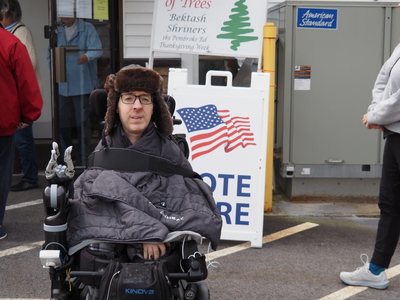
In the Concord Heights, Dan Hebert voted for a tax cap, and he said his vote was motivated by whats going on locally.
“I think every town is different,” he said.
He stressed that he respects the teachers and the work they do. However, he wants Concord School District and the state to seek other forms of revenue because of how hard property taxes hit people on fixed incomes, like himself. (Hebert receives benefits for his disability.)
“I also think that the property tax, being the only tax, is benefiting a certain group of people, ” he said. “And it’s not my people.”
Hebert usually votes absentee because his disability, which requires him to use a power wheelchair to move around, prevents him from getting into a standard voting booth. However, this year, he came in person because he saw a lot of politicians disparaging mail-in voting and was concerned his vote wouldn’t be counted.
Randy Stevens, 36, of Manchester, voted against a tax cap, even if it may impact his taxes.
Stevens has children in Manchester schools, and said that he does not “mind paying more taxes to take care of my community.”
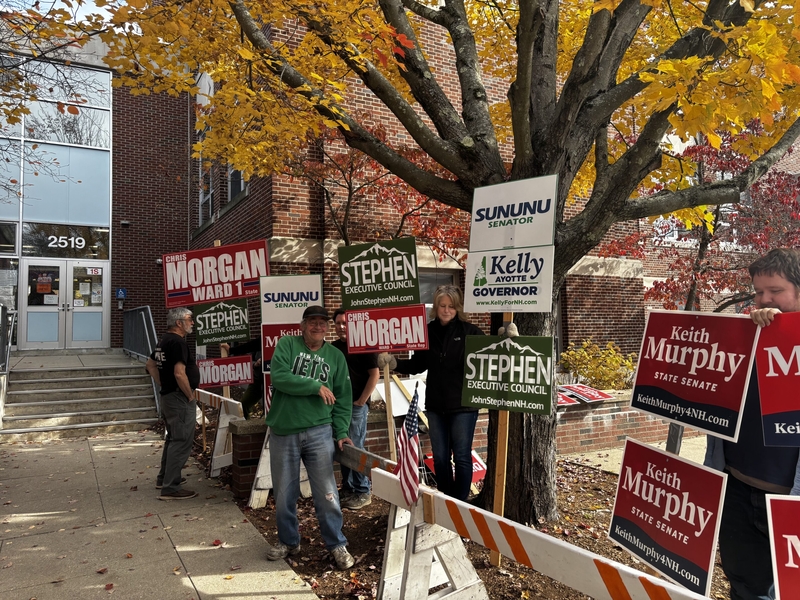
“I think it’s really important, and I also recognize that cost of living is going up for me and for everyone else, and that we have to continuously adjust and provide the level of education that our children need to be successful when they grow up and they’re adults into our community,” he said. “I really don’t know the minutia and the details. But if it means investing into my community and my educational system, I’m going to do that.”
Stevens said he always votes for candidates who “care about the people” he serves as executive director of Hope Recovery New Hampshire. He said human service problems are always top of mind when entering the voting booth.
Candidate quality
For some voters, it was more about the candidates than the issues.
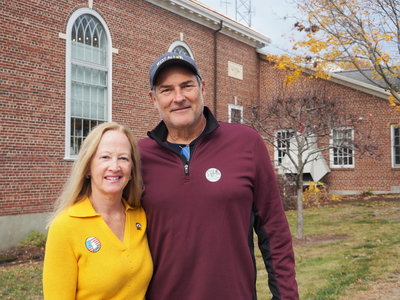
Husband and wife duo Gene, 60, and Linda Rosenthall, 63, of New London, said they both voted for Republican Gov. Kelly Ayotte to be reelected but chose Democrats Chris Pappas and Maggie Goodlander in the two congressional races.
Ayotte is counting on split-ticket voters like the Rosenthalls to bring her her first reelection victory. It’s a formula set by previous governors in the historically purple state that prides itself on independence. Her predecessor, Chris Sununu, also a Republican, swept through four consecutive elections while Democrats won in every single congressional race during that time. A September St. Anselm College poll found that 13% of voters planned to split their ballot between the two parties.
The Rosenthalls said the biggest motivators for them was putting a check on the Trump administration, which they vehemently oppose. Gene, a retired airline pilot, called the president an “embarrassment” to the country on the global stage.
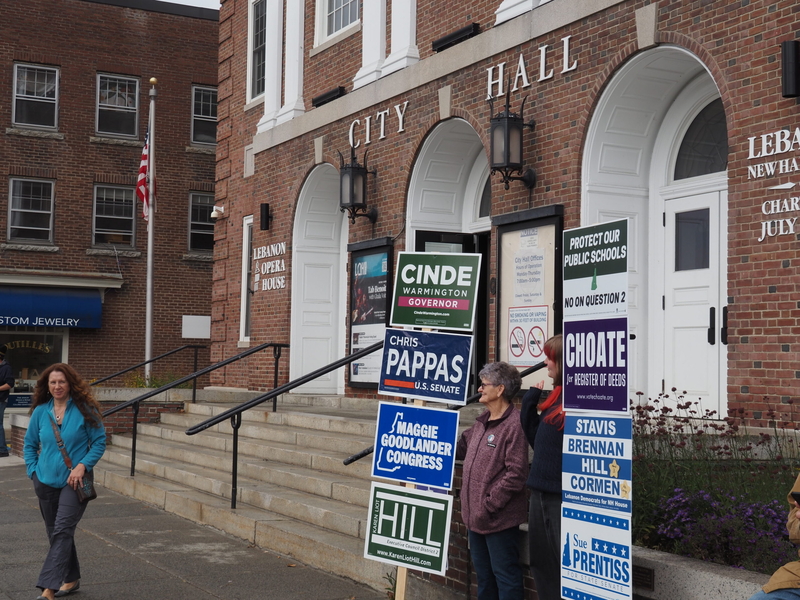
Kirk Ballard, 55, voted at Lebanon City Hall Tuesday. He said he was sad to see Jeanne Shaheen retiring instead of running for reelection, but thought that Pappas “looks like a good guy.” He voted for Warmington, he said, because “I’m never going to vote for a Republican governor.”
He had a unique motivation behind some of his local votes. For county sheriff, Ballard wrote in his own name as a protest vote.
“Because I was arrested on, what I would call, in my opinion, from my perspective, an illegitimate domestic dispute charge, and I was sent to the Grafton County jail for two months without bail,” Ballard said. “… I don’t agree with the way the Corrections Department works. I don’t believe in the way that the police department, here at least, responded.”
Other voters brought personal experience into the Pappas-Sununu contests.
Andy Desrosiers was a teacher at Salem High School when John E. Sununu and his siblings attended. “Comes from a great family,” Desrosiers said outside the polls in Windham.
When Gov. Chris Sununu was on the ballot for eight years, Desrosiers voted for him.
But that goodwill didn’t earn John Sununu Desrosiers’ vote Tuesday. Frustrated by a litany of decisions by President Donald Trump, from attacking Iran to imposing military-style crackdowns on undocumented people, Desrosiers is voting for change, and John Sununu was not the candidate to bring it, he said.
John Sununu’s opposition to abortion — he voted for multiple federal abortion restriction bills from 2002 to 2008 and earned a 100% rating from the National Right to Life Committee in 2006 — was also a dealbreaker for Desrosiers.
As he talked, Denise Dolloff came up beside Desrosiers. “My former student!” Desrosiers said.
Dolloff knows John Sununu too; she was his classmate at Salem High. And on Tuesday, she voted for him.
“Christine was my sister’s closest friend in high school. And I think Peter worked for my parents for their business when he was a teenager,” Dolloff said, naming two other Sununu siblings. “There was a Sununu for almost every grade at one point in time,” she added.
While she and John Sununu live in different towns today, he gives her a hug every time she sees him, Dolloff says. “He never forgot his roots,” she said. “He came to an event last St. Patrick’s Day in Salem and he went around shaking hands and remembering so many people’s names.”
And while he differs from his brother Chris — such as not being as comfortable on camera — there’s a hardworking, earnest side to John that might not translate in an interview, she said. Dolloff, a Trump supporter, argued it would allow him to separate himself from the president when needed.
Desrosiers was less sure.
“Right now, his association with anything Trump would give me a reason to not vote for him,” he said.
Concord, NH