Advocates press governor to sign remaining immigrant-protection bills
May 19, 2026 | 5:00 am ET
Description
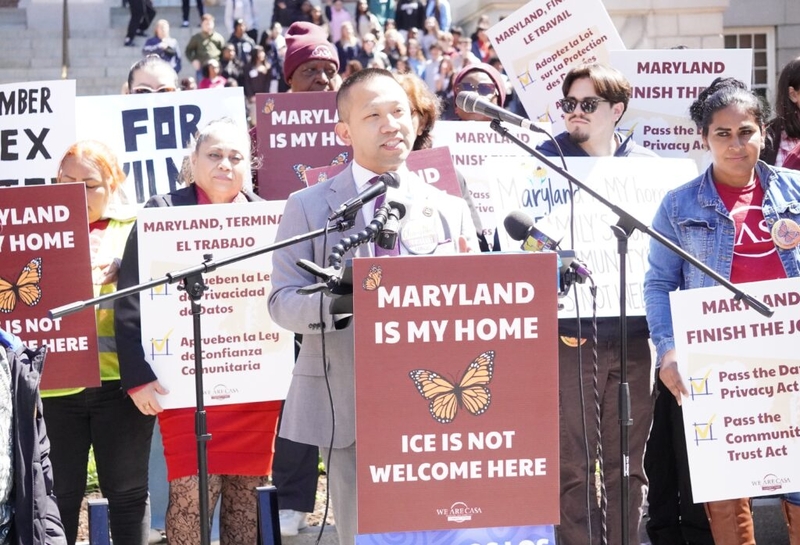
Sen. Clarence Lam (D-Anne Arundel and Howard) speaks at an April 8 rally in Annapolis in support of immigrant protection bills. (Photo by William J. Ford/Maryland Matters)
Two dozen immigrant advocacy and civil rights groups wrote to Gov. Wes Moore (D) Monday, urging him to sign two major immigrant protection bills that passed on the final day of the 2026 legislative session.
The Community Trust Act and the Data Privacy Act were priorities for immigrant advocacy groups during the session, but remain unsigned as the last scheduled bill signing of the year approaches next week.
Several other immigrant protection bills from the session — doing away with 287(g) agreements and making it harder to place immigrant detention centers in the state — have already been signed into law. But the two remaining bills “represent two essential next steps toward fully protecting Maryland residents,” says the letter, organized by the immigrant advocacy group We Are CASA.
“Just as advocates and families across the country have looked to states like Illinois and California for leadership, many are now looking to Maryland to help set the standard,” the letter says. “We urge you to continue leading Maryland — and the nation — by signing these bills into law.”
The governor’s office did not respond to a request for comment Monday on the status of the bills.
Despite threats, Maryland sheriffs quickly dropped 287(g) agreements with ICE
The Community Trust Act, sponsored by Sen. Clarence Lam (D-Anne Arundel and Howard), is an emergency measure that would prohibit local or state police from holding a person for U.S. Immigration and Customs Enforcement, except in limited scenarios: If a person was convicted of a felony in the United States; is a registered sex offender; served 12 to 18 months in a state prison; or committed an offense in another state and served at least five years in prison.
A major part of the bill prohibits the use of administrative warrants from ICE to hold a person. Under the law, local officials would only be obligated to recognize a judicial warrant.
The Community Trust Act is considered a complement to the emergency bill passed and signed early in the legislative session that banned the so-called 287(g) agreements between ICE and local law enforcement agencies.
“The Community Trust Act really is the critical bookend to the 287(g) ban by closing a loophole that became glaringly apparent after that was signed into law because of some of the statements local sheriffs were making,” Lam said. “We really did need to pass that to ensure that our local jails and law enforcement were not using informal communications to serve as an opening for ICE to be able to exploit.”
Some of the nine sheriffs in Maryland with 287(g) agreements had indicated they might continue cooperating with ICE on an informal basis, or that might challenge the law, but all nine ended up dropping their agreements after the bill became law.
The sheriffs are reportedly assessing legal advice on whether the Community Trust Act would hamper their ability to communicate with federal officials and which might force them to adhere to conflicting federal and state laws. Sheriffs such as Brian Albert in Washington County have said they hope the governor will veto the Community Trust Act.
The Data Privacy Act, sponsored by Del. Lorig Charkoudian (D-Montgomery), seeks to close loopholes in the state’s Public Information Act to prohibit a business from selling personal data of an individual “for the purpose of immigration enforcement.” Lam also sponsored the Senate version of the Data Privacy Act, which got approved in the Senate but not in the House.
More than 100 witnesses testified on the House version of the bill, the vast majority in support. But opponents worried that the bill could weaken the Public Information Act, and would make state officials liable for determining whether a request for information was for the purpose of immigration enforcement or not.
“Together, this legislative package delivers a powerful one-two punch: Restoring trust between communities and law enforcement while shutting down the data pipelines being abused to target immigrant families,” said a We Are CASA press release that accompanied the letter.
The Community Trust Act is an emergency measure that would take effect when signed. The Data Privacy Act would go into effect July 1 if signed into law.
“Obviously, these bills are important. We want them signed,” Lam said Monday.
According to state rules, most bills passed by the General Assembly must be presented to the governor within 20 days following adjournment, which this year was April 13. The governor has 30 days after that to veto a bill, sign it, or let it take effect without his signature.
Albert said Friday that if the governor lets the bill become law without his signature, it would go into effect by June 3.
“We are exploring some legal actions,” he said. “We are in a no-win situation.”
Annapolis, MD