Abortion rights advocates condemn Arizona GOP for undermining 2024 voter mandate
Feb 16, 2026 | 10:43 am ET
Description
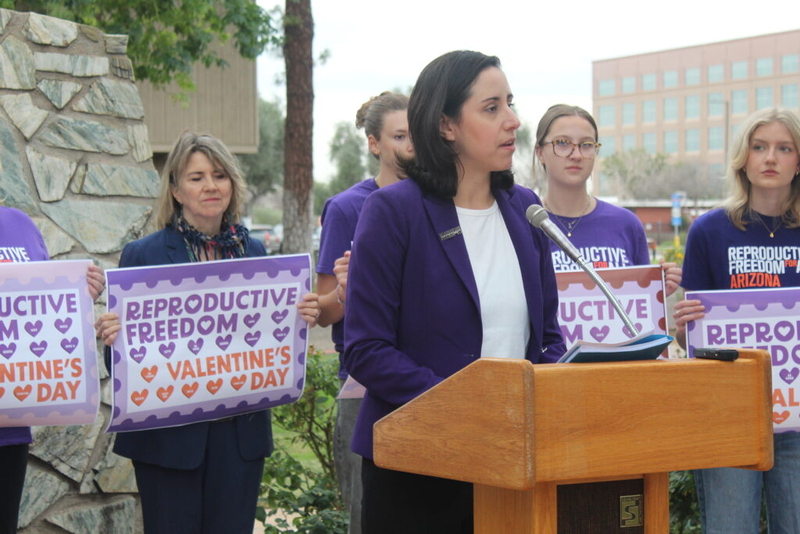
Athena Salman, the head of the Arizona branch of Reproductive Freedom for All, denounced the continued hostility toward reproductive rights from Republican lawmakers at a Feb. 13, 2026, press conference. (Photo by Gloria Rebecca Gomez/Arizona Mirror)
Days away from a legislative deadline by which bills must be heard or risk dying without ever being considered, Democratic lawmakers in Arizona are urging Republicans to respect the voter mandate issued in 2024 and support proposals that protect abortion access.
Those pleas are likely to continue being ignored.
For decades, the GOP-controlled state legislature has worked to restrict the ability of women to obtain the procedure. And that hasn’t changed in the two years since Arizona voters agreed to enshrine abortion in the state constitution as a fundamental right. In 2024, an overwhelming 62% of voters approved Proposition 139, which explicitly forbids the state from enacting any law that interferes with abortion access, with very limited exceptions for laws meant to preserve a woman’s health.
But Republican lawmakers have remained undeterred in their efforts to hinder access to the procedure, proposing legislation this year that would bestow personhood on fetuses by granting “preborn children” a right to child support — effectively banning all abortions — and potentially criminalizing both doctors and women by making the killing of an “unborn child” punishable with death or life imprisonment. Still other GOP bills make it impossible for doctors to talk about abortion with their patients or seek to drastically narrow access to abortion drugs.
Athena Salman, the head of the Arizona branch of Reproductive Freedom for All, denounced the continued hostility from Republican lawmakers. She accused them of undermining the wishes of their own constituents, noting that Prop. 139 won a plurality of voters in every legislative district, even deep red ones.
“In 2024, Prop. 139 got the most votes on the ballot,” Salman said, during a Feb. 13 news conference at the state Capitol. “It got more votes than any statewide candidate or any other proposition and won every single legislative district in the state. It got the most ‘yes’ votes in Arizona history. Yet Republican politicians at the capitol are refusing to accept that reality. They are blatantly ignoring the will of the people.”
Salman added that Arizonans are facing attacks on the procedure from both the state and federal levels. The state’s Republican congressional delegation has similarly supported national efforts to ban the procedure outright and continued to oppose it even after the passage of Prop. 139. Salman said the most effective way to protect abortion access and reproductive health care is changing the makeup of the state legislature.
“As Donald Trump and Andy Biggs and David Schwiekert and all their MAGA cronies keep attacking reproductive care and affordable healthcare at the federal level, the elected officials in state government representing our communities matter more than ever,” she said. “We need a reproductive freedom majority in the legislature not just to block the anti-abortion movement’s extreme and unpopular agenda but to advance the legislation that…would guarantee reproductive freedom for generations to come.”
In stark contrast to Republican efforts, Democratic lawmakers in Arizona have proposed legislation that would repeal dozens of abortion restrictions that remain in state law, including a ban on mailing the abortion pill, a law prohibiting the use of telehealth during consultations and medication abortions and another that requires doctors to delay procedures for at least 24 hours, forcing women to make multi-day trips for a procedure that, in most cases, can be carried out in one. Several of those laws are the subject of an ongoing lawsuit from reproductive rights groups that recently won a ruling declaring them unconstitutional in the wake of Prop. 139. That victory is likely to see an appeal from abortion foes. A repeal from lawmakers would eliminate the need for a drawn out court battle.
Republicans, who chair legislative committees and decide which bills move forward, have yet to grant any of the repeal bills a hearing. And with a Feb. 20 deadline for bills to be considered quickly approaching, it’s likely the proposals will die without ever being considered. Rep. Stephanie Stahl Hamilton, D-Tucson, said that she and her colleagues have repeatedly reminded Republicans that voters want the restrictions removed from the books and access to abortion protected, not restricted. But those reminders have largely gone ignored.
“We say it again and again,” she said. “Evidently, they’re not tired of hearing it enough because they continue to bring these (anti-abortion) bills forward.“
Stahl Hamilton pointed out that many Democratic proposals aimed at eliminating restrictions or broadening access have been assigned to multiple legislative committees — a legislative death knell. Scheduling multiple hearings for a single piece of legislation alone is an uphill endeavor, let alone winning the approval of more than one committee. One of Stahl Hamilton’s bills, which aims to prevent prisons from inducing the labor of incarcerated pregnant women without their consent, was assigned to the House Appropriations Committee along with the House Public Safety and Law Enforcement Committee, despite not including any appropriation that needs to be debated.
Ashley Ortiz called on Republicans to obey the voter mandate in Prop. 139 and stop pushing laws that she warned only harm women. Ortiz suffered an unviable pregnancy in late 2023, when the state’s 15-week abortion ban was still the law of the land. The ban prohibited abortions after its gestational deadline unless a woman was facing death or significant bodily impairment. That law was struck down in 2025. But at the time, Ortiz was unable to receive an abortion when she went into pre-term labor at 20 weeks. Her doctors would have faced a prison term of up to two years. Instead, Ortiz was hospitalized and made to wait until the fetus’ heartbeat stopped or her condition became fatal.
“I lay in that hospital bed for days before the heart stopped,” she said. “I was fearing for my life, for my future, for my future fertility, for my family. I was not allowed to make a decision for my medical care. My doctor was not allowed to make a decision to help me.”
The delay caused significant medical complications that forced doctors to perform an emergency surgery. Ortiz lambasted Republican lawmakers for continuing to try to make it harder for women to receive critical health care and said they should listen to the directives in Prop. 139.
“My suffering was preventable,” she said. “If Arizona politicians had not chosen to override my doctors, I would have had access to basic medical care.”
Salman said her Reproductive Freedom for All is preparing to educate voters ahead of the November election to ensure Democrats are elected up and down the ballot so that the next legislative session might see some movement on proposals that protect abortion. The group is especially focused on highlighting the disparity between the state’s gubernatorial candidates and targeting competitive congressional districts. Gov. Katie Hobbs, who has long advocated for abortion access, is seeking reelection. The Republican candidates vying for the chance to challenge her are U.S. Reps. David Schwiekert and Andy Biggs. The two have previously supported federal legislation that would ban abortions nationwide.
“There’s going to be a lot of accountability work,” Salman said.
It remains unclear how mobilizing abortion is for voters, however, when it comes to down ballot races. While Prop. 139 won a resounding victory in 2024 and both Hobbs and Arizona Attorney General Kris Mayes successfully centered their campaigns around their support for abortion in 2022, all three did under the shadow of the state’s near-total abortion ban. And the same year that Prop. 139 netted overwhelming approval from voters, Republicans in the state legislature expanded their majority. Political analysts in 2024 were quick to point out that abortion wasn’t the rallying issue that Democrats were counting on it to be.
But reproductive rights advocates and Democrats in Arizona remain confident that it will make a difference in November, especially in close races. Salman emphasized that voters in every legislative district in 2024 were in favor of protecting access to abortion, a stark contrast to how Republicans in the state legislature have been acting.
Sen. Priya Sundareshan, D-Tucson, the Democratic party’s leader in the upper chamber, added that President Donald Trump and Republicans successfully confused voters about their positions on abortion two years ago, but that’s no longer the case. Voters, she said, are well aware of how Republicans have sought to undermine their right to the procedure since then.
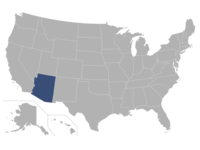
Phoenix, AZ