Gov. Shapiro signs $50.8 billion compromise budget, despite some opposition in both parties
Jul 12, 2026 | 5:12 pm ET
Description
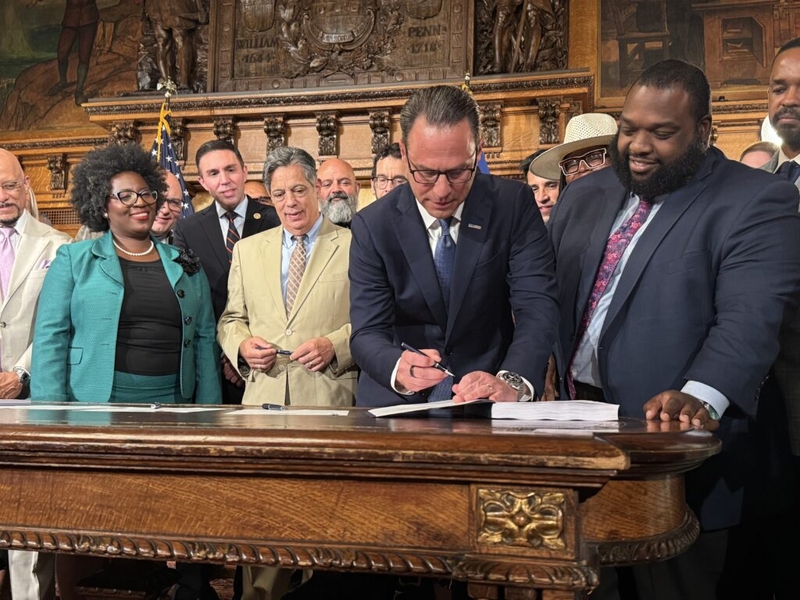
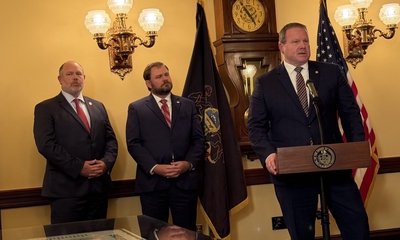
Gov. Josh Shapiro signs the 2026-2027 state budget as members of the General Assembly watch Sunday, July 12, 2026. (Photo by Ian Karbal/Capital-Star)
*This story was updated at 6:54 p.m. on July 12, 2026.*
Gov. Josh Shapiro signed a package of bills into law enacting a $50.8 billion state budget for the next year. The spending plan was approved by the state House and Senate earlier Sunday afternoon with only a handful of opposing votes.
“I knew there would have to be compromises in a divided government,” Shapiro said. “There’s a lot more work to do, but once again we’ve proven that here in Pennsylvania we can bring people together to solve problems, to get stuff done, and to build on this foundation that we’ve laid.”
The budget spends roughly $2.4 billion less than Shapiro asked for in his February address, and excludes a number of policies he requested to bring in new revenue, like legalizing recreational cannabis and regulating skill games.
It contains more than $920 million in new state funding for public education spending and will institute new energy policies and a long-sought increase to the pensions of teachers who retired before 2001. But many other policy changes and new revenue streams sought by Democrats and Republicans alike have been omitted.
Legislative leaders from both sides of the aisle described the package of bills that comprises the budget as a product of compromise, with Democrats and Republicans acknowledging concessions. The theme was driven home as three separate senators quoted the Rolling Stones’ song “You Can’t Always Get What You Want” in floor speeches.
“There are things that I think we all can recognize as being very positive, but I’m also sure that there’s things in here that some of us would prefer not be in it, and that would be coming from both sides of the aisle,” said Senate Appropriations Chairman Scott Martin (R-Lancaster), who played a key role in negotiations.
House Speaker Joanna McClinton (D-Philadelphia) said she’s proud to have steered a bipartisan budget with no tax increase that makes substantial investments in schools, public safety, health care and affordable housing.
In addition to the third installment of $565 million to fund public schools more equitably, the budget would strengthen school safety, expand career and technical education and provide free breakfast to students across the state, McClinton noted.
“At a time when federal actions have made life more difficult through deep program cuts and policies that have driven up costs, in Pennsylvania we continue to deliver for every family, senior, and child,” she said.
There were also defectors in both parties. Progressive Sens. Katie Muth (D-Montgomery) and Nikil Saval (D-Philadelphia) voted against the general appropriations bill. Both acknowledged positive aspects of the proposal, but said it failed to address important policy questions like how Pennsylvania will bring in new revenue, or address issues like public transportation and affordable housing.
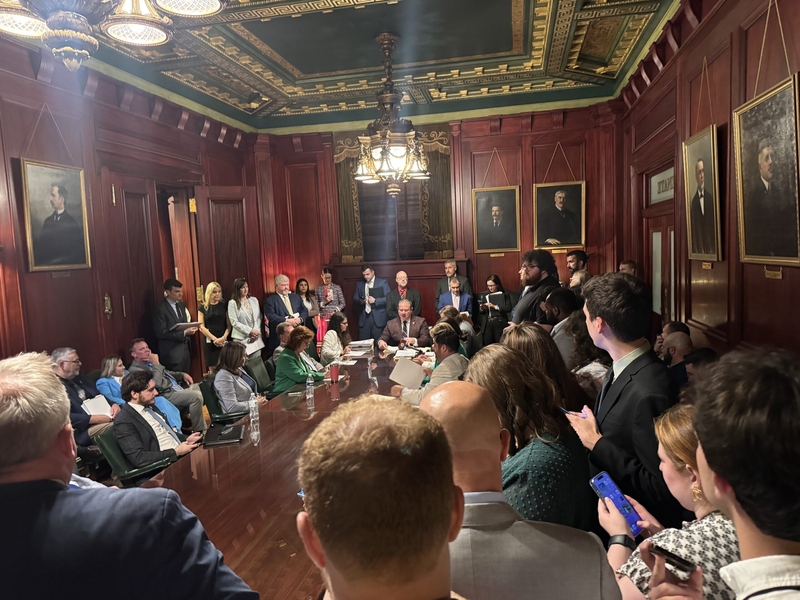
“I want to recognize that there is major progress that is made in this budget,” said Saval. “At the same time, I still feel that this budget marks time when we should be devoting ourselves to the full spectrum of issues that our constituents are suffering from at this moment.”
Muth criticized the compromise for failing to address the state’s structural deficit, and pushed for a digital advertising tax on some of the nation’s largest companies alongside a skill games tax.
“If we had pursued proposals in this chamber, we would have more to work with,” she said. “And we would not have to pass another mostly flat-funded and cost-to-carry budget.”
None of the four Republican Senators who voted against the general appropriations bill, Sens. Doug Mastriano (R-Franklin), Dawn Keefer (R-York) and Scott Hutchinson (R-Venango) and Jarrett Coleman (R-Lehigh) spoke on the measure.
In the House, Rep. Brad Roae (R-Crawford) called the spending plan “very terribly irresponsible” and warned that its relatively low price tag obscures looming debts by deferring some payments to later years.
Though the current measure doesn’t dip into the nearly $8 billion rainy day fund, he worried that the state was simply “postponing spending” into a future budget.
“We are going to spend the rainy day fund, whether we spend it this year or … (if) we spend it in a couple years from now,” continued Roae. “There is going to be a tax increase if this budget bill becomes law.”
He was one of 35 Republican House members to vote against the general appropriations bill. The measure was supported by every Democrat in the chamber.
Energy compromise
Energy affordability and hyperscale data center development have been at the forefront of policymaking debate this session, driven by double digit jumps in electricity bills and dozens of data center proposals across the state.
Lawmakers proposed multiple versions of bills that would give local government officials time to update land use ordinances by giving them the option of pausing new applications to build data centers. None have been approved by both chambers so far.
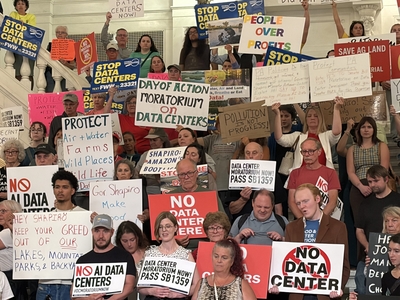
Also left on the table in the Senate was Shapiro’s plan to incentivize data center builders to meet benchmarks for energy procurement, community engagement, workforce development and environmental protection.
While the bill passed the House with strong bipartisan support, it did not receive consideration in the Senate.
The budget does incorporate a handful of measures that aim to improve transparency of the commonwealth’s electricity market and accountability for big tech companies with data centers in the state..
Some energy experts have claimed speculative plans for data centers are responsible for rising costs. Lawmakers responded by passing legislation that requires PJM Interconnection to share its forecasting information with state regulators. That language was added to the state’s fiscal code, which amounts to instructions for state agencies to carry out their duties.
The code also includes legislation that requires data centers that use more than 10 megawatts of electricity to report their power and water consumption to the state Department of Environmental Protection.
It also has language requiring electric utilities to assess whether “advanced transmission technologies” could be deployed to maximize the capacity of existing power lines before receiving approval to build new ones.
With data center developers looking to Pennsylvania’s abundant natural gas supply to power their facilities, the code bill also includes language that updates the regulatory framework for natural gas drilling.
The legislation’s prime sponsor, Senate Environmental Resources and Energy Committee Chairman Gene Yaw (R-Lycoming) said it would allow development of natural gas resources in the Utica Shale formation, which lies deeper than the Marcellus formation, the primary focus of gas extraction for the last two decades.
Yaw’s legislation requiring gas producers to fully plug wells with cement before abandoning them is also included in the Fiscal Code.
Passed separately, legislation that would make building a new class of nuclear power plants possible is headed to Shapiro’s desk. House Bill 2017 gives the DEP the discretion to charge lower fees for smaller, safer and faster to build small modular reactors and micro reactors.
Both chambers have also approved Yaw’s plan establishing financial accountability requirements to ensure the owners of solar energy facilities can’t walk away without restoring the land.
More education spending details
The bill to fund Pennsylvania’s hundreds of school districts — including public, charter and cyber charter options — alongside community colleges and trade school programs, was criticized for sending money to underperforming schools. But, it passed the Senate on a 45-5 vote.
“Over the past 10 years, Allentown School District, a district that I represent, has received almost $100 million in additional funding and during that same time period, their performance only gets worse,” said Sen. Jarrett Coleman (R-Lehigh). “Yet, we’re sending them even more money, even more rewards for that declining performance.”
Allentown was among the dozens/hundreds of school districts to receive extra dollars, known as adequacy funding, after the Commonwealth Court ruled in 2023 that the state funded schools unfairly to the tune of $4.5 billion.
Senate Minority Leader Jay Costa (D-Allegheny) defended the decision to devote another $565 million toward adequacy funding, which he said reversed years of “historic underfunding.”
That money “(allows) those school districts that were struggling to lift themselves up. Lift themselves up to be able to provide the education experience for the students that was necessary and adequate and equal and fair across this commonwealth,” continued Costa.
Sen. Nick Miller (D-Lehigh) previously served on the Allentown School Board and described challenges with 150-year-old buildings “filled” with lead and asbestos without air conditioning.
“We know the impact that that has on a child’s success rate,” added Miller. “These kids deserve this investment. They deserve the opportunity to be successful with programs that prepare them for the workforce of tomorrow.”
Four other senators, all Republicans, voted against the proposal: Keefer, Hutchinson, Mastriano and Pat Stefano, of Fayette County.
There was no discussion in the House chamber.
The school code compromise also contained several cyber charter policy reforms that build on and refine major legislative action from the 2025 budget. While Shapiro initially proposed a $75 million funding adjustment for cyber charters, no new funding cuts are in the final version.
Small cyber charter leaders in Pa. raise alarm over calls for funding reform
Cyber charter leaders previously expressed concerns over last year’s cuts, saying any further changes to their funding would be difficult to overcome, especially for smaller schools.
Last year’s budget also required families with students enrolled in cyber charters to provide proof of residency twice a year. This year’s school code reduces that to an annual requirement, aligning with proposals introduced by Coleman and Rep. Joe D’Orsie (R-York).
This year’s update mandates weekly wellness checks for cyber charter students, requiring students to be visible on camera and communicating with a teacher, administrator, or school district representative.
In addition, the code doubles down on preventing habitually truant students from enrolling in cyber charter schools, a policy first enacted last year. With this year’s update, cyber charters will no longer receive payments from school districts for going against state policy and enrolling habitually truant students.
Cyber charters typically receive tuition payments directly from school districts for each student they enroll.
The code outlines new procedures for “educational best interest” hearings for truant students who wish to transfer, during which a judge will consider academic performance, student safety, disciplinary history, and chances of success when deciding if a student may enroll in a cyber charter.
Republican lawmakers and cyber charter leaders have said blocking truant students from enrolling in cyber charters limits families’ access to school choice.
What’s not in the deal
Missing from the budget were a number of policies sought by Shapiro, such as a $1 billion “critical infrastructure fund” for housing, energy and school projects funded by general obligation bonds, and a proposal to raise the state’s minimum wage to $15.
In his February budget address, Shapiro also asked lawmakers to tax and legalize recreational marijuana and slot machine-like skill games, which he said could bring in millions in new revenue. Neither measure was included in the agreement.
“I think at the end of the day, there are people on both sides of this building that need to make a determination on what they want to do on skill games,” Harris told reporters Saturday. “We stand ready, willing and able to discuss that issue.”
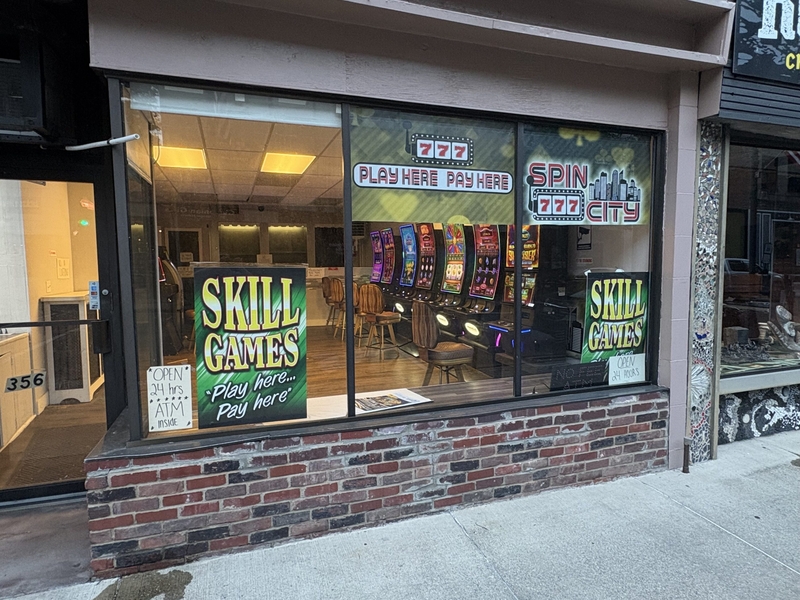
Senate Majority Leader Joe Pittman (R-Indiana) said his caucus was “open to a regulated marketplace,” but that it wasn’t a priority during weekend negotiations.
“These are slot machines and, if nothing else, they have to be combined with some sort of age-restricted environment,” added Pittman, noting that the legislature can still act after the deadline. “These machines are illegal and in less than 120 days, they will be leaving the marketplace.”
Lawmakers were unable to agree on new sentencing guidelines for second degree murder after the Pennsylvania Supreme Court ruled the existing law requiring mandatory life sentences was unconstitutional. Unless a measure is passed by July 24, the courts will have to decide how to resentence 1,100 people currently serving life sentences on second degree murder charges without legislative input.
Shapiro said he worked with lawmakers in the days before the budget was passed in an attempt to bridge the gap between Senate Republicans, who pushed to institute a 35-year minimum sentence in most second degree murder cases, and House Democrats who wanted to allow judges to be more lenient.
“We’re gonna continue to work on this issue,” Shapiro said. “I’m hopeful that we can get there.”
Democrats also failed to secure a new tax they sought on digital advertisers, which would be levied from major companies like Meta and Google. They estimated the proposal could bring in $500 million annually.
Republicans ultimately agreed to boost state education spending without restructuring the school district funding formulas, which a number of members had pushed for.
The budget also doesn’t address public transit funding. The issue was central to last year’s spending negotiations, and was resolved when lawmakers passed a two year stopgap measure. But transit advocates have warned a more permanent solution is necessary.
Despite the budget failing to address a number of legislative priorities of the governor and legislative leaders, it was passed only a week and a half after the deadline set by the state’s constitution.
That’s a major improvement over last year, when a spending plan wasn’t agreed to until November.
How the remaining policy fights play out in the future will likely be determined by the outcome of November’s election, where Democrats hope to flip enough seats in the Senate to take a majority in both chambers.
Issues like whether to legalize recreational cannabis and how to regulate hyperscale data centers have also already become central to the gubernatorial election, where Shapiro faces a challenge from Republican Treasurer Stacy Garrity.
Harrisburg, PA