Iowa professor teaches paper making art with international recognition
Nov 27, 2026 | 10:00 am ET
Description
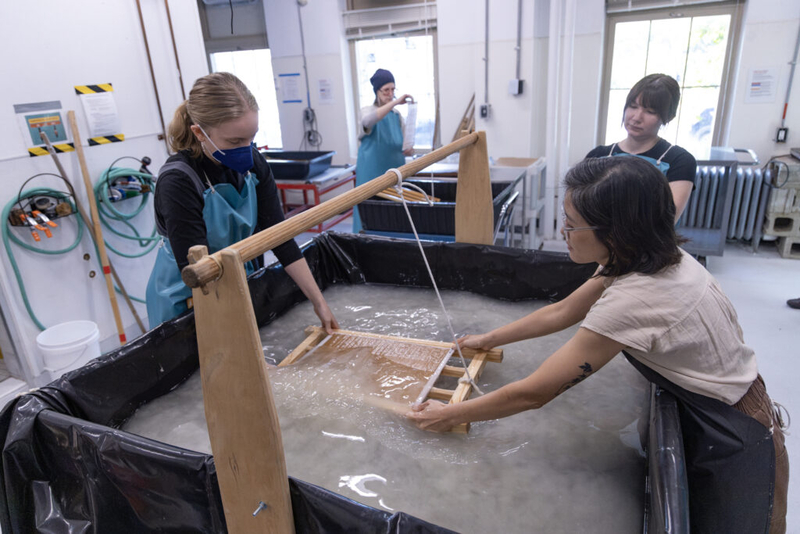
University of Iowa Center for the Book Assistant Professor Steph Rue teaches papermaking at North Hall during a visit from Korea Educational Broadcasting System. (Photo courtesy of University of Iowa)
International cultural recognition is pending for a traditional form of Korean paper making — and the University of Iowa is the only U.S. institution to teach about the craft at the master’s degree level.
Steph Rue, an assistant professor and artist at the UI’s Center for the Book, received her master’s of fine arts from the center in 2015, during which she earned a Fulbright scholarship. She spent time after graduation in Korea learning about hanji, a traditional Korean paper made from the bark of a mulberry tree.
UNESCO, also known as the United Nations Educational, Scientific and Cultural Organization, is reviewing hanji as a potential new addition to its list of “the Intangible Cultural Heritage of Humanity,” which the organization describes online as including arts, knowledge and practices inherited from ancestors and passed down to their descendants into the contemporary age.
Rue said that recognition for the craft will help support those who create the tools for it.
Originally from Sacramento, where she completed her undergraduate education, Rue said she already had some knowledge from a mentor about hanji before coming to the UI, which according to the university houses the only master’s degree program in the UI with coursework on the practice.
“Coming to Iowa seemed like a natural next step in wanting to learn more about papermaking in general and just the craft, but also was a great place for me to deepen my exploration in Korean papermaking,” Rue said.
Hanji is made with the inner bark of mulberry trees, in a process that involves dipping a bamboo screen side-to-side into a slurry made of the materials to weave the fibers together and make a single sheet. Hanji Edition, founded by Rue and fellow Korean American printmaker Lars Kim, details the process and produces art books and other products with the goal of introducing people to hanji as a base for print and other art forms.
Appreciation seems to be growing for hanji both in Korea and abroad, Rue said, and the industry has done well in finding different uses for the material and supporting the next generation of hanji makers. Hanji Edition lists the paper’s uses as for art, interior decorations and common household objects. Hanji can also become waterproof when coated with wild sesame oil or be woven into textiles for fabric, clothes and shoes.
However, those handling the “hard labor of keeping this industry alive” are still having a difficult time. Rue said there is only one person left in Korea weaving bamboo screens for hanji and she is over 80 years old. The woman’s husband used to be the “intangible cultural property holder” for the screen making process, Rue said, but he died a few years ago.
Dak, or paper mulberry, tree conservation is also an expensive and laborious practice, Rue said, and many hanji producers are now importing fibers from outside the country.
“I don’t think it’s dying, I think it’s evolving, but I also feel like there could be a lot more support for some of those more vulnerable parts of the industry,” Rue said.
Rue said she hopes the UNESCO nomination and potential designation will help drive support to those areas of vulnerability to keep the art form in its entirety alive and thriving.
The artist attributes much of her understanding and appreciation of craft in general to the Center for the Book, calling the UI program “really special.” It’s also becoming increasingly rare, as the five other MFA-granting book art programs in the U.S. that existed when she started at the UI has now shrunk down to two.
The Center for the Book has been “thriving,” Rue said, in large part due to the support for the arts, writing and books that the UI and Iowa City has provided. She said she hopes that this continues and students like her will keep enrolling, finding their passions and taking them on their journeys after graduation.
“Making things by hand, understanding where we come from and what our traditions are, why we did things the way that we did and how they tie us to our place and land and plants and nature and other people around us, I think that’s what makes us human, and that’s what makes it worth living,” Rue said. “And I think things like art and culture are so vital to why we exist as people.”
Des Moines, IA