SC colleges’ $2.2B in requests include defense, nuclear and cancer facilities
Nov 27, 2026 | 7:00 am ET
Description
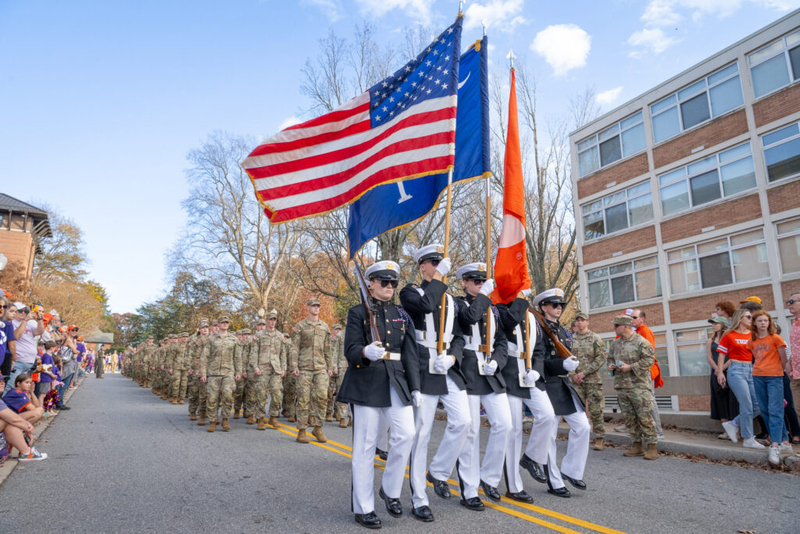
Clemson University's ROTC units parade during the schools annual Military Appreciation Game day. (Photo courtesy of Clemson University)
COLUMBIA — A new national security research center, a nuclear workforce training center and more money for a top-tier cancer hospital are among items on South Carolina colleges’ budget wish lists for the coming year.
In all, public colleges, including the state’s 16 technical schools, are seeking nearly $2.2 billion in additional state aid from taxpayers for the fiscal year starting July 1, according to a review of budget requests posted online.
Agency requests are rarely fully funded. The governor’s office and legislators use them to draft their budget plans.
The state’s three large research universities account for almost half of public colleges’ total ask, with Clemson University leading in dollars requested.
Money for defense and military programs
The Upstate school wants $368.7 million total, including $110 million to build a national security focused center on its acclaimed automotive research campus and $14 million more annually to run it.
The money would build a home for the center formed in March.
“The investments would give Clemson the facilities and talent to pursue larger federal and industry research partnerships and help more students enter South Carolina’s aerospace and defense workforce,” spokesman Joe Galbraith said.
The 65,000-square-foot building would include laboratories, offices, meeting rooms and incubator space for defense-related startups. Plus, there are plans for an outdoor test space for unmanned vehicles and aircraft.
Establishing a National Security Institute at Clemson University reflects the school’s “rising relevance to national security priorities and its capacity to serve as a strategic partner to the federal government, the armed services and the defense industry,” according to a statement from the college.
Clemson touts already having an annual federal research portfolio of more than $30 million with the Department of Defense.
And it boasts proximity to Lockheed Martin, located 40 miles away in Greenville, which builds F-16s for the international market.
Clemson’s new center will focus on developing materials that can stand up to harsh conditions, such as high-speed flight and fibers for high-powered lasers, as well as artificial intelligence.
Clemson also wants $42.5 million for a new combined ROTC center.
Most of that — $37.5 million — would renovate Holtzendorff Hall, which dates to 1915 and is located on the historic parade ground where the former, all-male military colleges’ corps of cadets drilled. The remaining $5 million would be annual dollars to pay for staff and programming.
The renovation would bring Clemson’s separate ROTC centers for various military branches under one roof. The hall would have classrooms and offices, as well as simulators for tactical training.
Going nuclear
Meanwhile, in the Midlands, the University of South Carolina is seeking $336.7 million in funding for its main Columbia campus.
That includes more than $100 million for a previously announced center to train a workforce for the nuclear power industry, should White House-led efforts to build more nuclear power plants across the country come to fruition.
USC, Westinghouse sign agreement for nuclear workforce training center
The school also wants $75 million to move its pharmacy school onto its new downtown medical campus.
Across the entire USC system, requests total $550 million. Larger projects at the system’s six other campuses include a $60 million expansion for nursing schools in Aiken, Beaufort and Spartanburg, as well as a $20 million marine and environmental science center in Beaufort.
And USC and Clemson, as well as South Carolina State University, are again asking legislators to pump more money into a workforce development partnership with South Carolina’s federal nuclear laboratory. The three schools are jointly seeking another $40 million, with $16 million each for USC and Clemson and $8 million for SC State.
The Legislature last funded the so-called Battelle Alliance at the Savannah River National Laboratory with $40 million in the budget year that started July 1, 2023.
Cancer treatment and rural health
In the Lowcountry, the Medical University of South Carolina is returning to the General Assembly to ask for another $175 million to put toward its proposed $1 billion cancer hospital.
The Legislature approved the first $175 million of the state-owned medical school and hospital system’s request in the current budget. Now hospital administrators are looking for the second half of its request from last year.
MUSC is chasing a Comprehensive Cancer Center designation from the National Cancer Institute.
If approved, the center would be the first of its kind in South Carolina.
Patients seeking this top level of care currently must travel out of state to centers in North Carolina, Georgia and Tennessee.
The hospital system also is seeking $10 million to take its cancer treatment efforts into more far-flung parts of the state.
“A key priority is expanding access to cellular therapy across the state, especially in rural communities. These personalized, targeted treatments use a patient’s own cells or donor cells to deliver therapies throughout the body or restore function,” MUSC’s budget request reads.
The annually recurring funding would cover the cost of rural clinical trials, infusion machines to deliver the treatments and research.
In a different rural health related initiative, the hospital system is asking the state for $5 million to open a dental clinic on its Lancaster hospital campus.
Tuition and more
Two other Lowcountry schools round out the top five college budget requests.
The Citadel wants $218.7 million, mostly for building renovations on the military college’s campus. And College of Charleston wants $80 million, including $67 million for a nursing school, business school and visitors.
And all of South Carolina’s colleges, including MUSC and technical schools, continue to ask the Legislature for more money in exchange for holding tuition rates steady for in-state students.
This year’s ask would add $133 million more to public college budgets.
So-called tuition mitigation is annual funding and stays in the budget year after year, the total amount growing with each new increase.
This fiscal year, South Carolina’s 17 public colleges, not including technical schools, split $406 million total in tuition mitigation. Yearly increases in the tuition aid since 2019 have cumulatively provided $1.6 billion to the public colleges.
This latest round of funding, if approved, would add to that.
Columbia