Gainesville Elementary ranks among Missouri’s top rural schools for academic growth
Nov 27, 2026 | 6:55 am ET
Description
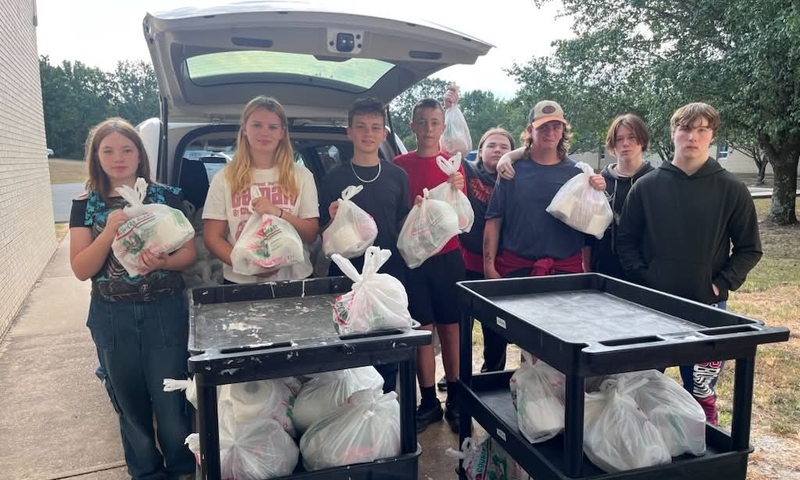
Gainesville students prepare supplemental food bags for the district’s weekend food program, which serves approximately 200 students each week (Courtesy of Gainesville R-V School District).
GAINESVILLE — An elementary school in rural southern Missouri ranks among the state’s top performers for academic growth in English language arts, an achievement its superintendent credits to improved instruction, dedicated teachers and efforts to address challenges students face outside the classroom.
According to Saint Louis University’s PRiME Center 2026 academic growth report, Gainesville Elementary School ranked 15th among 251 rural elementary schools in Missouri for three-year growth in English language arts, earning a growth score of 89.9. The rankings reflect student performance from the 2022-23 through 2024-25 school years.
The score measures student growth rather than overall proficiency. The report found that 55.1% of Gainesville students tested proficient or advanced in English language arts.
Superintendent Justin Gilmore, now in his seventh year leading the Gainesville R-V School District, said the recognition reflects an approach that places students’ academic, physical and emotional needs at the center of the district’s work.
“We’ve taken a holistic approach,” Gilmore said. “We have to take care of kids’ basic needs before we can ensure they’re ready to learn.”
Located in Ozark County, Gainesville is a community of approximately 700 residents. Gilmore said economic challenges facing local families have influenced the district’s approach to education.
To strengthen instruction, district leaders researched curricula used by high-performing Missouri schools and took teachers to visit those districts to observe classroom practices firsthand.
“We took teachers to visit other districts and see their approaches in action,” Gilmore said. “We have phenomenal teachers, and we trust them to help lead those decisions.”
The district also provided Language Essentials for Teachers of Reading and Spelling (LETRS) training, a professional development program focused on the science of reading, including phonics and foundational literacy skills.
“It was an eye-opener,” Gilmore said. “Some of what we thought we knew about how children learn to read wasn’t as accurate as we believed.”
While identifying curriculum changes and teacher training as important developments, Gilmore cautioned against attributing academic growth to any single strategy.
“You can’t just say, ‘We chose a new curriculum and everything changed,’” he said. “It’s the whole approach.”
Supporting students beyond the classroom
Gilmore said the district has increased its emphasis on addressing students’ basic needs, including employing two grant-funded community resource specialists who connect families with assistance.
The district participates in Care to Learn, a program that addresses needs related to hunger, health and hygiene. Its Youth Empowerment Project (YEP) also engages high school students in community service, including preparing supplemental food for students to take home on weekends.
Misty Cullipher, a community resource specialist and YEP coordinator, said her work involves helping families navigate housing difficulties, food insecurity and unexpected expenses.
In one recent case, the district assisted a single mother of four whose work hours had been reduced. The family received help with extracurricular expenses and $500 toward a utility bill, Cullipher said.
The district also maintains laundry facilities and a private shower for students experiencing housing instability or other hardships.
“We have a private shower in our community resource room,” Cullipher said. “That provides a little more dignity and confidentiality.”
Cullipher said the goal is to ensure students feel supported and prepared to participate in school.
“We believe in supporting students beyond the classroom,” she said. “Everything we do to help them feel ready to learn also helps them feel loved, seen and cared for.”
Students helping students
One of the district’s largest initiatives is its weekend food program, which has grown from serving approximately 60 students a week when Cullipher took over four years ago to about 200 today.
During the previous school year, the district distributed approximately 7,900 food bags.
High school students involved in YEP help prepare the bags, which are distributed to students from preschool through high school.
Cullipher said a partnership with Convoy of Hope, a humanitarian organization based in Springfield, has expanded the district’s resources to include household necessities such as laundry detergent and toilet paper.
For Gainesville High School seniors Ella Barber and Karlie Cole, both YEP leadership team members, volunteering has provided an opportunity to help classmates while gaining a greater awareness of the challenges some families face.
Barber said she initially joined because she wanted to volunteer alongside friends.
“We started out just wanting to get out of class and spend time with friends while packing food bags,” she said. “But it turned into something much more meaningful.”
Barber said students help prepare food bags, organize clothing and complete other tasks behind the scenes.
“I really like being able to see the difference we’re making,” she said.
When students have access to food, clothing and hygiene resources, she said, they can focus more on school and extracurricular activities.
“They can focus on being kids,” she said.
Cole became interested in YEP after attending a meeting where older students described the program’s activities.
“I was impressed that we could help students without making them feel embarrassed,” she said. “We provide food, clothing and household items every week.”
Cole acknowledged that packing food bags can become repetitive, but said its purpose keeps her motivated.
“Sometimes packing food bags feels repetitive,” she said. “But at the end of the day, knowing those kids are getting what they need makes it worthwhile.”
Gilmore said opportunities for students to serve others are central to the district’s educational philosophy.
“We want our students to read, write and do math,” he said. “But we also need them to be kind, to care for others and to have empathy.”
A personal commitment to Gainesville
For Gilmore, the district’s efforts to support students are rooted partly in his own experiences growing up in a family that faced financial difficulties.
“I grew up poor, so I understand what that experience is like,” he said. “My family eventually moved out of poverty, but those experiences have stayed with me.”
Gilmore said he has had opportunities to work elsewhere but chose to remain in Gainesville because he wants local children to have educational opportunities comparable to those available in larger districts.
“My goal has always been to stay in Gainesville,” he said. “I want us to be the envy of rural schools. I want our kids to have the best of everything we can provide.”
Gilmore said the district has secured more than $6 million in grants over the past seven years to support improvements and opportunities that would otherwise be difficult to finance through local resources.
Still, he emphasized that academic rankings and standardized test results are only part of what he considers a successful education.
As a parent himself, Gilmore said he wants students to leave school with more than the ability to perform well on academic assessments.
“At the end of the day,” he said, “I want our students to leave Gainesville not only with a good education, but with compassion for others and a desire to make a difference in their communities.”
Jefferson City, MO