South Dakota’s investments hit milestone of underperformance, but managers see silver lining
Nov 24, 2026 | 4:54 pm ET
Description
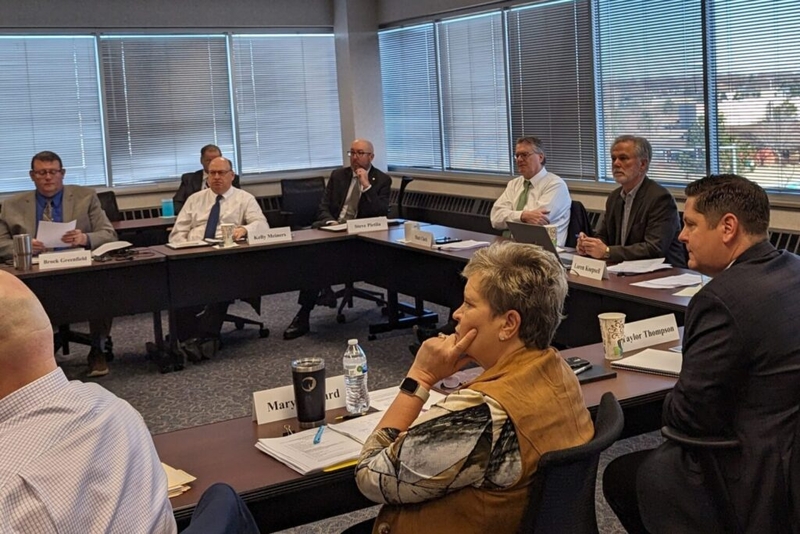
Members of the South Dakota Investment Council on April 4, 2024, in Sioux Falls. (Photo by John Hult/South Dakota Searchlight)
South Dakota’s state government investment portfolio tends to bring in less money from the stock market at times when other portfolios are making more.
That’s by design, according to the portfolio’s managers.
The “contrarian” approach includes putting a smaller share of money in stocks when prices are high, and snatching up more stocks when prices dip.
During the most recently completed fiscal year, that meant even though the state made money on the stocks it has, the returns weren’t enough to cancel out losses or lower returns from other investments, namely in private equity and real estate.
As a result, the South Dakota Retirement System fund made less money than its benchmark target on a 20-year time scale for the first time in the system’s 53-year history.
“It’s been really good more often than really bad,” State Investment Officer Matt Clark said of the state’s investment returns. “But the really bad’s been clustered in the last three years.”
Clark and other members of the state’s investing team spoke to South Dakota Searchlight last week about the public release of an annual report that documented the 20-year milestone of lackluster performance, as well as news about positive early earnings for fiscal year 2027.
“We’re hoping for a comeback,” Clark said.
Retirement system falls behind
The South Dakota Investment Council reviewed the annual report during a meeting Nov. 17. The council oversees the retirement system’s money managers, who also manage investments for various other funds that benefit schools, healthcare and the state budget.
Between the retirement system and the trust funds, the Investment Council oversees more than $21 billion, with the retirement system representing about $16.4 billion.
The retirement system has about 107,000 members, including state workers, teachers, police officers and other public employees. They pay at least 6% of their salaries into the retirement fund, matched by the state, in return for a guaranteed pension in retirement. Retirees get a cost-of-living adjustment each year, but that adjustment’s been less than inflation since 2021.
The retirement system still makes money — it grew year-over-year by about 11% in fiscal year 2026 — just not as much as the benchmark the Investment Council is measured against.
In April, three members of the Legislature’s Executive Board voted against approving a raise and incentive-based bonus for Clark.
One of the board’s members, Spearfish Republican Rep. Scott Odenbach, said lawmakers are bound to get questions from retirees who’ll want to know “are you doing your job to make sure we’re getting the returns?”
Clark’s team told Searchlight that the long-term strategy is designed as a buffer for the retirement system against the worst impacts of an economic downturn, and his team has pointed to stability as positive overall for retirees.
In June, the South Dakota Retirement System board learned that state pensioners would again see a cost-of-living adjustment lower than inflation, but the news was presented alongside figures showing that the average adjustment for South Dakotans still outpaces what state government retirees see in neighboring states.
Bulwark against potential losses
According to an analysis shared with the Investment Council privately and later with Searchlight, the state’s retirement system would remain 95% funded if an economic downturn as serious as the one in 2008 were to take place today.
If the system invested in stocks the way its benchmark fund does, that figure would fall to 85%, prompting not only the loss of a cost-of-living adjustment for retirees, Clark said, but potentially spurring talk of benefit cuts.
“The goal is to keep it 100% funded,” Clark said.
Lawmakers approve pay and bonus package for investment manager, despite concerns about returns
Clark’s team also points to past results as proof that the long-term strategy can pay off.
Not long after the 2008 crisis, South Dakota was able to give retirees cost-of-living adjustments near or higher than the rate of inflation, according to figures shared with the retirement board. In 2014, 2015 and 2016, those adjustments hit the then-maximum rate of 3.5%. Inflation during those years was 1.6%, 0.1% and 1.3%, respectively.
Jarrod Edelen, a portfolio manager for the state, said many public retirement systems didn’t fare so well after 2008. Some states took out loans to shore up underfunded pension plans or increased state and employee contributions to their retirement plans.
A report from the Pew Charitable Trusts in 2021 estimated that state retirement systems as a whole were 80% funded “for the first time since 2008.”
“That dynamic that occurred, with other states being underfunded, began in 2008 in spades when the market fell and their funded status declined significantly,” Edelen said. “They were stuck with that lack of recovery, but we got an enormous recovery.”
Other factors contribute to underperformance
The retirement system’s underperformance — its returns were 11% in fiscal year 2026 while the benchmark’s were 18% — is mirrored across the other funds managed by the Investment Council, including the School and Public Lands Trust and the South Dakota Cement Plant Trust.
The amount of money transferred to the state general fund for fiscal year 2026 was $136.8 million, down from $150.6 million the year before.
New voter-backed trust fund could become South Dakota’s largest, state treasurer says
That the state missed its 20-year benchmark in 2026 but outperformed it in 2008 is partially reflective of a current problem with part of the state’s portfolio that wasn’t present 18 years ago.
Back in the 2008-2009 financial crisis era, the state lost money when the stock market took a dive, but was buoyed by the returns delivered by its real estate investments just before it started.
Some of those real estate partners, Clark said, sold off real estate assets just before the crisis, then bought distressed assets afterward at a discount. That enabled those partners — and the state by extension — to lose less and bounce back more quickly.
During the 2026 fiscal year, real estate investments were under water. The Investment Council doesn’t buy real estate directly, but invests in firms that do. South Dakota lost more on those real estate partnerships in 2026 than it has in years.
There’s been a “slow-motion unraveling” in the real estate market, Clark said, because investors “thought interest rates would stay low forever.”
Because the state’s real estate partnerships are 10- and 15-year arrangements, Clark said, “it’s hard to sell and get out.”
The state’s private equity investments also faltered, not losing money but returning less than the state had hoped.
“We’ve never had them all do bad at the same time before,” Clark said.
A bad year, but hopeful signs
Shortly after accepting the annual report, members of the Investment Council heard the state’s retirement system returns were 1.27% in the first few months of fiscal year 2027, which began July 1. The benchmark’s returns in that time frame were -0.75%.
“But again,” portfolio manager Darci Haug told the council, “just note that this is only four-and-a-half months into the fiscal year.”
Even so, Clark told the council he sees some evidence that the strategy that’s kept the state from collecting on the stock market’s historic gains in recent years may finally be paying off.
“I guess it shows that contrarian strategies can eventually work out if you’re patient enough,” Clark told the council. “But you have to be very patient. Fortunately, I think you know that’s something we can do.”
He went on to say that South Dakota’s trading team is competing with “the best of the best” in the investment industry.
In that respect, Clark told the council, patience “may ultimately be our only competitive advantage.”

Pierre, SD