Nevada health officials warn of waning vaccination rate as measles becomes endemic in U.S.
Nov 23, 2026 | 8:00 am ET
Description
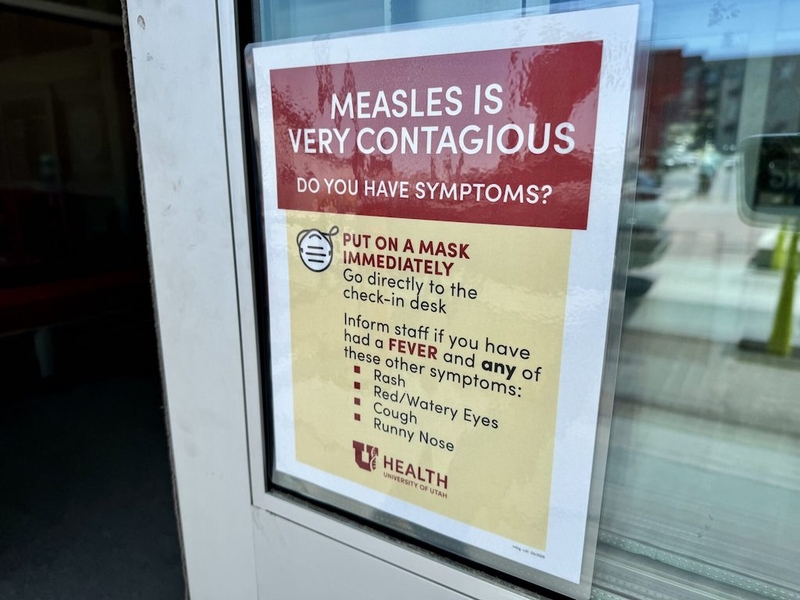
A sign at a University of Utah health clinic warns visitors about the spread of measles. Under the Trump administration, federal health officials have cut back the number of recommended vaccines, and more states are offering exemptions for parents who don't want to vaccinate children entering public schools. (Photo by McKenzie Romero/Utah News Dispatch)
While there haven’t been reported measles cases among Nevada residents this year, local health officials warn that the U.S. losing its measles elimination status makes local communities more vulnerable.
Health officials also stress the importance of investing in public health infrastructure to ensure it can prevent the spread of a potential outbreak.
The Pan American Health Organization (PAHO), a regional office of the World Health Organization, concluded in 2000 that the U.S. had essentially eliminated measles because spread had been squashed for 12 months or more.
After a year of surges across the country, the elimination status for the country was reversed Nov. 17.
The news means “that now all of our communities are more vulnerable than they ever have been,” said Dr. Cassius Lockett, the district health officer at the Southern Nevada Health District.
The Centers for Disease Control and Prevention has reported 5,800 cases across the country as of Nov. 19, which Lockett notes is “more measles cases in the past 11 months this year than all of the entire previous 24 years combined.“
“That’s alarming,” he said. “We forget measles definitely spreads like wildfire, and I really truly mean that because it’s really good at infecting up to 90% of unvaccinated people it meets. It’s really good at that.”
The Nevada Division of Public and Behavioral Health said that measles cases in Nevada are rare. Prior to 2025 the state hadn’t had one since 2018.
“This makes Nevada 1 of 5 total states that has not had a reported measles case so far in 2026,” Daniel Vezmar, a spokesman with the division, said in an email. “The loss of U.S. elimination status does not mean that measles is spreading in Nevada, and it does not change vaccine recommendations or school requirements.”
Nevada is not among the list of states with reported cases, but a CDC map shows Nevada completely surrounded by states with reported cases.
“What I might take away from the map, even though it’s not showing any cases in 2026, what that map means to me — because we have to always be reminded how good measles is at finding unvaccinated people — is that measles does not recognize state boundaries,” Lockett said.
Though no cases have been reported among residents, the health district indicated in March that a visitor who visited the Las Vegas Convention Center tested positive for measles.
The last reported residential measles cases in Washoe County was Dec. 25, 2025.
“Our neighboring states have seen activity surge,” said Chad Kingsley, district health officer for Northern Nevada Public Health. “Our history of high vaccine coverage has likely helped us by reducing the number of susceptible individuals. However, if vaccination rates continue to trend downwards while the number of outbreaks continues to rise, it could lead to even more exposures among susceptible individuals and, likewise, more cases.
U.S. Health and Human Services Secretary Robert F. Kennedy Jr. has a history of repeating false claims about vaccines and has opposed many vaccine mandates. DHHS this year began recommending fewer vaccines for children. Medical groups denounced the move.
Since then, the MMR vaccination rate in school-age children has since declined nationwide, reaching a new low of 92.4% in the 2025-2026 school year, according to KFF.
The MMR vaccination rate in Nevada is less than 90%, making the state “more vulnerable,” Lockett said. The herd immunity benchmark is 95%.
“The data is telling us, especially for Clark County here locally, that the coverage has declined over a four-year period by four percentage points,” Lockett said.
More concerning, he said, is that some pockets within Southern Nevada have severely low vaccination rates.
The health district provided Nevada Current with a list of the ZIP codes that had the lowest number of kindergarten students vaccinated for measles.
The health district noted that “vaccination coverage estimates reflect kindergarten students attending schools within each ZIP code and may not represent coverage among children residing in those areas.”
At the bottom of the list was 89121, which had a less than 53% vaccination rate. While 858 kindergarten students are enrolled in schools in that ZIP code, only 451 were up to date on MMR vaccinations.
Lockett said he is worried about the rise in nonmedical exemptions for vaccinations, saying the number of exemptions in Clark County rose from 5.4% to 8.8% in a four-year period.
Both health districts stressed they are prepared to respond to any potential surge in cases.
“Measles surveillance is already a high priority because of its potential to cause serious complications or death, particularly among vulnerable populations, and its infectiousness,” Kingsley said. “When we confirm a case, it becomes an all-hands-on-deck response involving multiple programs and collaboration with our healthcare providers”
There is “multi-layered approach to measles preparedness,” Lockett said, pointing to the wastewater surveillance systems as one part.
“It could be a tourist. It could be a resident here. But it allows us to start thinking we have to ramp up and get prepared,” he said.
Kingsley said that the national benchmark for local health department staffing is 1.7 epidemiologists per 100,000 residents.
“NNPH currently has fewer than one epidemiologist per 100,000,” he said. “With continued rising disease transmission and continued uncertainty around public health funding and diminished resources, securing sustainable financial support for epidemiology and contact tracing is a key to ensure our community has the resources needed to protect public health.”
Ahead of the 2027 Legislative Session, which starts Feb. 1, Lockett said state lawmakers should look at what it means to have sustained investment in public health infrastructure as some federal grants could end next year.
SNHD is planning for a federal Public Health Infrastructure Grant, which provided $21 million in funding to help pay for epidemiologists, laboratory professionals and disease surveillance investigators
Lockett also said he has heard rumblings that lawmakers might consider a bill draft request to address the rise in non-medical exemptions.
“From my standpoint, I think it should be a balance of evidence-based considerations while balancing individual protections,” Lockett said.
Las Vegas, NV