Memphis is not progressive… yet. But we can be.
Nov 23, 2026 | 5:59 am ET
Description
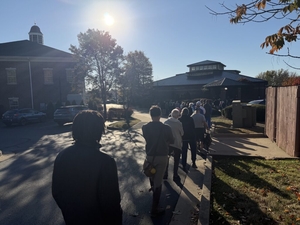
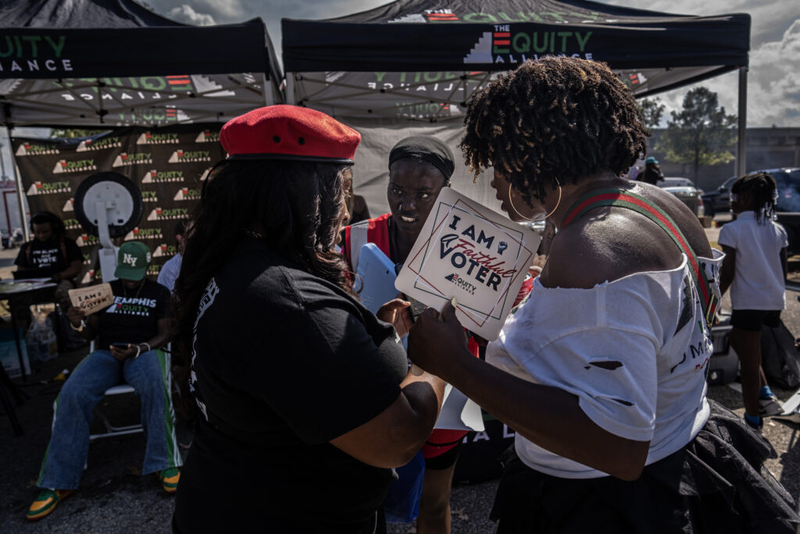
Despite voter registration efforts in Memphis and Shelby County, like the one conducted by The Equity Alliance, pictured here, only 44% of registered voters in Shelby County voted in the midterm election. (Photo by John Partipilo/Tennessee Lookout)
One of the conversations that will shape American politics after the 2026 elections is the conflict between so-called centrists and progressives within the Democratic Party.
That debate is underway nationally. Some Democrats believe the party’s future rests in moderation and incrementalism. Others argue voters want something more ambitious: universal health care, stronger labor protections, higher wages, restraints on corporate power, less militarism and a stronger challenge to concentrated wealth.
Memphis will inevitably be pulled into that conversation. But before we start calling ourselves progressive, we need to be honest.
Memphis is not a progressive city…Yet. We’re still moderate, at best.
We are a majority-Black city with significant Black political representation. Black women make up the majority on the Memphis City Council, Shelby County Commission and Memphis Shelby County School Board. We have also adopted policies once dismissed as too progressive for this region, including a wage floor above $15 an hour for Shelby County employees.
Those things matter. But representation is not liberation.
A city does not become progressive simply because Black people, women, queer people or other marginalized groups gain access to power. There is nothing inherently progressive about diversifying who administers an unjust system.
Sometimes oppression gets a new face and keeps the same address. That is not progressivism. Nor can progressivism become another ideological culture war where political sophistication is measured by mastering the latest vocabulary, canceling the right target, or disguising personal ambition as social justice.
For a majority-Black city like Memphis, progressivism must mean something deeper. It must mean building the self-determining political power and institutional capacity necessary to move Black people and other marginalized communities closer to genuine freedom. It must challenge economic exploitation, environmental injustice, inadequate health care, generational poverty, political exclusion, militarism and an American political order that too often asks Black people to become more loyal to the empire than the empire has ever been to us.
By that standard, Memphis has made progress. But we are not there yet.
The 2026 election exposed that contradiction.
Shelby County turnout increased. That matters. But only about 44% of registered voters cast ballots, leaving more than 328,000 registered Shelby County voters on the sidelines. Republicans won Tennessee’s 5th, 8th and 9th Congressional Districts by a combined total of fewer than 25,000 votes. The governor’s race was decided by less than 55,000 votes statewide.
Had Black Memphians gotten 100,000 of those voters who sat out to participate we would’ve decided each Districts 5, 8, and 9 as well as the gubernatorial race right here in Memphis!
The political power was here. We simply did not fully exercise it.
State Rep. Justin J. Pearson’s 9th Congressional District campaign also exposed some of our ideological limitations. Several elected leaders hedged their bets. Some appeared to believe Pearson would lose badly. Others seemed reluctant to associate themselves too closely with a candidate identified with a more confrontational, progressive politics.
I viewed much of that as political cowardice and miscalculation. But it would be too easy to blame elected officials alone. Their behavior also reflects a broader political culture.
If Memphis were already as progressive as some of us imagine ourselves to be, our electorate would likely look different. Political participation would be deeper. Organizing would be more sustained. Voter education would not be seasonal. People would be more willing to imagine possibilities beyond what consultants, donors and gatekeepers tell us is realistic.
That is the work before us.
Pearson accepts loss in U.S. District 9 race, but says ‘Tennessee politics will never be the same’
A progressive Memphis should mean Black workers earning wages that allow them not merely to survive, but to build wealth and interrupt generational poverty. It should reject the idea that every Black person must become a makeshift entrepreneur just to achieve economic security. Everybody does not need to own a business. Workers deserve dignity, stability, benefits, and a wage sufficient to live and thrive.
A progressive Memphis should mean health care people can reasonably access, clean air, safe water, healthy neighborhoods and protection from environmental hazards that disproportionately burden Black communities.
It should mean affordable housing without displacement, public education treated as a public good rather than a commodity, strong labor rights, serious investment in public transportation and public safety strategies that do not treat policing as the only legitimate response to social disorder. Politically, it should require enough courage and imagination to stop confusing what is familiar with what is possible.
That is where Memphis has to go next. Not toward performative progressivism, a politics obsessed with labels, or an ideological purity contest. And certainly not toward a politics where ambitious people learn progressive and social justice language because they believe it is the fastest route to personal advancement.
We need something more mature: a political culture rooted in Black freedom, democratic participation, economic justice, community power and self-determination.
That will require massive political education, year-round voter engagement, and a larger civic imagination across our churches, unions, neighborhoods, schools, organizations, and institutions. Most importantly, it will require political courage.
Because progressive politics, if it means anything, must be about more than who gets elected. It must be about what those elections make possible for people whose lives have historically been constrained by systems they did not design.
Memphis is not progressive.
Not yet.
But we have moved closer.
And if we are serious about 2027 — when there will be a Memphis mayor’s race — 2028 and beyond, we have an opportunity to become something more righteous than the labels we casually use.
We have an opportunity to become a city where political representation finally matures into political power. And political power finally moves us toward freedom.
Nashville, TN