Can Nebraska learn from Kansas’ mistakes?
Nov 21, 2026 | 6:45 am ET
Description
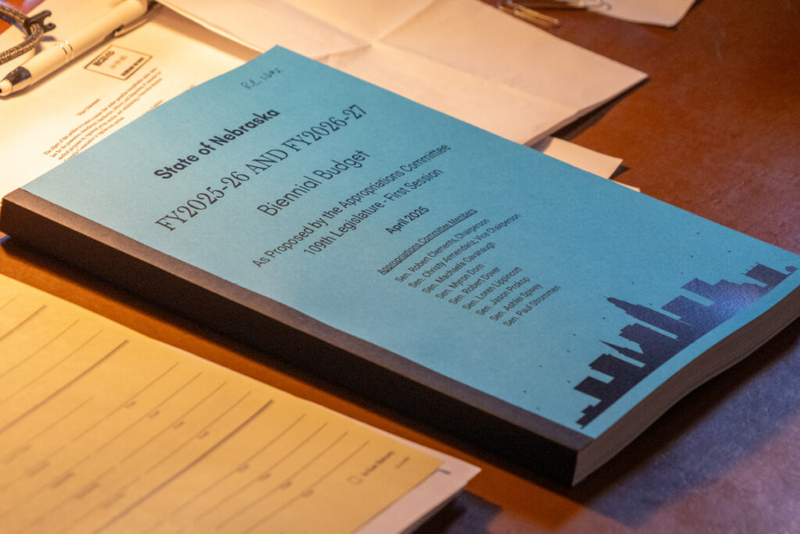
A budget book for Nebraska's fiscal years between 2025 and 2027 sits on a lawmaker's desk. April 29, 2025. (Juan Salinas II/Nebraska Examiner)
We Nebraskans had better learn from what happened in Kansas under Gov. Sam Brownback and a state legislature dominated by Republican politicians beginning just 14 short years ago. And we better do it quick.
In 2012, Brownback and the Kansas Legislature enacted significant tax cuts that soon produced unsustainable revenue shortfalls, budget deficits, credit rating downgrades and deep cuts to vital governmental services like public education and roads. Is any of this sounding familiar?
In 2012, legislation was passed that cut Kansas’ top state personal income tax rate from 6.45% to 4.9%. That was done so Kansas could “compete” with neighboring states with lower state income tax rates. The same law eliminated state income taxes on pass-through entities, prompting the creation of hundreds of thousands of small businesses that paid their owners pass-through “profits” rather than “wages,” allowing them to pay zero state income tax on those earnings.
Kansas’ revenue dropped $700 million in the first year alone. Ultimately, the state Supreme Court ordered the state to increase state funding of public K-12 education in 2017 and 2018 by $293 million in order to meet the state constitutional requirement that the state provide public education. Is any of this sounding familiar?
Brownback and his Republican cronies insisted that the tax cuts would pay for themselves through an explosion of economic growth. That did not happen, to put it mildly.
Instead, the Kansas economy grew at near average annual rates, and the loss of revenue from the tax cuts produced multimillion-dollar budgetary deficits and deep cuts to needed services like those to public education that the Supreme Court’s order attempted to remedy. Brownback’s approval rating fell to 25%, and Republicans lost seats in the Kansas Legislature in the 2016 election that elevated Donald Trump to the White House. In 2017, the Kansas Legislature repealed the 2012 tax cuts over Brownback’s veto.
Here in Nebraska, the state budget was bulging with a $1 billion surplus in 2021 and 2022, largely from receipt of one-time federal relief dollars in the wake of the COVID economic downturn. That surplus was offered as rationale for cutting the state income tax rate so Nebraska could “compete” with lower-taxing neighboring states.
In 2023, Nebraska Gov. Jim Pillen signed into law LB 754, passed by a Republican-dominated Unicameral that implemented, starting for the 2024 tax year, a phased-in reduction of the state income tax rate from 6.84% to 3.99% for the 2027 tax year. Ever since, we here in the Cornhusker State have watched our governor and state legislators scramble to repeatedly fill hundreds-of-millions-of-dollars holes in the state’s budget — holes caused by the reduction in revenue resulting from the income tax rate cuts.
Pillen directed state agencies to implement across-the-board spending cuts of 8%. Money was pulled from specifically designated funds such as the State Veterans Aid Fund, which provides for the needs of our state’s citizens who served in our nation’s armed forces, and the Environmental Trust, the funding for which is a portion of state lottery revenues as voters mandated when the lottery was approved by them in 1992. The clamber goes on to patch a deficit of approximately $300 million in the current budget, and projections are for a $1.2 billion deficit for the next two-year state budget that senators will be confronted with in the upcoming session.
In our Big Red state, registered Republicans outnumber registered Democrats by at least 20 percentage points. After being reelected two weeks ago by a margin of 7% over Democrat candidate Lynn Walz, Republican Gov. Pillen claimed a “mandate” for his policy of tax cuts and spending reductions, the policies that have produced the deficits, directives for cuts and raids on state funds.
Pillen insists that his approach of capping local government spending, the state paying the operational expenses of public education and cutting property taxes is the “fix” voters demand. Noticeably, Pillen fails to explain where the state — which has already exhausted the underside of every couch cushion to pay past bills and is still facing a $1.2 billion shortfall in the next biennial budget — is going to come up with anything near the $3.3 billion in local property taxes spent annually on public education.
Perhaps we can learn Kansas’ lesson? If the economic and societal damage sustained by our neighbors to the south is insufficient disincentive for following the path Pillen advocates, maybe the loss of elective office by the Kansas politicians who went along with an irresponsible fiscal fantasy will be.
Lincoln, NE