Data center developer responds to questions as Mandan voters consider ban
Nov 20, 2026 | 5:20 pm ET
Description
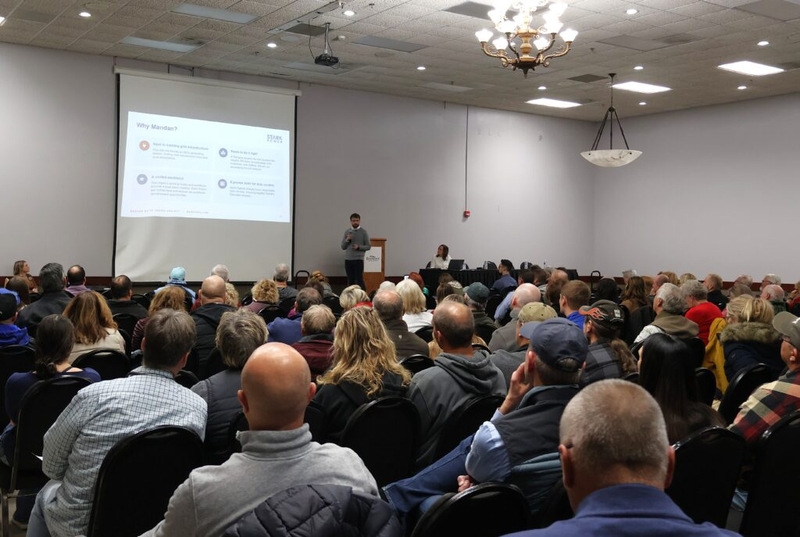
Michael Whalen, managing director of digital infrastructure for Stark Power, speaks to attendees of a data center forum in Mandan on Nov. 19, 2026. (Photo by Michael Achterling/North Dakota Monitor)
The developer of a proposed Mandan data center answered questions from the public this week ahead of a Dec. 15 vote that could ban such projects within the city.
Residents of Mandan petitioned for a special election to vote on a measure that would ban data centers within the city limits over 25 megawatts. More than 700 residents signed the petition submitted this fall amid debate over data center ordinances in Mandan and Morton County. Stark Power proposes a 300-megawatt data center in Mandan.
If city residents vote in favor of the ban, there would be “no path forward” for the project, said Michael Whalen, managing director of digital infrastructure for Stark Power. But rejecting a ban does not necessarily mean this project would advance, he added.
“It gives us an opportunity to submit an application and for there to be public debate,” Whalen said during a public forum.
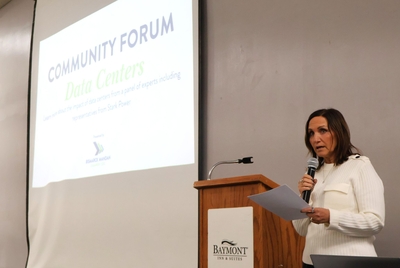
The discussion was hosted by the Bismarck Mandan Chamber EDC, which prior to the event announced the group’s board of directors had voted to oppose the ban.
“Anytime you put a ban on anything, it takes away the opportunity to have the conversation,” said Brenda Nagel, president of the Bismarck Mandan Chamber EDC. “We are for economic development.”
Residents voice concerns over Mandan data center during town hall
She added any ban could scare off developers and future projects in other industries from coming to the area based on the public’s sentiment over data centers.
Local elected officials could still reject the project across multiple permitting and zoning steps, if the ban is defeated, Nagel said. She also stressed the chamber is not for or against data centers, but is opposed to bans that could affect development of the area.
Jane and Clayton Feist live in the extraterritorial zone just outside the Mandan city limits, but adjacent to the proposed data center site. The city of Mandan has zoning authority for extraterritorial areas up to 2 miles outside of city limits.
“We can’t even vote on it even though it affects us,” Jane Feist said, since they don’t live within the city.
Clayton Feist said he worries about the standby electric generators that could produce noise at odd hours to power the facility, which could affect animals in the area and his ability to sleep.
“Some of us built for retirement,” Clayton Feist said. “If I try to sell you my home there, and there’s noise, are you going to buy it? I got 16 acres there.”
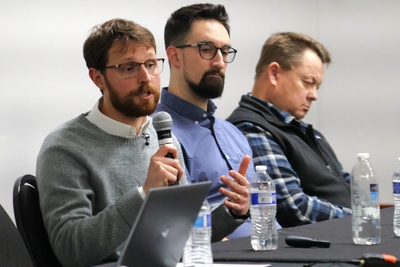
Wahlen made a presentation to the attendees during the meeting that highlighted a sound modeling study showing the noise would be limited to 45 decibels at the proposed facility’s property line.
The data also showed the noise outside of three schools within a mile of the proposed campus would be between 29 to 39 decibels and even lower once inside the school buildings.
According to the American Academy of Audiology, a 30-decibel sound is equivalent to a whisper while 40 decibels compares to a quiet library. A 50-decibel sound is comparable to a moderate rainfall.
Whalen said Stark Power plans to sell the facility after the permitting process is complete to a company, such as Amazon, Microsoft, Google or Meta, that would occupy the building and operate the data center.
Eden Stramer of Mandan lives about a mile and a half away from the data center site and said she will vote in favor of the data center ban. She said she asked Whalen after the meeting about any assurances Stark Power could give the community after that sale takes place.
“There are no assurances. You can’t control what the next person does,” Steamer said. “We don’t even know who’s going to buy it, who’s interested in buying it.”
Whalen said the conditions for the data center will be bound to their permits, if the project moves forward, regardless of who the operator ends up being.
“When another end user takes ownership of the project, they have to adhere to those same conditions or they are subject to revocation of the permit,” he said. “They are binding conditions.”
Whalen listed the potential benefits to the community and commitments, if the project was able to move forward.
The $3.4 billion project would sit across multiple buildings of a 300-acre campus on a 700-acre property. Stark Power projects the facility will generate $526 million in public revenue over 20 years to be spent on schools, parks and initiatives in Mandan and Morton County.
That impact includes a community benefit agreement providing $10 million to a community-controlled fund once the data center reaches its capacity. An annual $1 million stipend would be added to the fund after launch, the company says.
The city on its website says project-specific benefits or impacts have not been confirmed by city officials because no formal application has been submitted.
During peak construction between 2028 to 2031, it’s expected to employ more than 1,200 construction workers. Once operational, the data center is projected to add 210 permanent jobs with an average wage of about $80,000 per year.
The data center would use a closed-loop cooling system that would not draw water from the city, and the project would pay for road upgrades and repairs before construction begins, according to the company’s presentation.
Tom Hansen of Mandan attended the meeting and said he will vote against the data center ban.
“I say build it right now,” Hansen said after the meeting. “Why handcuff somebody because you are not 100% sure?”
Rob Bauer of Mandan said he thought the public forum was a promotion for the data center. He said his mind was not changed during the meeting and plans to vote for the data center ban.
“You hear about all the benefits of having one, and it’s mostly economic, and I don’t know of any other benefit than the economic one,” Bauer said. “I still don’t think there’s enough information to go forward with it.”
The Mandan special election will run from 7 a.m. to 7 p.m. on Dec. 15. Votes can be cast at the Spirit of Life Roman Catholic Church at 801 First St SE. Absentee ballots can also be obtained from the city of Mandan.
North Dakota Monitor reporter Michael Achterling can be reached at [email protected].
Bismarck, ND