Google funds $1.3M freshwater habitat at Cape Romain
Nov 20, 2026 | 1:32 pm ET
Description
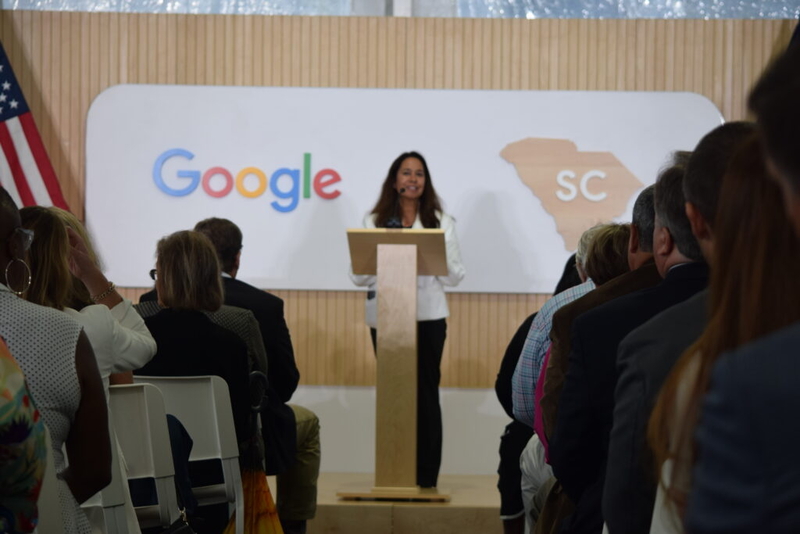
Audrey Van Belleghem, director of strategy and operations for Google's global data centers, speaks to a crowd of some 100 attendees at the technology company's groundbreaking in Dorchester County Thursday, Sept. 26, 2024. (Jessica Holdman/SC Daily Gazette)
Google gifted $1.3 million to the National Audubon Society to build protective berms at Cape Romain National Wildlife Refuge in South Carolina’s Lowcountry.
With public outcry against data centers growing nationwide and in the Palmetto State, the tech giant is taking on this and other projects across the country related to one of opponents’ concerns: water.
“Data centers are the nerve centers of the digital world, powering our daily lives with search, maps, online banking, healthcare and 911 systems,” according to a statement from Google. “As we grow our data center footprint to support these services, we recognize that how we build is just as important as what we build.”
That’s why Google agreed to help protect more than 100 acres of freshwater habitat at Cape Romain, said Marshall Johnson, chief conservation officer at the National Audubon Society.
The 66,000-acre coastal refuge features Bulls Island, maritime forests, hiking trails and lighthouses. It is home to loggerhead sea turtles, alligators, dolphins, shorebirds and red wolves.
This latest grant brings Google’s total investment in what it calls water stewardship projects in South Carolina to more than $5 million.
Past projects include a $4 million smart-irrigation project, working with Arable Labs and farmers on 20,000 acres across the Carolinas to reduce water usage by more than 500 million gallons annually. It also paid to help restore longleaf pine in Francis Marion National Forest.
According to Google, the company has supported 165 water stewardship projects across 97 watersheds nationwide, as of 2025.
The Cape Romain project is part of the company’s latest funding round, for which there were more than 700 applications submitted nationwide.
Of those applications, 22 were for projects in South Carolina. Cape Romain is the state’s only successful applicant so far.
Suzie Shin, Google’s manager of data center sustainability programs, said these and other water-related efforts have resonated with residents of communities where data centers are located.
Social Security, data centers and healthcare: Senate candidates exchange jabs while talking policy
When a Google data center comes into an area, the company pays for upgrades to the water system, which benefits all utility customers, she told the SC Daily Gazette.
“But our commitment extends beyond our four walls. It goes beyond our relationship with the utility and the water-wastewater infrastructure to understand that water is local and it’s interconnected. The headwaters of a national forest can actually be the water source supply for a community 100 miles away,” she said. “So that’s, I think, where we’ve been able to show the connection between the work that we fund within the broader watershed and the community.”
In 2024, a Charleston County man sued the Dorchester County Council when it refused to disclose how much water a new Google data center under construction there would use to cool the servers and chips that power the digital information superhighway, calling that a trade secret.
The county settled a year later, agreeing to publish the numbers. That same year, the California-based company also changed its tune and started disclosing water usage of all of its centers in an annual report.
Google’s Berkeley County data center, which has been in operation since 2008, used more than 900 million gallons in 2025. The company’s other two data centers — located near St. George and Ridgeville in Dorchester County — are still under construction.
Google announces $3.3B investment in SC data centers, 200 new jobs
One of the two planned centers could use 978 million gallons of water annually, according to the published county estimates.
By comparison, Google’s center in Council Bluffs, Iowa, has the heaviest usage — 1.3 billion gallons.
Its centers in Mesa, Arizona, and Pflugerville, Texas, use 100,000 gallons. But there’s a trade off. They’re air-cooled and require more electricity to operate, another pain point.
The largest data centers — known as hyperscalers — are facing pushback due in large part to the massive amount of energy required by the facilities. The need for power is going up at the same time residents are seeing their own monthly power bills continue to rise.
By relying on water cooling, a company can reduce data center energy use by approximately 10% compared to air cooling, according to Google.
Columbia