Missouri education board selects Senate leader Cindy O’Laughlin as interim commissioner
Nov 20, 2026 | 1:45 pm ET

Description
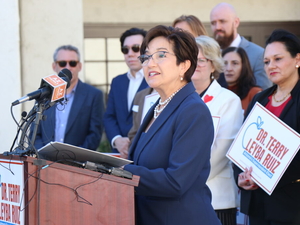
Cindy O'Laughlin, pictured speaking to reporters in May 2024, will lead Missouri's education department as interim commissioner beginning Dec. 1 (Annelise Hanshaw/Missouri Independent).
Senate President Pro Tem Cindy O’Laughlin, a Shelbina Republican, will lead Missouri’s Department of Elementary and Secondary Education as interim commissioner of education beginning Dec. 1.
The State Board of Education voted 6-1 to appoint O’Laughlin in a closed meeting Friday morning. It will continue its search for a permanent commissioner, aiming to hire a permanent commissioner by June.
O’Laughlin, who did not respond to a request for comment, will replace Lisa Sireno, who has served as interim commissioner since Oct. 21, following the resignation of Stacey Preis.
Missouri education chief resigns amid controversy over A-F ratings for public schools
The announcement came after months of rumors that O’Laughlin was being eyed for the position. As word circulated more widely in the past month, the state board’s inbox filled with angry emails and questions about her qualifications.
Wheaton school Superintendent Alyssa Kennedy was among those who opposed O’Laughlin’s possible appointment, sharing her letter to the board in a Facebook post.
“I respectfully urge the Board not to make this appointment based on political alignment or a predetermined outcome,” she wrote. “If the Board is considering Senator O’Laughlin, I urge you to carefully examine whether her experience and policy positions align with the responsibilities and public mission of this office.”
State law requires the commissioner to “possess an educational attainment and breadth of experience in the administration of public education.”
O’Laughlin’s Senate biography says she has experience “as a school bus driver, an administrator at a local Christian school and as a member of her local school board.”
She chaired the Senate Education Committee from 2020 to 2022, telling public school advocates that she hoped to work with them and that she was not an expert, as The Independent reported in 2021.
Duane Martin, an attorney whose law firm EdCounsel represents public school districts, told The Independent he does not think O’Laughlin meets the legal requirements for the job.
“It is interesting that you would put somebody in a position that is not qualified by statute, who is responsible for the department and reports to the state board that handles all of the licensures for all of the professional educators in the state,” he said.
In 1970, the State Board of Education sought an attorney general’s opinion on a candidate “who is not a certified teacher” but had led the House Education Committee and worked as a part-time professor at Missouri Valley College.
Then-Attorney General John Danforth wrote that the candidate was not qualified, since he lacked experience in administration.
“Executive experience in the field of public education would be invaluable, if not essential, in the performance of (the commissioner’s) duties,” Danforth wrote.
State Board of Education president Brooks Miller, who spoke to The Independent on his way into the department offices Friday morning, said he believes O’Laughlin is qualified.
In a press release, Miller said she “brings a range of skills that will be beneficial to (the department) and the children of Missouri.”
When asked whether his friendship with her has impacted his decision, he said, “not at all.”
Questions about O’Laughlin’s qualifications are not the only concerns raised by opponents of her appointment. Some have also pointed to her record on public education policy.
Former state Sen. Lincoln Hough, a Republican from Springfield, has spoken publicly about O’Laughlin’s leadership in the Senate and said he faced pressure during his time as Senate Appropriations chairman not to fully fund public education.
The two had a falling out amid disagreements over school funding and other Senate issues. In 2025, Hough led the Senate Appropriations Committee in restoring $300 million to fully fund the formula that determines state aid for public schools.
O’Laughlin removed him as appropriations chairman that September, shortly after he opposed Republican efforts to end debate on congressional redistricting and changes to the initiative petition process. O’Laughlin said at the time that the decision would provide continuity on the committee because Hough was approaching the end of his Senate term.
“She is one of very few people in elected office who has actually looked me in the face and said she didn’t want to fund or fully fund the foundation formula the last year that I was the appropriations chairman in the Senate,” Hough told The Independent.
Having O’Laughlin as the chief of the state’s education department is “going to hurt the next generation of students in this state,” he said.
“She’s going to try to systematically dismantle public education,” Hough said.
The department’s press release said O’Laughlin will work to “maintain organizational stability, strengthen relationships with local school districts and the General Assembly, and advance the state board’s strategic priorities.”
“I understand this is an interim assignment and that the state board is undertaking a national search for its next permanent commissioner,” O’Laughlin said in the public release. “My responsibility is to provide the leadership, stability and forward momentum the department needs during that process. I intend to make the most of that opportunity.”
O’Laughlin is a vocal proponent of policies that use public funds for private schools, including the state’s K-12 voucher system, MOScholars. At the end of the legislative session in May, there was a push to remove the program from the State Treasurer’s Office and instead have the education department administer it.
Expanding MOScholars and similar programs has long been a priority for O’Laughlin, who has expressed frustration for years that public schools “have a monopoly on public education.”
Gov. Mike Kehoe also supports expanding private-school options.
In October, Kehoe declined to share his opinion on Preis’s resignation or O’Laughlin’s possible appointment.
His communications director, Gabby Picard, pointed to the state board’s authority to hire a commissioner.
Kehoe has appointed a majority of the board’s members and “has confidence in their judgment,” Picard said in a statement.
The Missouri Constitution sets up the State Board of Education as an eight-member board with staggered, eight-year terms. This structure is designed to limit how quickly any one governor can reshape the board.
But in recent years, some board members have continued serving after their terms expired. That has allowed Kehoe to make appointments to seven of the eight seats during his first two years in office.
A similar situation occurred under former Gov. Eric Greitens who appointed board members who voted to oust then-Commissioner Margie Vandeven in 2017. When Greitens was forced from office, the board rehired Vandeven.
Martin sees parallels between the two situations, saying the key difference is timing.
“This is very similar to what was being attempted by Governor Greitens,” he said. “It is just at a slower pace.”
This report will be updated.
- 12:56 pmThis article has been updated to include statements from a Department of Elementary and Secondary Education press release received after publication.
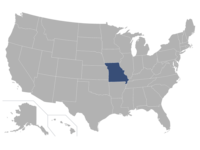
Jefferson City, MO