Federal judge considers rare review of grand jury proceedings in U-M protest case
Nov 18, 2026 | 6:12 pm ET
Description
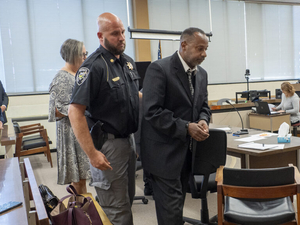
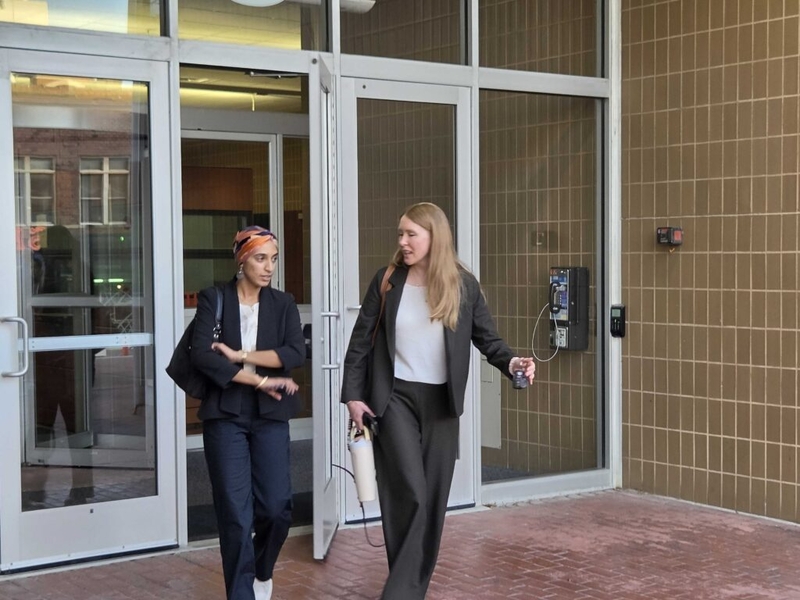
Zainab Hakim, left, and her attorney, Amanda Bashi, exit the U.S. District Court for the Eastern District of Michigan on Wednesday, Nov. 18, 2026 in downtown Ann Arbor, Mich. Hakim was in court for a revocation of bail hearing. (Photo by Ben Solis/Michigan Advance)
ANN ARBOR — A federal judge in Michigan may take the rare step of opening secretive grand jury testimony to determine if the panel was given the full and accurate account of a raid on a home that led to additional charges being filed against Zainab Hakim, one of 12 current and former University of Michigan students charged with crimes related to pro-Palestinian protests over the last several years.
Hakim, along with 11 others, has been charged in federal court on allegations of protests, graffiti and property damage at the offices and homes of weapons developers, political organizations and U-M officials related to actions in support of Palestine. She appeared in court on Wednesday for a hearing to determine if she would be jailed before her trial in the U.S. District Court for the Eastern District of Michigan due to new charges of evidence tampering, which her defense denies took place.
Hakim was not taken into custody on Wednesday and will be back in court on Dec. 2 as there were questions of whether the grand jury that brought the new charges — and made up the basis for the government to revoke her initial bond — was given the full scope of evidence on the raid that led to the request to revoke bail.
Hakim’s defense believed that the grand jury was not given an accurate picture of the raid, or the evidence of alleged tampering, and is asking U.S. District Judge Judith Levy to review the grand jury testimony to determine if prosecutors had presented misleading testimony or whether irregularities in the proceeding undermined the grand jury’s decision to bring the charges.
Levy entertained that idea and adjourned the bail hearing to do her own research on whether she had authority to do so. Levy also asked the government and Hakim’s defense attorney, Amanda Bashi, to file additional briefing on the issue.
Levy was clear, however, that there was limited precedent allowing judges to unseal grand jury proceedings, and Bashi only read off a handful of cases that helped her position.
State charges against the group were dropped last year, but the federal government pursued the case and charged Hakim and others for allegedly terrorizing various individuals who they deemed connected to or supporting Israel’s war in Gaza against Hamas.
The federal government has alleged that the group did so outside the bounds of the First Amendment and constituted criminal acts in support of Hamas.
In October, the FBI arrested Henry David Mackeen-Shapiro, one of the co-defendants, and then raided the home where Hakim and Mackeen-Shapiro live to execute an additional search warrant. In that raid, agents uncovered a laptop that they believed was dumped into a bath of either salt water or fresh water, in an alleged attempt to tamper with or destroy evidence. However, the complaint didn’t specify if it had been dumped in water or just kept in a wet bag. The government has claimed that the laptop was found in Hakim’s bedroom, and not in the room of its owner, Mackeen-Shapiro.
In court on Wednesday, Bashi said the public complaint filed with the court, in her view, contained so many inconsistencies that it appeared as there were two diametrically opposed accounts of what happened during the raid, and that the government’s account amounted to a misrepresentation to the court. During the bond hearing, federal prosecutors had to correct themselves multiple times before Levy as to the veracity of the statements in the complaint.
That led Bashi to believe that, potentially, the grand jury which brought additional evidence tampering charges against Hakim hadn’t been told the whole story, or an incorrect version of events.
A timeline of the raid, along with body-worn camera images, showed that Hakim and others appeared to have cooperated with FBI agents and made themselves present at their front door. It also indicated agents had not congregated inside the home. Statements from defense witnesses also showed that agents had commended the home’s residents, including Hakim, who had cooperated with agents during the raid.
The federal government said it is still actively restoring the laptop in question, and that it had not been chemically tested prior to the grand jury presentation to show whether it had been dumped in salt water or fresh water in an attempt to destroy it.
Federal prosecutors, however, did not quarrel with Bashi’s alleged timeline of the events.
Bashi noted that neither the laptop’s surroundings nor Hakim were wet when agents obtained the laptop, and that earlier insinuations that the laptop was found in a bag of wet clothes — as a way to destroy it — were inaccurate; the wet bag had been found on top of the laptop during the raid.
The laptop belonging to Mackeen-Shapiro, Bashi added, was in poor condition that showed it was heavily used and possibly damaged by Mackeen-Shapiro well before the raid and the alleged attempt to destroy it.
Bashi posited that it was more likely that Mackeen-Shapiro “was a slob” and failed to take care of the laptop, leading to its dilapidated condition, which was not evidence of material destruction.
Federal prosecutors characterized Bashi’s attempts to poke holes in the grand jury testimony as a delay tactic, but Levy was open to the idea of at least peeking behind the curtain — if she was allowed to do so under legal precedent — to gauge the official account of the raid to what was presented to the grand jury.
Briefs on the matter are due next week from both Bashi and federal prosecutors while Levy researches the matter.
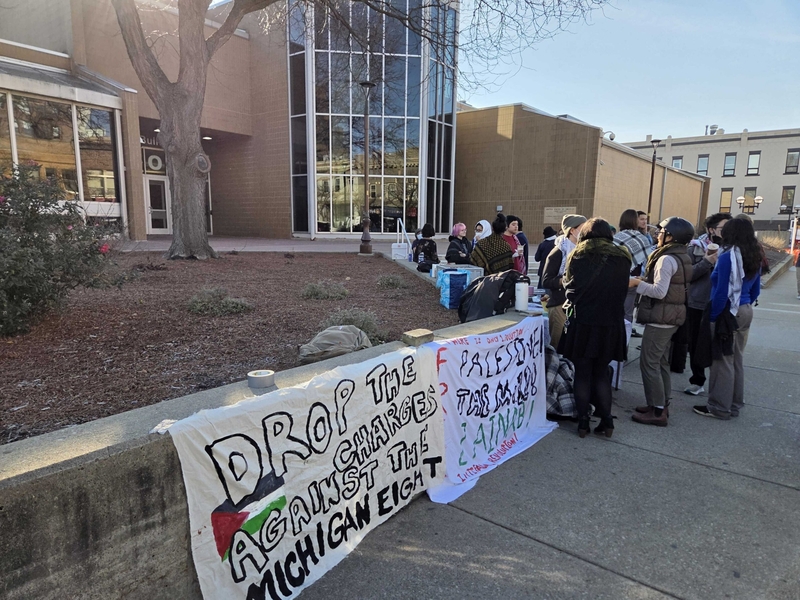
Meanwhile, Hakim was able to walk free on Wednesday. She had a crowd of supporters with her, including her parents, in the courtroom, as well as another group holding a small solidarity rally for her outside.
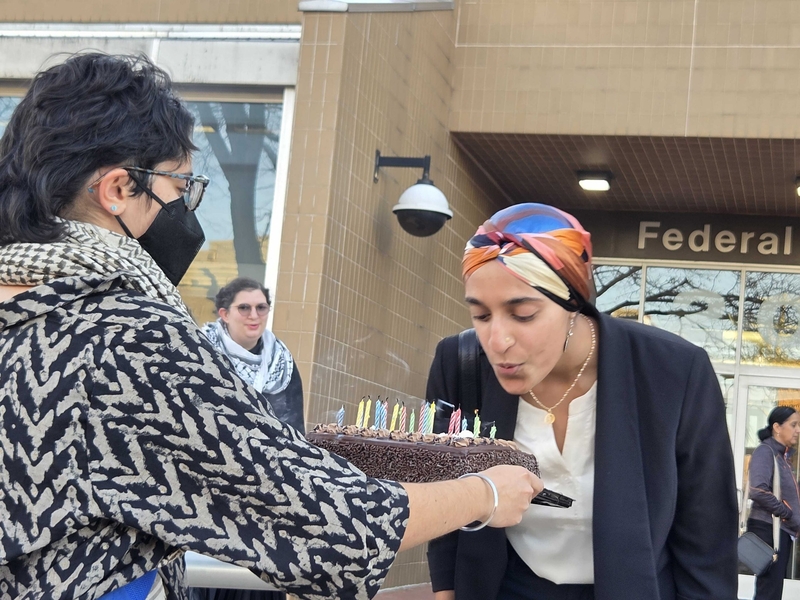
It was also Hakim’s birthday and her friends and allies presented her with a cake and sang to her on the courthouse steps following the proceedings.
Lansing, MI