Advocates, state representative criticize ‘bad faith’ appointment to sentencing commission
Nov 18, 2026 | 3:15 pm ET
Description
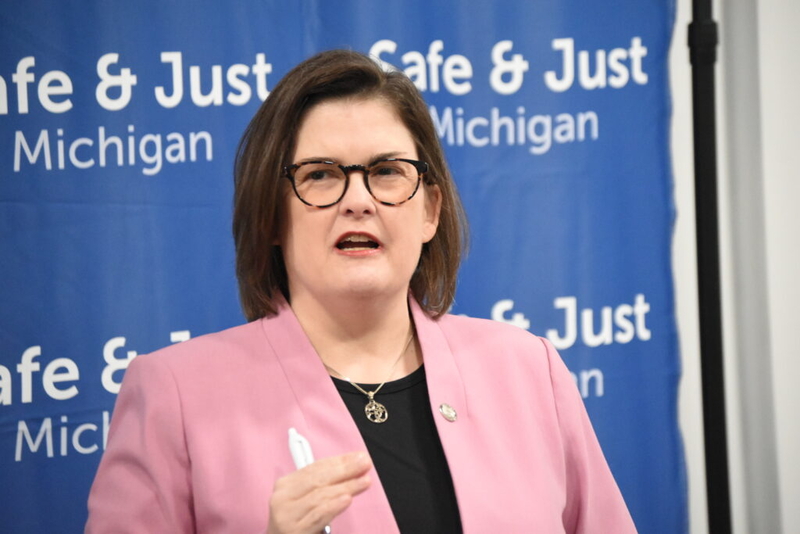
State Rep. Kara Hope (D-Holt) speaks at a press conference criticizing the appointment of former state Sen. Rick Jones to the Michigan Sentencing Commission in a seat reserved for formerly incarcerated individuals. Nov. 18, 2026. (Photo by Katherine Dailey/Michigan Advance)
State Rep. Kara Hope (D-Holt) joined criminal justice advocates Wednesday to criticize the appointment of former state Sen. Rick Jones to the Michigan Sentencing Commission, which was established in 2024 to examine the state’s sentencing laws and procedures.
Jones was appointed not because of his previous legislative experience or his time as Eaton County Sheriff — but instead to fill a seat designed for a previously incarcerated person, based on a single night spent in jail after being arrested for drunk driving in February.
“Power can sometimes be misused, and I think that’s what we saw here,” Hope said. “Misused to shut out the very people that we met to give a seat at the table, and that’s why I’m here. That’s why we’re all here, to demand that it never happens again.”
Jones was appointed to the commission, which held its first meeting in May, by outgoing Senate Minority Leader Aric Nesbitt (R-Porter Township).
Ken Nixon, director of outreach and community partnerships for Safe and Just Michigan, likened the appointment to filling a seat intended for a judge with “someone who once sat in a courtroom.”
“When the Legislature built this commission, it made a choice. It said judges get a voice, prosecutors get a voice, law enforcement gets a voice, and people who have actually lived under these sentences get a voice too,” Nixon said. “That seat was a promise, and right now that promise isn’t being kept. One night in the county jail is a bad weekend. Five years in prison changes your life. It changes your family. It changes whether your kids know you. It changes whether you can find a job or a place to live when you come home. Those are consequences this commission is supposed to weigh, and the people who carry them are the experts nobody has been asking.”
Edward Sanders, the founder and CEO of Alternative Sentencing and Reentry Solutions, who was incarcerated in a Michigan prison for over 40 years, similarly said that a person with Jones’ experience could not personally speak to the impacts on education, employment, or emotional and physical development of someone who has spent significant time in custody — especially someone who was first incarcerated as a minor, as Sanders was.
“It’s more likely that that child would die a premature death. It’s more likely that that child’s employment outcome would look different after that experience. It’s more likely that that child’s mental state would deteriorate,” he said. “A person that has spent a day in jail cannot share that with you. Not one day could that person take and explain to you what that meant or will mean for that child.”
Jones, however, sees no problem with his nomination to the commission in this seat.
“I can say truthfully that I have a great deal of knowledge about inmates as a jail administrator for four years and a sheriff for four years,” he said in an interview with the Advance. “I dealt with inmates and trained to help them, trying to restore them to being a successful person in society, and so I don’t know why she would object to me being on there, and you know that’s her prerogative. If she wants to object, that’s fine.”
Jones pointed to his time as a jail administrator and a sheriff, as well as his background in the state Legislature, as his relevant experience to serve on the commission.
“I’m certainly for reform,” he said. “I also believe, I think as most Michiganders do, if it’s a violent crime, such as a crime with a gun or rape or something, I don’t believe that we should be lowering those sentences. But if there’s other crimes that are nonviolent that we can reform, I certainly am all for.”
When asked if he had known he would be filling the position on the commission for a formerly incarcerated person, Jones said that Nesbitt mentioned that the person filling the seat had to have “served time.”
“I was contacted. They asked me if I’d serve. I get no compensation for it, and I serve. And if they want to change the rules, so be it,” Jones said. “I was arrested and served a night, and that counts for two days. I understand that’s not five years or something, but it certainly was not a happy time for me. And I understand the anxiety people have about serving.”
Hope emphasized throughout the press conference that her problem is not with Jones specifically, but instead with the fact that he was appointed in what she called bad faith to a seat intended for someone with significant experience in Michigan’s carceral system.
“This isn’t about him personally,” she said. “It’s about reading the statute in bad faith and doing something that’s completely contrary to the intent of the drafters and all the advocates who worked so hard on this.”
Nixon, who was previously incarcerated himself, also emphasized that his criticisms were not about Jones as an individual, but that it was “heartbreaking” to have a member on the commission in that seat who “can’t speak to any of the things that we’ve been through or we’ve seen or the struggles of reentry, the struggles of trying to fight your way back into society after that.”
Hope introduced a bill in the state House on Nov. 5 to alter the language that dictates the commission’s membership. The law, as currently written, states that the commission’s membership will include “One individual who was previously incarcerated,” and that member will serve for a term of three years.
Hope’s bill would amend that section of the law to specify that seat for an “individual who was convicted of a felony in this state and served a sentence of not less than 5 years in a department of corrections facility.”
“We can’t undo the commission that we have now,” Hope said. “That’s not what this bill is intended to do, but it is intended to cut the reader in bad faith, or the legislator in bad faith, off at the knees if they try to apply it in a way that’s totally contrary to what was ever intended.”
She noted during the press conference that she does not expect her bill to pass during the lame duck session that will run through the end of the calendar year. Although Hope herself decided not to seek re-election in 2026 and will be leaving the Legislature at the end of the term, she said that she has spoken with leaders of the incoming Democratic House majority, including caucus chair Rep. Stephanie Young (D-Detroit), who have committed to take up the issue next term.
José Burgos, a policy advocate for the Campaign for the Fair Sentencing of Youth who spent 27 years incarcerated in Michigan, expressed hope that the changes would eventually lead to better representation on the commission.
“I am very hopeful, very optimistic that at some point the seat that was promised to us will eventually be for somebody with that lived experience to inform that committee on the impact that those sentencing guidelines have on Michigan residents,” he said.
- November 19, 202610:54 amComments from Rick Jones have been added to this story.

Lansing, MI