Regulators keep SLECA plugged into coastal camps in Lafourche, Terrebonne
Nov 18, 2026 | 4:47 pm ET
Description
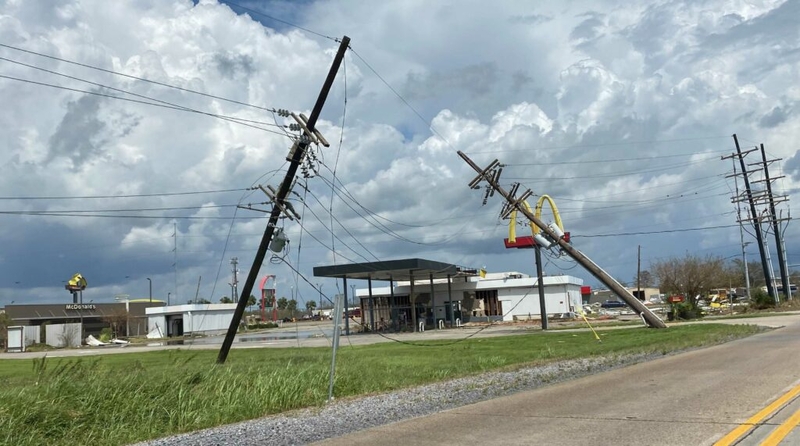
Power lines in Houma swayed following Hurricane Ida in 2021. The Louisiana Public Service Commission has denied a South Louisiana Electric Cooperative Association wish to permanently cut off portions of its service area in Lafourche and Terrebonne, damaged by Hurricane Ida five years ago. The properties are still reliant on generators. (Photo by JC Canicosa/Louisiana Illuminator)
The Louisiana Public Service Commission has denied a South Louisiana electric utility’s wish to permanently cut off portions of its service area in Lafourche and Terrebonne parishes that Hurricane Ida damaged five years ago, with the areas still reliant on generators.
Commissioners rejected a request Wednesday from the South Louisiana Electric Cooperative Association for a new hearing over whether it can abandon infrastructure in Lake Fields, Four Point Island and Grand Pass. The Public Service Commission voted in September to allow SLECA to walk away from customers it served in Lake DeCade, one of four areas it sought to leave, but it kept the other three in its network.
The four areas SLECA wanted to abandon would have left 282 properties that had electricity before the hurricane without power, according to its filings with the commission. These customers are mostly fishing and hunting camps in the coastal marshes.
A heated discussion between SLECA’s lawyers and Public Service Commission members at Wednesday’s meeting reflected many months of frustration over the matter.
Commissioner Eric Skrmetta, R-Metairie, said the co-op was making a business decision that was unfair to the affected camp owners.
“SLECA is given a license, effectively, from the commission to provide service to all people in that region who seek service,” Skrmetta said. “They are not given a license to deny service to people in that area.”
“What if this was a neighborhood, a concentrated neighborhood that had lost power? … They would have repaired their service and sent you the additional bill associated with repairing,” he added.
SLECA has said restoring power to the four areas would cost upwards of $140 million, with another $11 million to $23 million for environmental permitting and right-of-way acquisition. Though the Federal Emergency Management Agency will cover 90% of the restoration, the co-op said it would have to bill customers another $13 to $24 a month to cover its expenses.
Commissioner Davante Lewis, D-Baton Rouge, told SLECA’s lawyers the matter was settled and did not deserve a re-hearing.
“I think it is very disingenuous to constantly throw the cost out there as a consideration of understanding why you didn’t comply with (the September decision),” Lewis said.
Camp owners from the storm-damaged areas also spoke at the meeting in opposition to SLECA’s rehearing request. They have previously said the co-op has taken down power lines without the Public Service Commission’s approval.
“I understand the whole co-op would have to pay for us, but I’m part of that co-op,” Houma resident and camp owner Brent Story said. “I’ll be paying my share, as I have in the past when it wasn’t me that was being restored.”
Discussion before Wednesday’s vote turned to SLECA possibly paying settlements to the abandoned customers to cover the cost of generators, but ratepayers were unswayed.
“What would it take to make you happy?” Commissioner Foster Campbell, D-Shreveport, asked the property owners in attendance, looking for a dollar amount.
“Put my power back,” said Sara Boudreaux, one of the camp owners. “Money is not equitable.”
Skrmetta agreed, making the point that operating a generator would be a continuing expense.
“Yeah, they can give you some money, you might be able to get a generator, you might get some fuel,” he said. “Generators are mechanical. They don’t last forever. Fuel is an ongoing expense.”
Along with the high restoration costs, SLECA has said it wanted to abandon service to the areas because of safety concerns and difficulty in accessing the marshy areas in the event of an emergency.
The co-op’s leaders have argued that when the lines were originally installed in the 1960s, the land was more stable and able to support infrastructure and access. But because of “continuing coastal erosion and subsidence,” as well as repeated damage from storms, it’s a more vulnerable area than ever before and no longer in the interest of the co-op or its members to service.
The Alliance for Affordable Energy, a consumer advocacy group, has said SLECA’s quoted costs for restoration are based on the most expensive option available, and they reflect replacing infrastructure the co-op chose prematurely to remove — including lines that were hardly damaged.
Baton Rouge, LA