Gov.-elect Gina Hinojosa says she talked border with Trump, will roll back Abbott executive orders on H-1B visas, THC
Nov 18, 2026 | 4:11 pm ET
Description
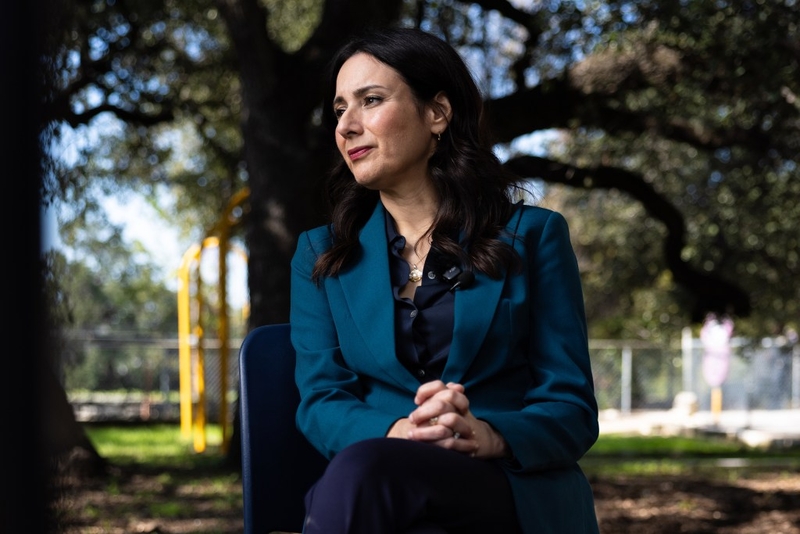
Gov.-elect Gina Hinojosa speaks to The Texas Tribune in an interview at Pease Elementary School in Austin on Nov. 18, 2026. (Jacob Lujan/The Texas Tribune)
Gov.-elect Gina Hinojosa spoke with President Donald Trump about border security Saturday and told him Texans near Big Bend National Park would rather have electronic monitoring than a border wall, she said in a wide-ranging interview Wednesday.
“He understands my commitment to keeping a secure border,” Hinojosa said. “I reached out to him to make sure that he had a direct line to me, and it was a very positive conversation. He indicated his desire to help Texas, and any friend of Texas — anybody who wants to help Texas — is a friend of mine.”
Hinojosa did not say whether Trump made any commitments about Big Bend, but she called their exchange on it “the first of what I hope is many conversations.”
She said she also plans to rescind several of Gov. Greg Abbott’s executive orders and agency directives, including one that directed state agencies to identify public lands for the detention of migrants. She also would undo Abbott’s freeze on hiring H-1B visa holders at state agencies and public universities, as well as his ban on selling hemp-derived THC products to those under the age of 21.
“I’m not doing culture wars. That’s not what I was elected to do,” Hinojosa said of the H-1B freeze. She added that the visa program has been abused but that many school districts rely on H-1B teachers.
Hinojosa revealed the Trump call and her plans for Abbott’s executive orders in an interview with The Texas Tribune that spanned public education, immigration and how she is coordinating with fellow Democrats who were elected Nov. 3 to lead state government.
During the interview, Hinojosa said she met with the rest of the statewide Democrats elected in this month’s generational wipeout and felt the entire slate was “aligned” on prioritizing affordability and reining in everyday costs.
Throughout her campaign, Hinojosa criticized Abbott for, in her view, working on behalf of his major donors and corporate interests over everyday Texans. She said during the interview that she would prioritize new anticorruption and ethics guardrails this legislative session.
She also said she wants the Legislature to repeal a law, dubbed by opponents as the “Death Star” bill, which bars cities and counties from passing measures that aren’t aligned with state law.
And she said she wants to transition away from the Teacher Incentive Allotment, a performance-based teacher pay program, toward a compensation model that boosts all teacher salaries.
Hinojosa, who takes office Jan. 19, spoke with the Tribune at her son’s former school, Pease Elementary. The school was threatened for closure, prompting her to run for the Austin ISD school board in 2012. The district is now partnering with United Way for Greater Austin to transform the campus, which closed in 2020, into an affordable early childhood education center.
Editor’s note: These responses have been lightly edited for clarity and length.
Madam Governor-elect, thank you so much for sitting down with us.
Great to be with you.
Let’s just start talking about public ed, your favorite policy issue. You talked about overhauling the [private school] voucher program, perhaps in a way that expands access to pre-K. I know you want to mitigate some of what you see as the damages of the program. I’m curious if it’s a hard line for you that the revamped program has to include pre-K.
The whole thing’s a negotiation. What we know is that our schools are in crisis, and we’re sitting on a campus right now that was shut down, but they’ve figured out a way to bring in early childhood onto this campus, and so we know that so many of the applicants for the voucher were families that were looking for pre-K help, right? And so that tells me there’s a need out there, and I think that the Legislature should be responsive to that need.
So yes, I would like to see whatever we can do to put money back into our public schools, and the Legislature is going to have to figure that out. But this was an election for change, and I do hope that the Legislature heard that and will be responsive.
Are there any must-haves that you want out of that negotiation in terms of what the program might look like in the end?
In the end, we just need to make sure that we’re fully funding our public schools.
Is there any world in which you could see the voucher program getting more funding or expanding?
I don’t really see that happening.
You also campaigned on ending state takeovers, and yesterday you said that your administration would “begin the systemic return of local control to Texas communities.” What does that mean for the eight districts that are currently under state control?
We’ll have to evaluate each district independently. But for instance, Houston is in a situation where they desperately need their schools back. And so we can already begin transitioning those schools back to the local community, and each one will be a conversation with that local community to figure out what is happening because they’re all different.
But ultimately, I don’t think it is a successful turnaround model for the state to take over a whole school district. It is not proven to be successful. It drives teachers out. Local communities should have a say in how their children are educated, and they shouldn’t have their voice taken.
So that will be my priority, and I will make sure to appoint an education commissioner who shares that priority.
Where are you in that process? I know a few weeks ago you said you were interviewing.
We’re evaluating, yes, and making sure that we get the best candidate for that position.
If state takeovers end, I’m curious how you think the state should hold districts accountable if they fail to improve student achievement. What, if any, role do you see for the state?
The accountability that’s lacking is accountability at the state level. So much of what happens at our public schools are because the state has systematically underfunded our public schools. We know Abbott started in ’23 by withholding money from our public schools and from teacher pay raises because he didn’t get his vouchers passed. That money went into the rainy day fund.
So the state bears responsibility, and I think we’re at a point because the crisis for public schools is so bad. The crisis in our public schools is so bad that the state needs to act as a partner and make sure that we are partnering with our local communities, local districts, so that our kids have what they need — because they don’t right now.
I know you’ve also said that increasing teacher pay is a priority.
Yes.
How much do you think that needs to be increased by?
We’ll see what we have available to increase teacher pay by, but we are a wealthy state. There’s no reason why we shouldn’t be paying our teachers their worth. They are not paid their worth right now, but we should have amongst the highest paid in the nation.
People should want to be teachers again. And part of my job will be to make it a profession that is appealing again to young people. We’ve had fewer and fewer certified teachers join the profession. We’ve never had a situation where we, like we have now, have more uncertified teachers than teachers joining the profession. That’s not good for kids. We need a professional educator in the classroom. That is the governor’s role to help secure that. Working with the Legislature, I think we can do it.
Would you draw from the rainy day fund, or how would you—?
Well, the rainy day fund is one-time money, so it’s not really available much for the ongoing operation of our schools.
Do you support continuing the Teacher Incentive Allotment or any kind of performance-based pay?
I’m not a big fan of the Teacher Incentive Allotment because it requires teachers to jump through more hoops to get more money, and teachers already do too much. So there are teachers who have jumped through those hoops and who are getting that money, and I want to respect that. But I think that we can have a compensation model that is really applying to all Texas teachers because all Texas teachers have a very important job of educating our kids, and right now base salary is just too low.
So you would want to transition away from the teacher incentive?
I would want to transition away from it. Yes.
Over the next session, or what kind of timeline?
Well, it’s working with the Legislature. We can figure that out. But I just don’t think it works. And I’ve heard lots of complaints about how it’s used. And ultimately, it’s about focusing on test results, and that’s how teachers are able to earn that extra money. I think a system that is teaching towards a test is not what families want.
The test should be to measure and to be able to be used in the classroom by the teachers to measure where kids are, so that our teachers know where the gaps are. It shouldn’t be used the way it’s used right now, as really a punishment for our schools and as a driver for education. That’s not good for kids, and it has not been good for Texas public schools.
Moving away from public ed, one of your big criticisms of the governor on the campaign trail is that he seemed to be working on behalf of his donors and corporate interests more than on behalf of everyday Texans. You said in your victory speech that corruption is bad, no matter which party does it, and you would build a more honest and accountable government. Do you plan to prioritize ethics and anti-corruption legislation, like campaign contribution caps?
We have now elected a new attorney general as well who has rolled out a strong ethics plan. I support it, and I think that we need big reforms when it comes to ethics. Working with the Legislature, I think it’s an important thing to do. People have lost faith in government delivering for them. We need to rebuild that trust.
What specific kind of guardrails?
There’s just so much. Like really, there’s so much. For instance, there’s been talk, really in a bipartisan way, about dark money, about AI in ads and misleading people when it comes to who candidates are and what they’re doing, when it comes to money being used from out of state to pay for those ads. So there’s just a lot. There’s very little regulation when it comes to ensuring we have ethical government, and I think people are at a point where we need better guardrails.
Do you hope the Legislature takes up those measures this session?
I do.
How do you expect that to go with the Republican-controlled Senate?
I think Republicans want a lot of those changes, too. Look, good government, clean government should not be a partisan issue. It should be something that we all want — to make sure that our taxpayer dollars are being spent on us, and not to line the pockets of donors or politicians.
I know you’ve also said that you’ll declare a cost of living emergency on your first day to freeze electricity rates. I’m hoping you could talk more about that because the state doesn’t set electricity rates. So I’m curious how you would achieve that.
Well, but the state regulates electricity rates through the Public Utility Commission, and so working with them, I think that’s something that we can accomplish.
With Abbott’s current appointees on the board?
Well, we’ll have appointees too, but with my appointees and Abbott’s appointees, making sure that we can get that done. I think that really there is pressure.
These things that I ran on, they aren’t partisan goals. They are, really, good government goals. They are being responsive to the needs — I can’t tell you how many times I heard from voters about the cost of their electricity over the summer. It’s through the roof. People are paying too much for electricity, and people know that a lot of the infrastructure that is being factored into our bills is to pay for corporations and data centers, and that’s what people are angry about. So, making sure that we’re no longer subsidizing that and providing some relief for Texans is a goal that should not just be a Democratic goal, but it should be a bipartisan goal.
Another thing that I think has changed is maybe the relationship between the state and local governments. I’m curious how you see that relationship shifting now with Democrats in control, with you in the governor’s mansion. What are the most pressing places you could see the state partnering with local governments?
We talked about schools. Most of our taxpayer dollars that go to our property taxes are going to our schools. So making sure that we’re a partner with our public schools, but also with all our local governments.
Our local governments are most responsive to the needs of their local community, and we should respect that. We should respect that local communities elected these people to represent them. This state, if it’s anything, it is diverse in all the ways. We are like a country, and what I learned in the Legislature is that for so many things, one size fits all doesn’t work because we are so different in this state.
Would you like to see the Death Star bill [HB 2127, the sweeping law that nixes certain local ordinances] repealed this session?
I would. Yes, this session I would like to see that happen.
In the local and school conversation, I’m curious what your plan would be to address property taxes.
There is so much grift in the system. What I have seen 10 years in the Legislature is, really, policy is being driven by big donors. And so my commitment and what I think is absolutely necessary is to have an audit of all the contracts, of all the programs, of everything, to make sure that we find savings for property tax relief, find savings to invest in Texans — whether it’s through property tax relief, whether it’s through paying teachers, making sure schools have what they need. But I do think there’s already a lot of money in the system that we can use to deliver for people.
That would be a process, though, right?
It would be a process. Yes, absolutely.
Would that be Sarah Eckhart in the comptroller office?
Sarah Eckhart could be a partner in that. The attorney general could be a partner in that. It’s something we can take on within our administration as well to just review our own contracts. There’s a lot of money that flows through the agencies and through the governor’s office, and making sure that — and especially through the agencies — all those contracts that have been entered into, that Texans are getting what we should be bargaining for.
Have you spoken with the rest of the incoming Big Three, [Lt. Gov.-elect Vikki Goodwin and] the presumptive speaker [Rep. Senfronia Thompson], the rest of the slate that won, about the agenda moving forward and how to work together?
Yes.
Tell me more about those conversations.
We all like each other. We all get along. We have been working together for some time, and so I’m excited about really amplifying our efforts by working together.
How do you see this partnership working? And are you aligned on what to tackle first?
I think that we are aligned on coming together to help with the burdens in this high cost economy. I hear that from all the statewide electeds. If you have been on the campaign trail in the last year, you know that has to be the priority because Texans are really struggling.
We spoke a little bit about appointees. I’m curious, generally speaking, what your approach is going to be toward replacing appointees. Do you intend to keep any of Gov. Abbott’s appointees? Are any doing a good job that you could see renewing?
Well, there’s so many. We’re talking about thousands. So, yes, I’m sure there are Abbott appointees that are doing a great job and will stay. And at the same time, I’ll use my prerogative to bring in people who are aligned with our agenda. Also there are people who are serving in these roles who understand that their agenda needs to change. I think this election was a big wake-up call for people, and I think people in both parties understand that people want change. In fact, we have a mandate for change, and I have not encountered — whether it’s been in the Legislature or in agencies, on commissions — resistance to that idea. People understand that voters spoke, and I think people want to be responsive.
Beyond Mike Morath, who I know you want to replace on day one, are there other top line important appointees that you’re thinking about? I know the secretary of state is up soon.
Right, secretary of state’s a big one as well. We’ve seen big problems, challenges with making sure that our voter applications are being processed, that people have access to the ballot. That will be a priority appointment.
Are you also looking at Gov. Abbott’s executive orders and agency directives that you might want to repeal?
Yes, we are reviewing them.
Okay, I have a few that I want to ask if you would rescind. The first one is the requirement that he rolled out for state agencies to help federal immigration officers investigate, arrest, detain unauthorized migrants.
What ICE is doing is making us less safe. We should not facilitate that. So I’d have to read the specifics of that executive order, but I do not think we should be facilitating the chaos that ICE has wrought in Texas. That is something that we’ll make sure to do what we can to stop that.
Another related immigration one was one telling the prison system and the Texas Facilities Commission to look for state land that federal agencies could use to detain and hold migrants. Would you revoke that executive order?
Yes.
While we’re still on immigration, I’m curious. I know you’ve said that we need to keep the border secure, but the operations on the interior aren’t acceptable. Tell me more what that agenda looks like.
Yeah, it means making sure we’re working with local law enforcement along the border. It means, where we can, also working with the federal government, with the Trump administration as well, to make sure the border is secure, but also making sure that people understand we have rights here, we have laws, we have customs, law enforcement requirements to make sure that we don’t have masked agents, we have body cams, we have dash cams — some accountability measures that we just currently don’t have. That’s what keeps all of us safe. That will be my priority.
I know a bunch of border sheriffs had endorsed Gov. Abbott before the election. Have you met with those folks yet?
I think a lot of those people actually didn’t endorse Gov. Abbott, as we came to find out. But no, we’re meeting with border sheriffs tomorrow.
Tell me more about those plans.
I’ve invited, with the help of longtime [Democratic state Rep.] Richard Raymond from Laredo, who’s helped convene the border sheriffs so that we can have conversations to make sure people understand that nothing has changed along the border, to make sure that any message going out by cartels trying to make money is not believed. This election was a mandate for people inside the state of Texas, not for people outside the state of Texas, and it is important to me to have a secure border, and it’s important to those border sheriffs and those border communities. And my commitment is to use my power to keep that border secure. And I will need to be working with our local law enforcement to make that happen and understand what their needs are.
Have you heard from the White House at all on this issue?
I’ve talked to President Trump on border security, and he understands my commitment to keeping a secure border. And I hope to work with him to make sure that happens.
When did you speak to President Trump?
Over the weekend.
What prompted the conversation? Tell me more about it.
I reached out to him to make sure that he had a direct line to me, and it was a very positive conversation. He indicated his desire to help Texas, and any friend of Texas — anybody who wants to help Texas — is a friend of mine.
You discussed the border. Did you discuss other issues?
We mostly discussed the border, and making sure that he understands the nuance when it comes to border security. There’s a difference between having a wall, for instance, in Big Bend than there is in South Texas. And there’s different ways we can secure our border in 2026, 2027 that involve technology and not just necessarily a physical barrier. So I just wanted to make sure he understood that I am committed to a secure border and that I would like to work in partnership with him to make sure that we do that in a way that is appropriate to the needs of Texans.
Did you talk about the plans for the wall in Big Bend?
I did mention to him that there is concern about a wall and that people there would rather have electronic monitoring. So that’s the first of what I hope is many conversations.
Is the border and immigration the most pressing place that you see to work with the White House on? Where are the areas you want to prioritize?
The border is one, but certainly there’s all sorts of federal funds that the state benefits from, and so there’s lots of areas to partner. And yes, we could use a partnership that is benefiting Texans, and there’s a lot of money at the federal level that I’ll work with, not just the Trump administration, but our new senator and our old senator and members of Congress, to make sure we can deliver for Texas.
Back to executive orders. Gov. Abbott had also issued one freezing the hiring of H-1B visa workers by state agencies and universities. Would you rescind that?
Yeah, that does not make sense to me. I will tell you, I’m not doing culture wars. That’s not what I was elected to do. There are abuses when it comes to H-1Bs, absolutely. I will tell you, companies should not be getting a bunch of tax breaks for jobs to only then use that money to hire H-1B employees. That’s wrong. That’s happening right now. I don’t support that. And I’m a labor lawyer. As a labor lawyer, I have worked in law firms that have dealt with and seen terrible abuses of H-1B workers. So there are absolutely abuses, but we need to make sure that we are smart about how we are approaching this. It’s not a one-size-fits-all.
I will tell you that a lot of school districts hire H-1B teachers because we can’t get teachers here in this state who want to work for school districts anymore. So what we have to do is be a partner, so that we alleviate and minimize the need for H-1B teachers, but that we are working with our school districts so that we have a highly qualified pool of teachers here within our own state for our schools.
One more executive order.
Okay.
There was a ban on selling THC hemp-derived products to those under the age of 21. Would you revoke that?
Yes.
You would revoke that. Okay. Would you want the Legislature to address THC?
People want access to THC. I think there should be an election. The Legislature will have to tackle that the way they see fit. But I think people deserve an election on that issue.
Disclosure: United Way for Greater Austin has been a financial supporter of The Texas Tribune within the past five years. The Texas Tribune is a nonprofit, nonpartisan news organization that is funded in part by donations from members, foundations and corporate sponsors. Financial supporters play no role in our journalism. Find a complete list of them and more information about our financial and disclosure policies here.
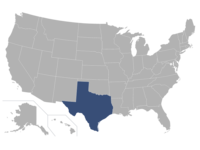
Austin, TX