State eyes restart of American Legion Bridge replacement, Capital Beltway widening
Nov 17, 2026 | 5:00 am ET
Description
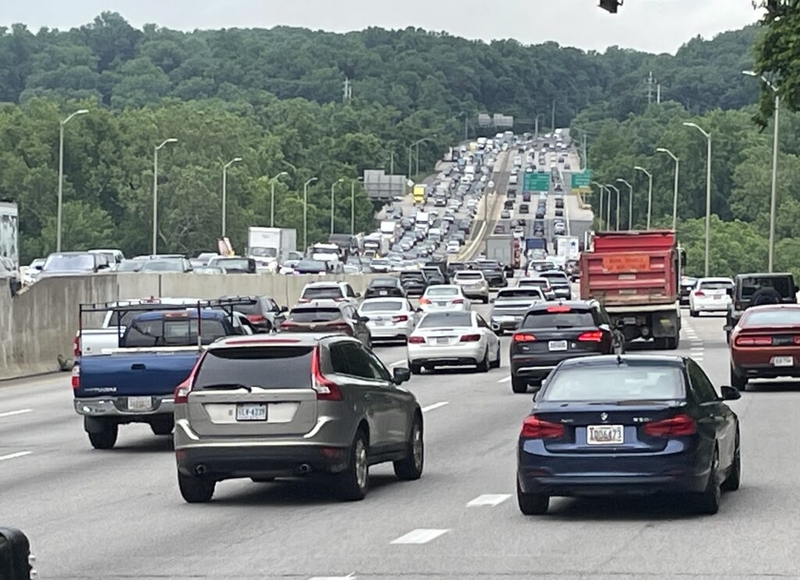
Traffic congestion along Capital Beltway including the American Legion Bridge continued to be a concern. A memo obtained by Maryland Matters suggessts state officials are looking to restart a widening project proposed six years ago and possibly partner with a private contractor to build it. (File photo by Bruce DePuyt/Maryland Matters)
State transportation officials appear ready to test industry interest again on a joint venture to replace the American Legion Bridge and widen a portion of the Capital Beltway in Montgomery County.
An internal Department of Transportation memo obtained by Maryland Matters says one option under consideration is seeking a partner for a new Public-Private Partnership — commonly known as a P3.
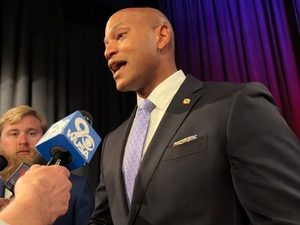
A P3 had been proposed for the project when Gov. Wes Moore (D) first entered office in 2023, but the deal fell through as the new administration questioned the benefit to the state. State transportation officials, who confirmed the authenticity of the memo, were quick to say that no decisions have been made, but that a P3 is one of the options actively under consideration.
“It’s just to get more information out into the public domain about what we expect in terms of delivering the project, and it sets the stage for us to begin to have conversations with developers … later this month into December about options for delivering this project in a way that’s going to meet Maryland’s needs and best serve the public interest,” Transportation Secretary Katie Thomson said on Monday.
The memo lays out a timeline with an industry forum and one-on-one meetings with potential contractors as the first stage, possibly by the end of the year. That would be followed by applications for P3 candidate concepts, possibly in the first part of 2027.
The Board of Public Works could be asked to designate the project a P3 in mid to late 2027, and the state could close on the financial agreement by early 2029, according to the draft memo.
As costs balloon, state officials pitch Key Bridge project to key federal lawmakers
The memo and transportation officials caution that there has been no decision “to deliver the project as a P3 or proceed with any solicitation.” But state officials acknowledge the fastest and most likely path would be to partner with a consortium that would build and profit from the project.
The project laid out in the memo is trimmed down from the $7.6 billion plan that was eyed when Moore took office, but officials say it will still be in the billions. Despite the expense, there is interest at the state and federal level to restart the project.
Thomson said she is optimistic about receiving federal grant money.
The state applied for a grant through the federal Bridge Infrastructure program, requesting $864 million to be put toward eight spans on Interstate 495, including the American Legion Bridge. The route coincides with the widening project.
“It is an important down payment on advancing the project itself, it allows us to to cover costs that would not be recoverable if we pursue a P3, like the right of way,” Thomson said.
The federal money would be coupled with state funds previously earmarked for the project
Congestion and safety issues
Replacing the aging American Legion Bridge is seen as a priority for easing congestion and improving safety.
The bridge, built in 1962, is considered to be at or near the end of its useful life. Nearly a quarter-million vehicles use the bridge each day. In all, state officials estimate there are 12 hours of congestion on the bridge daily.
“It is considered the worst bottleneck in the state for freight mobility,” said State Highway Administrator Will Pines. “All those Amazon trucks and the packages that people get every day are greatly impacted for this interstate corridor.”
Over a three-year period, the state recorded 1,000 crashes along the stretch of the proposed highway widening. One third of those involved an injury or fatality. Pines said transportation officials estimate they can reduce those injuries by as much as 28% if the project is completed.
The pre-solicitation memo restarts a conversation on a project that was essentially mothballed nearly four years ago. It also comes after Maryland officials have had a chance to talk with other states “to kind of learn how they’ve done innovative financing for large similar projects,” Pines said.
“The next step for us is to engage industry through market soundings to really understand the right structure” if a P3 were to be done, Pines said, “which again, as the secretary said, that’s not decided by this document.”
“I think the timeline in the document reflects the funding that we think could be available from a P3,” Pines said. “Certainly, if we brought public funding forward as fast as that assumption, then we would be able to meet a similar delivery schedule.”
Thomson agreed, calling a P3 “a more viable option, assuming we can get the terms and it it meets the needs that we described earlier. But if that does not appear to be the best approach, then we will work with the governor and the General Assembly to pursue public funding.”
Costs less but still ‘in the billions’
The widening of portions of the Capital Beltway in Maryland and replacement of the American Legion Bridge were first proposed roughly six years go by Republican Gov. Larry Hogan.
The original $7.6 billion plan called for construction of toll lanes to widen the Capital Beltway along a 15-mile stretch including the American Legion Bridge and Interstate 270. At the time, it was considered to be the largest public-private partnership project in the country.
A consortium led by Australia-based Transurban would have built and maintained the project and recouped costs from tolls over a 50-year period. The company has built similar toll lane facilities in Virginia. After 50 years, the entire project would have reverted to state government control.
“It was a really, really large program that frankly had a lot of challenges with it,” Pines said.
Moore entered office agreeing that congestion in the area was a problem, but his administration had questions about the proposed P3 deal. Transurban ultimately withdrew from the project. Moore later told reporters he did not oppose P3s, just “dumb P3s.”
Pines called the new vision for the project “a more truncated” version of the 2023 plan, The new plan calls for widening a 6.5-mile stretch to the I-270 spur.
“We did truncate the limits to the spur because previously the biggest controversy and sort of distaste for those lanes was really primarily in the Rockville area,” Pines said. “We worked with the mayor of Rockville and others to say, ‘This is something that may be there for the future, but for right now, we don’t need to jam a solution that you’re not looking for.'”
Proposed six-year transportation plan focuses on priorities, not new projects
Pines said a cost estimate at this stage on the truncated project is difficult, but he believes it would be less than the cost of the original project, even with the sharp increases in construction costs seen by MDOT over the last few years.
“I would say it’s definitely in the billions,” he said. “We’re not expecting it to be $7 billion because of the truncated limits, but it’s certainly a big project, and we will want to do updated cost estimates given today’s market conditions as we work towards making that delivery decision.”
Currently there is $60 million in the state’s annual transportation plan for early work on the project.
“We will continue to evaluate financing options for the bridge P3,” Thomson said last week. “As the governor has said, it’s one option as long as it’s an option that’s in the public interest. So we continue to evaluate that. But it’s really a decision for the governor and the General Assembly to make about how they want to fund these projects.”
A ‘bad rap’
But not everyone thinks P3s are a good deal for taxpayers.
Gary V. Hodge, a transportation advocate, said he worries that state officials will be seduced by P3 agreements in order to move big projects.
“I suspect that cutting deals … will mean that Maryland loses some of its autonomy and decision-making authority on transportation on our highways,” Hodge said. “So, there’s a difficult negotiation to be had there.”
Pines acknowledged the negative views some have on such agreements, but pointed to P3 agreements on projects including the Seagirt Marine Terminal and travel plazas along Interstat 95 as successes.
“Sometimes P3s can get a bad rap, but when they’re done well, done correctly, when risk is managed appropriately and the contracts are structured right, they can work and be really advantageous for the state. And we’ve seen that in several cases in Maryland,” he said.
Pines had previously said that similar projects in Georgia, Tennessee and Virginia were potential models. Those projects were based on fixed prices to build rather than a progressive model, where costs can increase as the project is built.
“We would say it’s a lesson learned that the progressive model that was attempted previously had a lot of risks that were left open,” Pines said. “I think that we want to resolve issues like right of way, utilities, and making sure that things like the design in Virginia are resolved that would allow us to move towards a fixed price rather than leaving a lot to be negotiated as an afterthought.”
Officials have also learned lessons from the Purple Line light rail project and its delays and major cost overruns.
‘The state is broke’
Thomson and Pines repeatedly stressed that a P3 is not the only financing option.
“The state could come up with additional revenues,” Thomson said when asked about the project last week.
Given the state’s financial position, that seems more difficult.
“The fundamental point … is that the state is broke. The state has no financing capacity in the transportation trust fund,” said Hodge. “So, anything that’s done capital-wise, and we’re talking a huge swath of projects — we’re talking about everything from the Red Line in Baltimore to my project in Southern Maryland, the Southern Maryland Rapid Transit Project, the Key Bridge, the American Legion Bridge, on and on — the state has absolutely no money for any of these projects in the capital fund.”
Thomson, in a letter to county officials last week, reiterated that her agency would focus on existing projects and maintenance over new projects.
“One of the things that we intend to work with the General Assembly on in this next session is sufficient, predictable, and sustainable funding for the transportation trust fund that would allow us to continue to invest in critical capital investment projects across the system,” Thomson said Monday.
Pines said relying on traditional public funding of the project based on current finances would force the state to reprioritize projects in its six-year program.
“There’s a lot of other competing needs,” Pines said. “It’s important to us that if a P3 is considered, that we actually make sure that it’s a smart decision, not just a hold your nose and take it. We want to make sure we get this thing right and that we make an intelligent, well informed, deliberative decision.”
Annapolis, MD