Survey shows broad agreement on school screen time limits, value of devices
Nov 11, 2026 | 5:59 am ET

Description
A child with a finger on a tablet. The Commission on Screen-Based Instruction, formed by Gov. Kay Ivey, reviewed preliminary results of a survey on attitudes about screen usage in classroom, ahead of filing a final report to the governor next month. (Oscar Lopez Rogado via Getty Images)
A survey of over 3,400 Alabama parents and school employees found broad agreement about time limits on screen use by students, though several instructors also noted that the devices could be useful in classrooms.
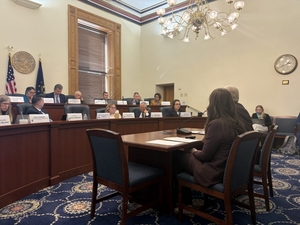
The Commission on Screen-Based Instruction, formed by Gov. Kay Ivey, reviewed preliminary results of the survey on Tuesday, ahead of sending a final report to the governor next month.
Over 3,000 teachers and parents; nearly 400 school leaders and roughly 30 IT directors and staff participated in the survey. The survey was self-selecting, meaning people volunteered to take the survey.
Teachers who responded said they used screens in classrooms for assessment or progress monitoring, independent work, review skills, research and core instruction, among other tasks.
“What was interesting to the research team is that all of these activities are used (at least) sometimes or more (frequently in the classroom). So everything from passive practice review types of things to student creation work,” said Stefani Wind, a professor at The University of Alabama who worked on the survey.
Of the respondents, 50% of parents, teachers and school leaders strongly agreed that students are distracted by non-instructional content, or content that doesn’t directly involve teaching or coursework, and at least 30% of teachers, school leaders and parents agreed or strongly agreed that it’s difficult to bring attention back to instructional material after using devices.
Over 80% of teachers, parents and school leaders agreed that regular screen-free periods would benefit students.
The survey also took open-ended responses from teachers, parents and school leaders.
“Screen use interferes with the way the brain works and prevent(s) retention and transfer of information,” one school leader said. “Learning apps ‘gamify’ education to promote ‘engagement,’ but engagement does not mean learning.”
One parent said that while devices can be useful in classrooms, they shouldn’t be used across all grade levels.
“We need to be cognizant of how much time students are spending on screens. In my opinion, my five-year-old kindergartener should not know how to use a Chromebook and sign into Google Classroom,” the parent wrote.
One teacher wrote that they liked the access to information devices in the classroom provided and said there should be guidance.
“Sometimes, a kid might have 30 minutes on a screen, but during a research project,” the teacher said. “It might be more like an hour just because that’s the most efficient (and relevant) research tool.”
Brandy White, superintendent of Houston County Schools and a member of the commission, said in an interview after the meeting that the survey results were encouraging.
“There were times where they may have their Chromebook open, but it’s actually guided instruction where the teacher is up at the board, and she’s going over certain questions,” White said. “So that looks like screen time, if you just calculate the amount of time that they were on it, but it’s actually guided instruction where they’re communicating back and forth.”
Rep. Jeana Ross, R-Guntersville, said after the meeting that filing legislation is a “possibility.”
“I think first you got to look at the recommendations and see exactly what’s in there, and also I want to talk some more to teachers and local school districts because that teacher autonomy I think is very important. But sometimes it helps, you know, to have some kind of guidance for them to be able to fall back on,” she said.
The committee will deliver its final report to Ivey on Dec. 1.
Montgomery