SC preservationists worry federal permitting bill could make saving historic sites more difficult
Nov 10, 2026 | 6:00 pm ET
Description
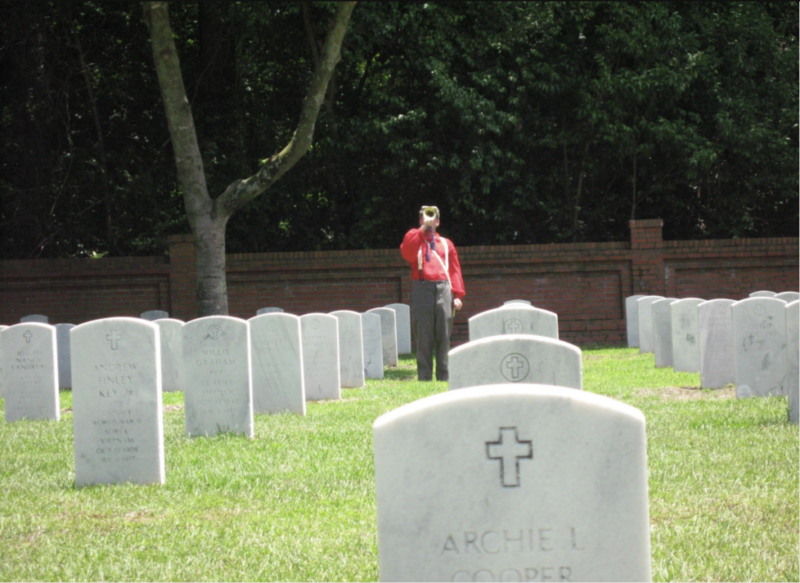
A trumpeter plays at Florence National Cemetery during a burial service for a skeleton uncovered during an archaeological survey to expand the cemetery on May 16, 2010. (Photo courtesy of Friends of Florence Stockade)
Portions of a federal bill meant to speed up permitting could make saving South Carolina’s historic sites more difficult, state preservationists said ahead of an expected vote on the bill this week.
A massive regulatory bill advanced in the U.S. Senate on Monday in a technical vote that sent the proposal to the floor.
Advocates for preserving historic sites said a section of the bill could claw back protections written in federal law 60 years ago that require government agencies to consult with local communities before interfering with potentially significant areas.
The bill’s supporters say it will improve efficiency in government permitting, allowing energy-related projects, such as gas plants, oil drilling, and wind and solar projects, to face fewer delays.
“For far too long, our broken and outdated federal environmental review and permitting processes have stood in the way of energy reliability, secure jobs, modern infrastructure, and economic growth,” U.S. Sen. Shelley Moore Capito, a West Virginia Republican and the bill’s main sponsor, said in a news release.
The three co-sponsors are from New Mexico, Rhode Island and Utah.
Preservation advocates are worried about a section of the nearly 500-page bill that would change the process for deciding when a project affects culturally or historically significant areas.
Under those changes to the 1966 National Historic Preservation Act, federal projects could move forward with little input from surrounding communities, say preservationists opposed to the changes.
“Essentially, the opportunity for public input would be stripped,” said John Sherrer, director of preservation for Historic Columbia.
More than a dozen South Carolina preservation groups signed onto a letter opposing the project, joining more than 600 similar groups nationwide.
What does the bill do?
Under the National Historic Preservation Act, any project using federal money has to go through a review process to make sure changes won’t affect any nearby cultural or historic resources.
That could mean demolishing historic buildings, developing unmarked cemeteries or battlefields, or building projects that conflict with an area’s appearance, said Brian Turner, president of the Preservation Society of Charleston.
In its effort to speed up the permitting process, the bill would remove much of the local input, instead leaving decisions as to whether an area is significant up to the federal agency, said James Stewart, president of the Archaeological Society of South Carolina.

The proposal requires input from neighbors only if the project is under “substantial federal control,” which is not defined.
Getting detailed regulations explaining which projects would be covered could take years and introduce confusion into the process, Turner said.
“Our concern is that this defeats the very purpose of the bill, to create so much unpredictability and revision to an existing process,” he said.
When building new projects, federal agencies wouldn’t have to take into account the character of the area, opening up the possibility of creating eyesores in otherwise historic areas, Turner said.
Take, for instance, the sea wall designed to protect Charleston from storm surges and flooding. The city needed help to pay for the roughly $1.3 billion project along The Battery at the southern end of the peninsula. But that doesn’t mean people should have to look at a concrete wall instead of the harbor, Turner said.
“We would expect that the (Army Corps of Engineers), when it comes, doesn’t just design a big concrete barrier around the peninsula but instead makes it more aesthetically arranged with our historic district,” Turner said.
Cutting locals out of the process could mean losing stories federal officials wouldn’t otherwise know about, Stewart said.
“You don’t have the context to say, ‘This is where this important historical event occurred,’” he said.
Preservationists hope SC battlefield’s designation as endangered will boost attention
The changes might also make it so federal officials don’t have to consider portions of sprawling battlefields when building new projects, he said.
Because battlegrounds generally aren’t well-marked, it’s hard to say where an archaeologist might find important artifacts or markers without first doing a survey, Stewart said.
The same is true of many small, historic cemeteries, he said. Sometimes, those types of places remain undiscovered until a project such as a road widening starts and officials uncover remains or artifacts.
Under the proposed changes, “you’re going to have cemeteries and sites that are going to be graded and paved over all over the state,” Stewart said.
How the federal law has been used in SC
During a planned 10-acre expansion of the Florence National Cemetery in 2005, local advocates for historic preservation raised concerns that work might interfere with unmarked portions of a Confederate prison camp.
Under the federal law, state and federal officials organized a survey of the area.
Archaeologists unearthed hundreds of previously unmarked features of the prison camp for Union soldiers, including dropped buttons, fences and poles giving a clearer idea of the stockade’s dimensions, and a human skeleton, said John Andrews, president of Friends of the Florence Stockade.
Without the survey, “those things would have been lost,” Andrews said. “Nobody would have found them, or they would have been ignored.”
Scientists identify a soldier who died in the 1780 Battle of Camden, hold out hope of naming others
Local historical groups buried the skeleton in an unmarked grave, giving respect to the unidentified soldier, Andrews said.
And the findings of the survey helped researchers better understand what might have happened at the stockade, where the Confederate Army held as many as 15,000 captured Union soldiers, thousands of whom died there.
“That information is important to understanding the period and understanding how men on both sides of this conflict lived and how they survived or didn’t survive during that period,” Andrews said.
The Florence stockade isn’t much of a tourist attraction, but it’s still important to save, Andrews said.
“History’s not always pleasant,” he said. “How do you honor those people who died there? You need to preserve that site.”
The recovery of the H.L. Hunley, a Confederate submarine, was also done under the preservation law.
Because the submarine was considered a historic artifact, the Navy had to consult with local partners when moving and preserving the ship to ensure as little damage as possible, according to the Preservation Society of Charleston.
Other examples of where the federal law played an important role include the city of Columbia’s decision in 2021 to raze two crumbling public housing complexes, Gonzales Gardens and Allen Benedict Court, Sherrer said.
The two complexes were among the first public housing complexes in the country, though they had grown dated and dangerous over time. In 2019, two men died of carbon monoxide poisoning at Allen Benedict Court due to a faulty furnace.
Because federal agencies had to give local historians a heads up before demolishing the property, Historic Columbia researchers saved photographs of the complexes, collected stories from former residents, and created a website detailing the history of public housing in the city.
Those sorts of stories, which don’t seem important to outsiders but matter a lot to people in the community, are the ones that might get lost without public input, Sherrer said.
“What if you grew up in an area and that area was totally erased because of some project using federal funds, which you contributed to with your tax dollars, and you had no say-so in that?” he said.
That happened in the early 1950s, after the federal government took 310 square miles from Barnwell, Aiken and Allendale counties to create the Savannah River Plant to produce nuclear materials for bombs.
In 1950, about 6,000 people were given 15 months to evacuate from small towns before they were wiped off the map. About 6,000 graves were also moved. Local officials’ post-Cold War efforts to get some of the land back have failed.
Columbia