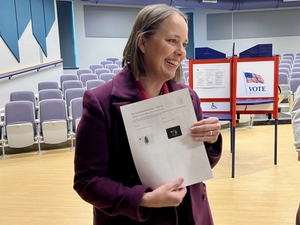
She graduated from a segregated high school at 27. Now 105, she returned for its centennial.
Oct 27, 2026 | 3:01 pm ET

Description
Around a hundred people attended the centennial ceremony of the Rosenwald School in St. George on Saturday, Oct. 24, 2026. (Photo by Tiffany Tan/Special to the SC Daily Gazette)
ST. GEORGE — Clara Mae Britt graduated from high school at 27, the oldest in her class by about a decade. After quitting school in eighth grade to help her family make money, Britt was excited to go back six years later, even if she had to repeat elementary classes at 22.
Holding on to her dream of becoming a teacher, despite poverty and racial discrimination, Britt became part of the pioneering 12th grade class of the Rosenwald School in St. George.

On Saturday morning, nearly eight decades since Britt graduated in 1949, she returned to the formerly segregated school for Black children.
Dressed in a matching sequined top and skirt, she was given a seat of honor on the school’s front porch, looking over a hundred people who came to mark the school’s centennial on the sunny fall day.
“I was glad that I could be there,” Britt, now 105 years old, told the SC Daily Gazette, “and to know what’s going on.”
She is the school’s oldest-living student and, with her sharp memory, fellow alumni regard her as the best narrator of its history.
The existing wood-frame structure, built from 1925 to 1926, was constructed through the Rosenwald Schools fund.
It was a matching grant program established by wealthy philanthropist Julius Rosenwald in the early 20th century, which sought to improve education for hundreds of thousands of African American children in the segregated South.
Rosenwald, president of Sears Roebuck and Co., started the program with Booker T. Washington, who rose from slavery to become president of Tuskegee Institute (now Tuskegee University).
The program helped build more than 5,000 schools all over the South by the time construction ended in 1932, when Rosenwald died.
The school in rural Dorchester County, which opened in October 1926, was among nearly 500 Rosenwald schools built in South Carolina. It closed five years after Britt graduated.

It’s now only one of around 40 still standing in the state, according to a WeGOJA Foundation study in support of a proposal to create a Rosenwald trail system linking six of them.
Two stone markers in the front yard bore the names of some of the students who attended the six-classroom school, initially called the St. George Colored School, then renamed Williams Memorial High to honor its former principal, the Rev. A.D. Williams.
The people who gathered for the 100th anniversary celebration included other graduates or their descendants. They considered the Ronsenwald school a symbol of perseverance, community and opportunity in an era when government support for Black schools was severely inadequate.
The crowd sang “Lift Every Voice and Sing,” widely called the Black national anthem.
“Sing a song full of the faith that the dark past has taught us,” they sang in unity. “Sing a song full of the hope that the present has brought us. Facing the rising sun of our new day begun, let us march on till victory is won.”
The St. George school reopened as a community center in 2023 after a years-long renovation effort led by Ralph James, who attended the school through second grade and chairs the nonprofit board that manages it. Funding included $1.3 million from the state budget through earmarks sponsored by local legislators.
The school auditorium has been turned into an event space for rent, hosting celebrations such as birthday parties and bridal showers. Three of the school’s six original classrooms have been repurposed into a satellite location of the Children’s Museum of the Lowcountry, filled with toys and books.
Two of the classrooms have been set up to show visitors how they would have looked back in their Rosenwald School days. Columns of small wooden desks, some scarred with inscriptions, face the blackboard. A teacher’s desk holds teaching materials.
Proposed national historic park would highlight history of SC’s Rosenwald schools for Black students
The school library has been redone as an exhibition room, with photos from the Civil Rights Movement, when the building became a meeting site for organizers.
The materials include a magazine article on Britt.
She is the second oldest-known student of a Rosenwald School in South Carolina, according to research by Dr. Valinda Littlefield, associate professor of history at the University of South Carolina, who conducted the WeGOJA study. (The oldest is Thelma Strother of Lexington, who turned 107 last month.)
“That is rare,” Littlefield said of a centenarian alum’s presence at the centennial of a historic Rosenwald School.
A year before Britt (whose maiden name is Dixon) graduated from high school, she married Arrie Britt, an Army veteran.

Altogether, they had five children, four of whom served in the military. Four finished college, with two getting master’s degrees and one obtaining a doctorate.
Flo Sanders, Britt’s oldest child at 73, said her mom emphasized the importance of education, even when the family had no idea how they’d pay to send their children to college.
“She said, ‘You got to get a good education to be able to make a good living,’” the licensed professional counselor said during a visit to her mom’s house. “We heard that our entire lives.”
Britt was the eighth of nine children, born in the St. George area, where she’s lived all her life. She was able to return to school in 1944 when one of her brothers began sending money home after joining the Navy.
“I wanted to go back,” she said. “My mom and all of them, see, they just went to third grade, and then they didn’t have no more school.”
Britt never attained her dream of becoming a school teacher, because she did not have the money to go to college.
But she was happy to achieve what she considers the next best thing: being a Sunday school teacher at St. Mark Missionary Baptist Church, where she’s been a life-long member.
Editor’s note: This article has been updated to clarify the school was renamed Williams Memorial High in the 1940s. That name transferred to another school when the Rosenwald School closed in 1954.
Columbia