Judge weighs dismissing charges against journalists in anti-ICE church protest
Nov 10, 2026 | 8:29 am ET
Description
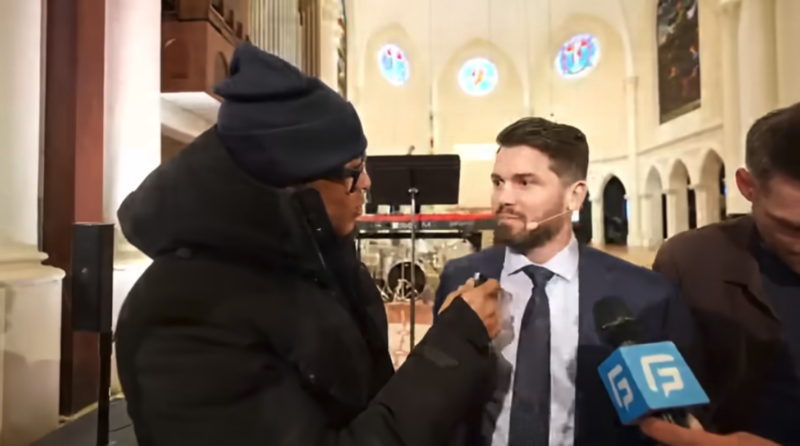
Journalists Don Lemon and Georgia Fort (off camera) interview Cities Church Pastor Jonathan Parnell during the protest inside the church on Jan. 18, 2026 (Screenshot from The Don Lemon Show)
Attorneys for five journalists facing felony charges over an anti-ICE protest inside a St. Paul church urged a federal magistrate judge during a Monday court hearing to reject the “vindictive” prosecution of the press by the Trump administration and dismiss the charges.
Former CNN anchor Don Lemon, Center for Broadcast Journalism founder Georgia Fort and three other journalists — Michael Beute, Jerome Richardson and Shane Bollman — were charged after covering a January protest disrupting a Sunday service at Cities Church, where a U.S. Immigration and Customs Enforcement field director serves as a pastor.
Attorneys for Lemon, Fort and the other journalists accused the federal government of criminalizing journalism and said that even if every allegation in the indictment were true, their clients’ actions would not constitute a crime.
“This is what a vindictive prosecution looks like,” Isabella Salomão Nascimento, an attorney representing Fort, told the judge Monday. (Salomão Nascimento of the firm Ballard Spahr has represented the Reformer on unrelated matters.)
The court’s decision could have implications for press freedom across the country. Allowing the case to proceed may have a chilling effect by forcing journalists to weigh the risk of a costly trial before covering protests or other newsworthy events the federal government views unfavorably.
Federal prosecutors said the journalist label can’t be used as a shield for illegal conduct, alleging all 39 defendants carried out a coordinated “invasion” of the church aimed at disrupting religious worship.
“They were not singled out because they were journalists. They were not singled out at all,” federal prosecutor Neville Hedley said.
Attorneys argued over the motions to dismiss before U.S. Magistrate Judge Douglas Micko in a packed downtown St. Paul courtroom. Micko will issue a recommendation on the motions to U.S. District Judge Laura Provinzino.
The Jan. 18 protest came at the height of Operation Metro Surge, when President Trump sent about 3,000 federal agents to Minnesota in what the Department of Homeland Security called its largest operation ever. Demonstrators, led by civil rights attorney Nekima Levy Armstrong and St. Paul School Board Member Chauntyll Allen, interrupted the service with chants of “Justice for Renee Good,” who was shot and killed by an ICE agent earlier that month.
Demonstrators targeted the church because one of its pastors, David Easterwood, is also an ICE field director. Easterwood was not present, but protesters confronted Lead Pastor Jonathan Parnell.
Fort, who was in court Monday, and Lemon, who hosts a show on YouTube and was not present, livestreamed the protest and asked Parnell questions. Beute was Lemon’s photographer and Richardson his assistant.
According to federal prosecutors, some congregants feared the demonstration was the start of a mass shooting, and a child asked whether their parents were going to die. They also acknowledged not every parishioner felt intimidated or scared.
All 39 defendants face the same two charges: conspiracy against the right of religious freedom at a place of worship and injuring, intimidating and interfering with the exercise of the right of religious freedom at a place of worship.
The felony charges were aggressive even for an administration known to tangle with the media, including suing over disagreeable coverage, mocking journalists based on their appearances and barring reporters from the White House.
The charges drew swift condemnation from news organizations, including from the Minnesota Reformer, which joined a consortium of news organizations in filing a “friend-of-the-court” brief calling for dismissal based on First Amendment grounds.
Right to gather news
Attorneys for the journalists argued that the First Amendment protects their right to observe and document newsworthy events, even if illegal activity occurs.
Abbe Lowell, an attorney for Lemon, said charging journalists for doing so “would make virtually all important journalism a crime.”
Lowell listed the verbs prosecutors used to describe Lemon’s conduct in the indictment: He “livestreamed,” “observed,” and “asked.” None amounts to threatening or intimidating worshippers, Lowell said.
Among the worst that Fort, Lemon, Richardson and Beute are accused of in the indictment is “largely” surrounding the pastor as Lemon “peppered him with questions,” which prosecutors allege “obstructed his freedom of movement.” Prosecutors also allege Lemon stood at the main entrance and confronted congregants.
Attorneys argued that even if their clients engaged in everything the government alleges, no crime was committed.
“The government has pleaded themselves out of court,” Matthew Ebert, an attorney for Fort, told the judge.
Prosecutors repeatedly referred to the group as a “mob” and urged Micko to consider the journalists’ conduct as part of a coordinated effort rather than in isolation.
Rob Keenan, a federal prosecutor, cited a Russian general whose name he couldn’t remember saying something along the lines of “quantity has a quality all of its own.” He also compared journalists to the getaway driver of a bank heist, alleging they were in on the crime even if they didn’t personally demand the teller fill up a bag with cash.
“It was joint mob action,” Keenan said.
FACE Act challenge
Defense attorneys also asked the court to strike down the portion of the Freedom of Access to Clinic Entrances Act — the FACE Act — that protects religious worship, arguing that Congress exceeded its constitutional authority under the Commerce Clause when it adopted the law in 1994.
The law, signed by President Bill Clinton, came in response to attacks on abortion providers and patients. A Republican added protections to places of worship as a poison pill to doom its passage, but Democrats didn’t object.
Charges have rarely been brought under the FACE Act’s religious worship provision, and the constitutionality of it has not been decided by the courts.
The journalists’ attorneys argued that religious services are not inherently economic activity that involve interstate commerce and therefore fall outside Congress’ authority.
Federal prosecutor Katie Neff pushed back, noting that Cities Church receives many out-of-state donations, and it sends a portion of its revenue to the Southern Baptist Convention in Tennessee.
Micko, the judge, said it would seem problematic to conflate commercial activity with religious activity.
“That fundamentally misunderstands religion in America today,” Neff said.
Micko could recommend dismissing the charges without deciding the constitutionality of the law.
He did not rule Monday. His recommendation will go to Provinzino, who will determine whether the case can proceed toward trial.
Vindictive prosecution
The journalists’ attorneys also alleged the Trump administration brought the case in retaliation for coverage that angered the president, noting his extensive record of criticizing Lemon.
“This is a vindictive prosecution brought against one of the president’s perceived enemies,” said Joe Thompson, an attorney for Lemon and a former federal prosecutor who resigned during Operation Metro Surge.
Federal prosecutors denied that the journalists were targeted, but defense attorneys pointed to public statements from Trump and top administration officials condemning Lemon before charges were filed.
The day after the protest, Harmeet Dhillon, then the Justice Department’s assistant attorney general for civil rights, warned Lemon on social media that he was “on notice” and claimed the First Amendment did not protect his “pseudo journalism.”
President Donald Trump called Lemon a “loser” and “lightweight,” while Attorney General Pam Bondi characterized him as an “online agitator” during a Fox News appearance.
“That’s clear proof of actual vindictiveness,” Salomão Nascimento said.

Saint Paul, MN