Is the honeymoon over for data centers in Washington?
Nov 10, 2026 | 7:00 am ET
Description
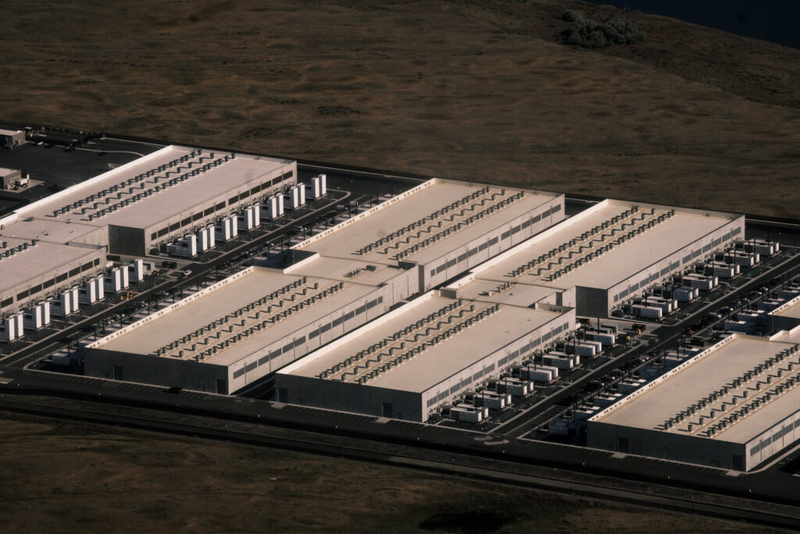
A data center along the Columbia River Gorge. (Photo by Jordan Gale/Oregon Capital Chronicle)
Data center regulations are the event horizon that communities across the nation, including in Washington state, are calling on their elected officials to achieve.
The blue wave that flooded the nation after Tuesday’s election also made its landing in the Washington state House of Representatives, where, for the first time since 1929, Democrats hold a supermajority.
With an even stronger presence in the state Legislature, will Washington Democrats hone in on the issue next year?
Last week during a press conference, Gov. Bob Ferguson said he’s “confident” that the Legislature will pass “something” on data centers during the 2027 session.
“There is … a political will to get to a resolution,” Ferguson said. “I do think it will lead to an outcome. I don’t think it’s going to leave some political stalemate.”
Across the state, communities are demanding a moratorium on data centers. Their concerns are widespread: water consumption, noise pollution, location near communities, power consumption on a strained grid, groundwater contamination and a lack of transparency from elected officials.
“I’m asking very simple questions and I can’t get a basic, simple number answer like, how much water are they going to use? How much electric are they going to use?” said Brittany Anderson, a Spokane-based activist who’s investigated hyperscale data centers in Eastern Washington. “This is unprecedented for our county. We do not have this particular type of development.”
Washington ranks 10th in the nation for the number of data centers in operation, though the number of facilities is disputed. More than 100 data centers are estimated to be operating in the state, according to Front and Centered, a coalition of more than 50 Washington community-based organizations.
Some communities have taken action. Data center moratoria exist in Seattle, Spokane, Pasco, Federal Way, Burien and in the counties of Spokane, Snohomish, Pierce, Skagit, Skamania and Yakima. In October, communities across Washington protested in sync, demanding a statewide moratorium. Front and Centered has also called on the state to act.
“Allowing the rapid build-out of hyperscale data centers without having more clarity about how existing facilities are harming Washingtonians sends a clear message that our decision-makers value profit over our own people,” reads a Front and Centered 76-page report released in July.
The group describes a statewide moratorium “as a way to build upon Washington’s existing commitments to environmental justice and protecting overburdened communities.”
So far, lawmakers haven’t pursued that route.
A moratorium is “a short-term solution,” said Rep. Beth Doglio, D-Olympia, who sponsored a sweeping data center regulation bill during the last session. “I’m far more interested in putting in place guardrails.”
What did pass this year was a bill that eliminated tax breaks for replacing or refurbishing older server equipment. A separate tax break is still in place for new facilities that purchase the equipment for the first time. The state also offers a tax break on labor to install that equipment.
Doglio’s bill fell short in the eleventh hour. She blames big tech.
“There was considerable pressure from the data center industry to kill the bill,” said Doglio, who chairs the House Environment and Energy Committee. “There are particular issues that continue to be challenging, and that includes curtailment.”
What is curtailment? During a major climate event, for example, when the grid is at peak capacity, Doglio wants data centers to temporarily shut off operations and rely on backup generators. This would ease grid pressure and could save folks from a power outage.
“Just like any other large load that utilities serve, they should have some responsibility for curtailing their use in the very rare instances,” Doglio said.
She’s bringing the bill back next year with a new provision: transparency. That includes banning non-disclosure agreements, she said.
Earlier this year, Walla Walla Port Commissioners announced that Amazon Web Services was behind the purchase of some 500 acres in a nearby industrial park. For three years, the commissioners kept the corporation’s name under wraps as part of a non-disclosure agreement signed in 2023, Patrick Reay, executive director, previously told the Standard.
Doglio has also been working with the state’s Utilities and Transportation Commission on another idea. In theory, utilities would charge data centers additional fees if they use a certain amount of energy. She wants to avoid passing massive power costs onto ratepayers. A similar provision was included in last session’s bill.
Anderson, the Spokane-based activist says she’s “strongly dissatisfied” with Washington’s lack of regulations. She ran as a write-in candidate for Washington’s 5th Congressional District with a campaign focused on data center regulation.
“They’re not putting the people first,” she said.
Olympia, WA