Terri Sewell plans to refile legislation restoring Voting Rights Act
Nov 10, 2026 | 6:01 am ET
Description
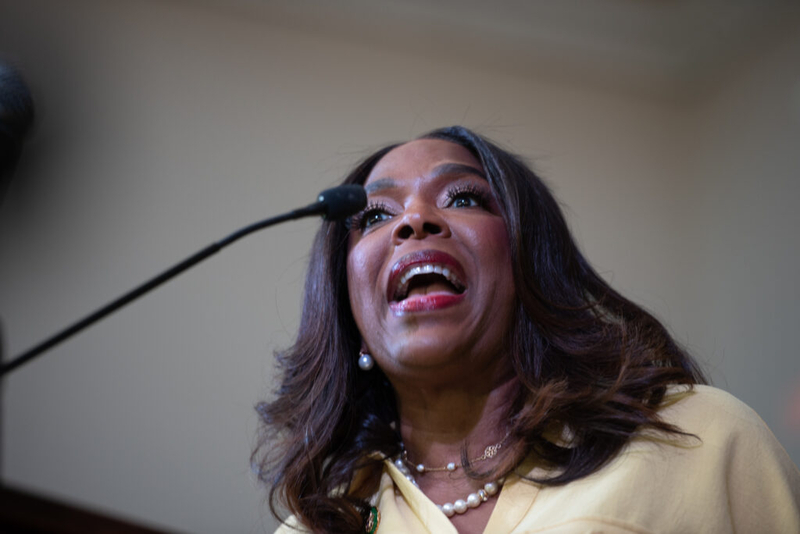
U.S. Rep. Terri Sewell, D-Birmingham, addresses the Tabernacle Baptist Church In Selma, Alabama on May 16, 2026. Sewell said in a statement Monday she would reintroduce the John R. Lewis Voting Rights Advancement Act, aimed at restoring parts of the Voting Rights Act gutted by the U.S. Supreme Court. (Andi Rice for Alabama Reflector)
U.S. Rep. Terri Sewell, D-Birmingham, plans to refile a bill to restore major provisions of the Voting Rights Act gutted by the U.S. Supreme Court.
Sewell in a statement Monday that action on the new version of the John R. Lewis Voting Rights Advancement Act, named after the icon of the Civil Rights Movement and former Georgia congressman, was “more urgent than ever given the Supreme Court’s repeated decisions gutting the Voting Rights Act of 1965.”
The Supreme Court in Louisiana v. Callais, handed down in April, severely weakened Section 2 of the Voting Rights Act, making it harder for plaintiffs to challenge congressional districts as racial gerrymanders. The decision, which led to widespread gerrymandering by Republican-controlled Legislatures in the South, helped spur Black turnout around the country, delivering control of Congress to the Democrats.
“I am working closely with voting rights organizations and my colleagues in the House to ensure the next version of the bill responds directly to the Court’s recent rulings and provides stronger tools to combat modern-day voter discrimination,” Sewell’s statement said. “In particular, we are examining ways to address the harmful consequences of decisions like Callais, which paved the way for states like Alabama to adopt discriminatory maps in an effort to silence Black and minority voters.”
The John R. Lewis Voting Rights Advancement Act was first introduced by Sewell in 2021 as a response to the Shelby County v. Holder case, which gutted Section 5 of the 1965 Voting Rights Act, requiring states and areas with histories of racially discriminatory voting laws, such as Alabama, to have changes to election statutes pre-cleared by the U.S. Department of Justice.
Challenges
The bill could pass Congress, but would likely face a veto threat from President Donald Trump, a Republican. Experts also said that the bill would have to confront the court’s holdings in Holder and Callais and its interpretation of a 1982 amendment to the Voting Rights Act, which itself was a response to the Supreme Court’s ruling in Mobile v. Bolden in 1980, which said a law had to have a racially discriminatory purpose to violate the Constitution, not discriminatory effects.
“Congress is empowered to talk about what we call the effects test, the effect of a rule that dilutes people’s votes, and so Congress has to be creative in how it does that, because the court said that the way that Congress did that through the original Voting Rights Act, or at least the 1982 amendment, was unconstitutional,” said Arthur Ago, director of strategic litigation and advocacy with the Southern Poverty Law Center, in an interview on Friday.
Because Democrats now control the U.S. House and Senate, Ago said passing the bill could be easier than last time.
“There is, I think, an appetite to pass this, and so now the work for them and alongside organizations such as ours, who does this advocacy work in this space, is really the beginning, and to signal to the country that it’s really important to pass this act,” he said.
David Hughes, a political science professor at University of Louisiana at Lafayette, said Monday addressing the Holder decision will be simple for Sewell, but addressing the court’s ruling in Callais will be more difficult. Callais, he said, told judges “how they have to interpret Section 2 and the relevant precedents around it when plaintiffs come asking for relief.”
“If I were putting on my political science hat, I would say don’t even bother trying to find the right magic words that are going to make the Supreme Court happy that accomplishes what you want to accomplish politically through updating the laws of the United States,” he said. “Your time would be better spent attacking the Supreme Court, trying to get some of the conservatives to retire or add new seats to the court that would eventually interpret your updated Section 2 the way you want them to interpret it.”
Redistricting looming
U.S. Rep. Shomari Figures, D-Montgomery, managed to win re-election in Alabama’s 2nd Congressional District last week despite a Republican gerrymander meant to draw him out. He said in a statement Monday that the bill had to “guard against some of the tactics we’ve seen deployed this cycle, like mid-decade redistricting.”
“I’m ready to work with Congresswoman Sewell to introduce a strong bill in the new Congress that ensures free and fair elections,” the statement said.
Hughes said the legislation could be critical ahead of the U.S. Census in 2030, which will lead to redistricting.
“If pre-clearance is back, that means Texas would have to go to Washington D.C. and ask permission to re-gerrymander the state,” he said. “Whereas if the Voting Rights Act doesn’t get renewed, if the pre-clearance stays dead, then Republicans in Austin, should they retake the majority, can re-gerrymander the state and kick a bunch of Democrats out of office.”
But Hughes said if Sewell’s bill fails to pass, it could still be useful for Democrats in 2028.
“The majority party can force votes on the Republicans they don’t want to take, and that gives you campaign fodder for the next election,” Hughes said. “Then you go back to your voters and say, ‘Why would you vote for this party? They’re denying you your voting rights.’”
Montgomery