How SC plans to boost its profile in the energy industry, bringing in new companies and jobs
Description
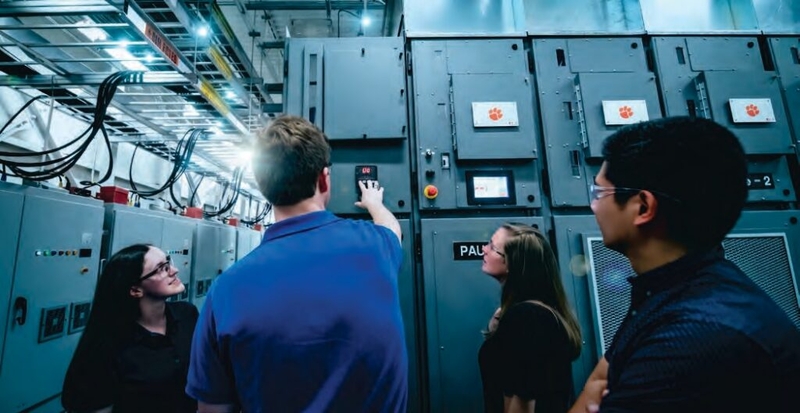
Students at Clemson University's Electrical Grid Research Innovation and Development center at the former U.S. Naval Base in North Charleston. The test hub was expanded using federal dollars as part of the state's SC Nexus program. (Photo courtesy of Clemson)
COLUMBIA — South Carolina’s economic development agency wants to turn the state into a powerhouse of energy manufacturing and research.
It’s leaning on a federally-funded research program to make that happen.
For the past three years, a conglomerate of South Carolina colleges, a federal nuclear research laboratory and the state Department of Commerce — collectively known as SC Nexus — earned the right to bill itself as an expert in energy technology.
The effort, which started with the University of South Carolina and Clemson University, was aimed at reeling in more federal research dollars but has also become a tool for luring new employers — and jobs — to the state.
SC Nexus, in October 2023, officially became one of 31 U.S. Commerce Department designated technology hubs across the country, with the goal of creating more high-paying technology jobs and making the nation more competitive in high-tech industries.
A dozen of those hubs, including SC Nexus, went on to receive federal financial backing.
In 2024, the state netted $45 million from the Biden administration’s CHIPS and Science Act, meant to reduce U.S. dependence on China for semiconductors, artificial intelligence, high-powered computing and more.
SC technology hub gets $45 million in federal money for energy projects
That initial funding round lined Clemson up for success on a second grant: This year, Clemson partnered with the University of North Carolina at Charlotte on a National Science Foundation grant that could bring in as much as $160 million over the next decade for research related to the power grid.
So far, the two schools have jointly received $15 million. How much they’ll ultimately receive is not yet known.
Energy research and testing
The $45 million was split four ways. The money paid to expand existing energy test beds at Clemson and at the Savannah River National Laboratory, open a new one at USC, and educate students.
Those three test beds are set to come online through spring and summer, starting in March with Clemson’s Electrical Grid Research Innovation and Development center at the former U.S. Naval Base in North Charleston.
Before the expansion, Clemson researchers had access to a mini-grid that could test technologies up to 15 megawatts. In early spring, that number will increase to 35 megawatts, with the ability to test in remote, rural locations.
“That makes it one of the most advanced grid simulation facilities in the country. It’s a really unique asset,” Christina Long Paredes, executive director of SC Nexus, told the SC Daily Gazette.
The goal, according to Long Paredes was to get these technologies out of the lab and solving real-world industry issues. As companies come up with new ideas, they can use the Clemson site to test it out, ensuring everything works as planned.
“It’s starting to really elevate the conversation that South Carolina is more than just a manufacturing state,” she said. “We also have the research and development capabilities, specifically in energy.”
Energy Department unveils project to squeeze more juice through existing power lines
This is of particular importance as power companies nationwide are dumping billions into updates to the country’s aging power grid.
In September, the U.S. Department of Energy awarded Duke Energy $50 million to increase the power capacity on its electric grid in the Carolinas. That includes upgrades to power lines and conductors in Greenville and Spartanburg counties.
Come July, South Carolina’s other two test beds are expected to be operational.
At the national nuclear laboratory near Aiken, the testing relates to hackers and cyber attacks on the grid. And at USC, it’s a mini-manufacturing line meant to help build better batteries, essential to the solar industry as well as electric vehicles.
“Again, we want to make sure we help companies and budding entrepreneurs lower their financial risk, getting them to market sooner and thereby enhancing their bottom line and putting more people to work,” Paredes Long said.
For example, Pennsylvania-headquartered EnerSys announced in 2024 it would build a $500 million lithium-ion battery plant in Greenville, employing 500 people when it’s fully operational.
It’s expected to open late next year.
While EnerSys is a $3.75 billion company, the world’s largest industrial battery maker, it plans to use the USC battery test bed for its research and development.
$500M battery cell plant employing hundreds coming to the Upstate
“That’s a great example of recruiting a company into the state and tying them directly to our research and development capabilities,” Paredes Long said.
The hope is that the reverse will be true as well — that companies start out doing research at one of the test sites and ultimately decide to open manufacturing operations here.
Since 2024, more than 25 energy-related companies announced plans to locate in the Palmetto State, pledging more than 4,000 jobs and $3.5 billion in investments.
Educating students
Part of the federal funding was set aside for scholarships at the state’s technical schools and a hands-on traveling lab meant to get K-12 students interested in energy-related careers.
So far, the state has given out 230 scholarships, each worth between $2,000 and $5,000, to technical college students studying to become linemen for utility companies in the state.
Westinghouse investing $1B to make a new kind of uranium at SC nuclear fuel factory
The effort focused on South Carolina’s more rural technical colleges first, Long Paredes said. At Denmark Technical College, for example, three students have already graduated and gone to work at Dominion Energy, energy contractor Gregory Electric and Black River Electric Cooperative.
At the S.C. Governor’s School for Science and Mathematics , the state is offering summer camps and educational workshops once a month just on energy, “to spark conversations and make young people who are just formulating what they’re going to do, see that as a pathway and a career opportunity,” Long Paredes said.
By next school year, South Carolina will have a mobile career exploration bus it can send to K-12 schools, complete with virtual reality glasses that let students practice skills, such as scaling a power pole.
“So when you think of South Carolina, you think of it as an energy state where you can develop, test, and deploy energy technologies,” Long Paredes said. “That includes the research and development capability, that includes the manufacturing side, and it includes the talent pipeline to support each one of those. And all of it is in the name of energy security and national security.”
Columbia