Dozens of NH school districts adopted tax caps. Now, a balancing act begins.
Nov 10, 2026 | 5:00 am ET
Description
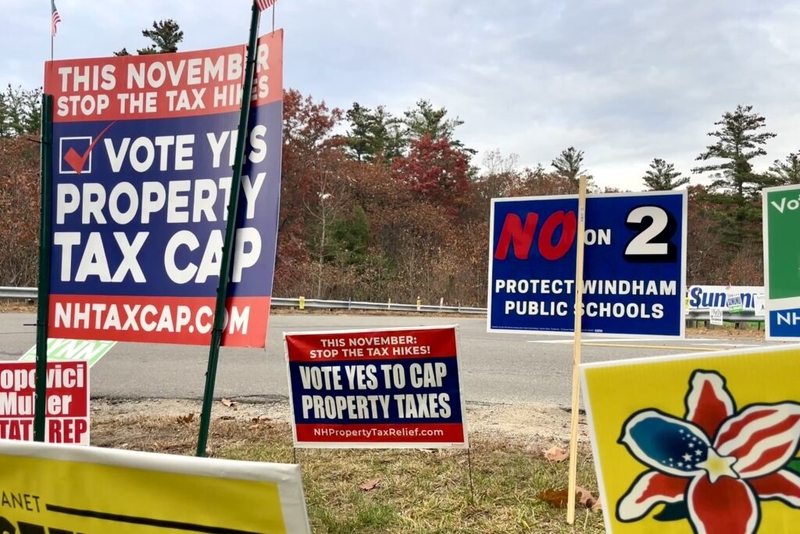
Lawn signs advocating for and against a tax cap on Election Day in Windham, Nov. 3, 2026. (Photo by Ethan DeWitt, New Hampshire Bulletin)
New Hampshire voters took out their affordability frustrations on more than just lawmakers last Tuesday.
As they elected Democrats into eye-popping legislative majorities in Concord Nov. 3, Granite Staters also voted in large numbers for a tax cap over their school districts, a policy many of those same Democrats opposed.
The numbers are decisive. A majority of school districts — 91 out of 168 — cleared the 60% requirement to impose a tax cap, according to a tally of Associated Press results by Chris Maidment, a Republican consultant. In total, 58.8% of voters statewide opted for a cap, the tally shows.
Now, school boards and superintendents in districts with the caps are grappling with a new mandate just in time for the winter budget-crafting season: Produce a budget that respects the will of their voters this November without upsetting them in March.
For many, it’s a delicate task. Spiking prices for diesel, electricity and healthcare could require school board members to make cuts elsewhere to stay within their new tax caps, some say. Yet many of those board members say they recognize the financial pain that drove their constituents to seek out the tax cap — and want to respond.
“I feel as though the tax cap is a way of our town saying, ‘OK, we’re feeling a lot of pressure in the wallet, and we’re nervous about food prices, gas prices, pick your poison,’” said Bob Loiacono, chairman of the Wakefield School Board, who was not speaking on behalf of the board.
Tough calculations
Loiacono and other school board members say they are working to keep the budgets acceptable to voters, even if the cap does lead to cuts.
“We would do everything possible to make sure it doesn’t affect the education of our students or have an impact on the parents,” he said.
But many school leaders in newly tax-capped districts say they are also confounded by a process that requires them to propose a budget next year without knowing the exact limits of the tax cap itself.
Under guidance issued by the state Department of Revenue Administration Friday, the department will set the final tax rates — using the previous year’s “tax levy,” or total haul of property taxes, plus any increases in inflation and new taxable property growth — in November 2027. While that is standard practice for the department when setting local property tax rates, for tax cap districts, the timing could mean school boards will be passing a budget in March months before they know the final tax levy to pay for it.
That will require estimating.
“It would be as if you decided in March how much money you were going to spend next year, but you weren’t actually going to have your salary until November,” said Pelham School Board Chairman Greg Smith, speaking in his personal capacity.
Many boards say they are still confused, or have heard contradictory information.
“If you put 20 superintendents in the room, you’ll probably get five different answers because there are five different lawyers advising these 20 school districts,” said Fremont Superintendent Brian Stack.
Smith, a former Republican state representative who retired in 2018, says the tax cap’s restriction to inflation — currently about 3.7% — does not on its own reflect specific expenses that have skyrocketed.
In Pelham, healthcare costs from HealthTrust, the district’s insurer, climbed 14% this year, Smith said. Transportation costs are expected to spike 20% next year, he added.
“The only way to balance the books is to cut out other things that make the overall pie work out,” Smith said in an interview, speaking for himself and not the school board.
To lay out what a district like Pelham might cut, it is easiest to begin with what it can’t cut, Smith says.
The district can’t change staff salaries or benefits, which are mostly negotiated in collective bargaining agreements.
It can’t cut special education funding mandated by law, or transportation, which is required for all K-8 students, and optional for high school students, under state law.
And it must absorb a number of fixed costs to keep its buildings heated, lit and safe.
Because it can’t reduce benefits and salaries — and because 70 to 80% of a typical Pelham budget consists of benefits and salaries — if the district must make cuts, it has one clear avenue: cutting positions.
“The only way to get there is through reducing headcount, ideally through attrition,” Smith said. It’s a situation he says he hopes to avoid this winter.
The timing is tight. School district employment contracts for teachers and other staff are typically issued in March, April and June. That means if a district deems it needs to reduce staff to adhere to its tax cap, it must make those decisions during its budget-writing process over the winter.
“You have to wrap those decisions up in January, because by January you’re having public hearings and deliberative sessions,” said Brian Stack, superintendent of Fremont School District.

Concern, optimism
While some school boards are fretting, others say they are ready.
The Middleton School District has absorbed some of the same spiking costs affecting its peers. In part, it has done so by cutting staff positions and hours in its last budget. But it has also stripped away what School Board Chairwoman Rebecca Eastman-Derrow called unnecessary spending.
“I think the tax cap has really been put in place to limit this frivolous spending that has been occurring within the school district,” Eastman-Derrow said. “With Middleton, we really haven’t had any frivolous spending.”
She noted that the district’s cost per pupil was among the lowest in the state: $19,699.60 for the 2024-2025 school year, below the state average that year of $22,700.
She credited that frugality to the board’s budgeting approach and its communication efforts with constituents.
Eastman-Derrow said she believes the board can pass a budget next year that will fall under the cap, without further staff reductions. But nothing is 100%.
“We’re hoping not,” she said. “But it’s something that is always a possibility. At the end of the day, we have to do what we have to do.”
For its part, Fremont is in a unique position that could spare it difficult decisions, at least for the first year of the cap, said Stack.
That’s because the district, which provides K-8 public education, is already set to save about $500,000 in its next budget due to a planned change in where it sends its high school students, Stack explained.
Starting next year, the district will no longer send its students and pay tuition to Sanborn Regional High School, Stack said. Instead, it will offer its middle school graduates different choices with cheaper tuition rates. That transition, which will take at least four years to complete before the current cohort of students at Sanborn Regional graduate, will ease any immediate budget woes.
But that cushion may not last long, Stack warned.
“I can’t say my budget’s going to go down a year from now,” he said. “So I may be in this situation.”
Stack disagrees with the notion that a tax cap will allow a district to maintain the status quo from the year before. Because of rising expenses like healthcare and diesel, it could result in cuts, particularly in smaller districts.
Districts also face unpredictable costs, like incoming students with special education requirements or sudden building failures.
For years, school boards have sought to thread a needle between paying for existing services and setting aside funds for emergencies while keeping taxes low. The tax cap will shrink that needle and require delicate balancing, school board members say.
“Unfortunately, there are too many uncontrollable costs, and from the standpoint of a really small district, those uncontrollable costs get magnified so much more,” Stack said.
For a district, the consequences of overestimating the tax cap could be high. If the Department of Revenue Administration calculates a lower amount than the budget accounted for, the district might need to make emergency cuts, months into the 2027-2028 school year.
“Unless you have some other revenue stream, which most public schools do not,” Stack said. “So most superintendents are trying to use a best-guess estimate of what they think it will be, erring on the side of caution.”
Override chances murky
The tax cap law allows voters to override the cap for a specific budget, provided 60% of voters at a district meeting choose to do so.
But it is unclear how many New Hampshire school districts with new tax caps will pursue that route this spring, especially in the cap’s first year. Many superintendents and school board members say they want to respect the will of their voters and present budgets that adhere to the cap, even if it means tough decisions.
In Massachusetts, where statewide tax caps have applied to whole municipalities and their school budgets since Proposition 2.5 passed in 1980, state data indicates that a relatively small percentage of cities or towns successfully pass override measures each year. Of the state’s 351 municipalities, 57 put an override question on the ballot in fiscal year 2026 — about 16% of all cities and towns. Among the municipalities that attempted overrides that year, about 49% were successful.
Those numbers fluctuate; in 2006, for instance, more than 160 Massachusetts municipalities put override measures on the ballot, and again, about half of them passed.
Meanwhile, since 2000, 22 Massachusetts municipalities have voted to reduce their tax caps below the 2.5% allowable increase set out in the law, a process known as an “underride.”
Stack stressed that the Fremont School District will likely not be requesting an override. But if it ever does down the line, he has an idea how to sell voters.
To pass an override, the district would present a budget that meets the tax cap but contains cuts, and add the most important of those cut programs into a separate warrant article, Stack said. Then, the board could make the case to voters to pass the article by 60% and override the cap if they want those items, he said.
In Wakefield, Loiacono plans to follow the cap, not resort to an override.
Doing that won’t be easy, he admitted. It could require a number of uncomfortable questions for the K-8 school district, which sends its high schoolers to Spaulding High School in Rochester.
“What’s the tuition to Spaulding?” Loiacono said. “What’s the transportation cost to Spaulding? Can we afford our pre-school? There’s so many items that are part of the budget that could end up having a spotlight on them.”
Making taxes ‘a little bit harder’
The success of the tax cap initiatives on Election Day came after years of unsuccessful attempts to pass similar caps at annual school meetings, and after months of Democratic opposition to the law that put the question on the Nov. 3 ballot, House Bill 1300.
Democrats argued the question was confusing, and dealt with a matter that should be debated and passed at annual school district meetings in March, not in a ballot box.
But Rep. Daniel Popovici-Muller said putting the measure on the November ballot was more democratic. The higher turnout in November would allow districts and school boards to take a better measure of what their constituents wanted, he said.
Speaking outside the Windham High School on Election Day, Popovici-Muller brushed off any concerns over potential budgeting problems caused by tax caps. If school boards wanted to spend more, they could always present and advocate for a 60% override option, he noted.
“All that the tax cap is about is making it a bit harder for the school boards to raise taxes,” he said. “I don’t think that making it a bit harder to increase property taxes is such a bad thing in New Hampshire today.”
Popovici-Muller, who formerly chaired the Windham School Board, recalled campaigning for a $39 million renovation of the Golden Brook School in that role, an expense that required a 60% vote because it involved a bond. While the measure passed in 2017, it only did so after multiple attempts, Popovici-Muller said, which he said required the board to thoroughly make its case.
One Londonderry voter brought personal experience to her vote on the cap. When Cathy Himmel was in high school in Massachusetts in 1980, voters passed Proposition 2.5, which applied the state’s default tax cap that stands today. Himmel saw immediate cuts to school districts. But those new restraints didn’t stop Himmel from later pursuing teaching herself, eventually capping off a 35-year career, retiring and moving to Londonderry.
On the one hand, she said, some Massachusetts schools initially cut music and art programs. On the other: “I think it has helped the schools stay in some kind of a line.” Throughout her career, Himmel declined to participate in teacher-union-led opposition campaigns to the caps.
“I wanted to have a positive effect on my students,” she said. “I wanted to be a good teacher, a good individual, contribute to society. That’s a much smaller personal contribution type picture compared to the administrative, political, money-based environment I had to live in.”
On Nov. 3, Himmel voted for a tax cap in Londonderry. The effort fell short, gaining just 51% of the vote there. But to Himmel, facing a mortgage, increasing home insurance and a recent $5,000 roof repair, her vote was necessary.
“The circumstance is not good for anybody,” she said. “Everybody’s taxes are high.”
Concord, NH