Big corporations dodge taxes as Pennsylvania families pick up the tab
Nov 10, 2026 | 5:15 am ET

Description
The Keystone Research Center found that corporations’ share of Pennsylvania’s general fund tax revenue fell from 30% in 1972 to 12% in 2023-24, and that more than almost two-thirds of corporations operating in the state pay no corporate net income tax. (Photo by Jessica Kourkounis for the Pennsylvania Capital-Star)
From the steps of the Pennsylvania Capitol, looking out toward the Susquehanna River, North Street runs off to the right — quieter than the avenues that feed the statehouse, more suburb than seat of power.
That is where Andrea Grove built Elementary Coffee, the shop she opened at Harrisburg’s Broad Street Market in 2014, when she was 26.
Grove pays her taxes. What she doesn’t have is what the coffee giants have. “We don’t have accountants that will tell us about loopholes and these ways to get around these things,” she said. “The expectations for small businesses, particularly in coffee, is to live up to what these big corporations are producing but with way less resources — so you’re hustling harder than ever.”
Just a few miles from her counter are several Starbucks, with which she competes for customers — but Starbucks has a huge advantage since its multinational parent company takes advantage of the so-called Delaware loophole, which allows it to avoid paying Pennsylvania income taxes by having its parent company in Delaware and shifting its profits to overseas subsidiaries.
Within walking distance of Grove’s counter, lawmakers have spent more than two decades deciding whether to close the mechanism that lets those corporations do exactly that. So far, lawmakers have balked.
The Voluntary Victim State
The Delaware loophole works like this: A multistate corporation sets up a subsidiary — often one that exists on paper only — in Delaware, which does not tax royalty income. The Pennsylvania operation pays that subsidiary a royalty for use of its own trademark and deducts it as an expense. Profits earned in Harrisburg or York are logged in Delaware, untaxed. Most states have closed the loophole through “combined reporting,” which taxes a company and its subsidiaries as the single business they present to shareholders. Pennsylvania is one of 18 states that still have the loophole, costing taxpayers in those states $2.85 billion annually in total lost revenue, according to the Institute on Taxation and Economic Policy.
Don Griswold spent nearly 40 years on the other side. He built a 600-person state tax minimization group at accounting giant KPMG — “We weren’t hiding what we’re doing,” he told Capital & Main. “It’s all legal loopholes” — and finished his corporate career as Warren Buffett’s executive tax counsel before joining the Center on Budget and Policy Priorities. At KPMG, he said, states that were easy to shift profits out of were called “voluntary victim states.” The company referred to Pennsylvania, Griswold said, as “the Rip Van Winkle of states in terms of tax policy.”
The strategies he designed, he said, “pulled hundreds and hundreds of millions of dollars out of state coffers.”
“Think about the food stamps that were cut by the One Big Beautiful Bill. Think about school lunches,” Griswold said. “How many kids did without their only meal of the day at school because of stuff I was doing?”
The Keystone Research Center found that corporations’ share of Pennsylvania’s general fund tax revenue fell from 30% in 1972 to 12% in 2023-24, and that almost two-thirds of corporations operating in the state pay no corporate net income tax. (The percentage paying up increased slightly in 2025-2026, a bump attributed by fiscal watchdogs largely to surging corporate profits and federal tariff refunds.) The Pennsylvania Policy Center estimated that the state collects $2.21 billion to $2.99 billion less each year in corporate income tax than it would have, had it kept pace with national collections — with no evidence the cuts delivered stronger economic growth.
Worldwide combined reporting — treating a company and all of its global subsidiaries as one entity for tax purposes — would, the center and the Institute on Taxation and Economic Policy calculated, raise $1.537 billion in Pennsylvania corporate tax revenue annually.
Working families pay the difference. The nonpartisan tax policy organization ITEP ranks Pennsylvania’s tax structure the fourth most regressive in the nation: the lower a household’s income, the larger the share that goes to sales, property and income taxes.
“I think of the woman who has incredibly limited income and a little kid,” Griswold said. “That sales tax may be the difference between choosing food or diapers.”
The Bill in the Drawer
In June 2025, Rep. Elizabeth Fiedler, a Philadelphia Democrat, pushed HB 1610 — a combined reporting bill — through the state House, 104 to 99. It has now been sitting in the Republican-controlled Senate Finance Committee since September 2025. When Democrats tried to force a vote, said Felicity Williams, executive director of the Pennsylvania Policy Center, the Senate refused to take one.
“Right now the tax system in Pennsylvania is really upside down,” Fiedler told Capital & Main. “The people who are benefiting from that are billionaires, for-profit corporations, all sorts of people who are really not paying their fair share, and the people who are suffering as a result are working and middle class Pennsylvanians who are just doing their best to get by.”
She added: “It’s always been outrageous, but especially right now during this affordability crisis.”
“Year after year this idea pops up,” said Fiedler, who has served since 2019. “It’s been an intractable problem.”
The opposition to eliminating the loophole is well financed. The Pennsylvania Chamber of Business and Industry, which represents nearly 10,000 companies, warned House members in a memo that the bill would make the state less competitive, add complexity for employers and create revenue volatility. Republican senators echoed it.
“Combined reporting is double taxation,” state Sen. Greg Rothman, a Cumberland County Republican, told ABC affiliate WHTM. “It’s going to drive companies out of Pennsylvania, and it’s not fair.” Rothman did not return calls from Capital & Main for comment.
“If businesses weren’t paying their fair share, you’d have more businesses moving into Pennsylvania,” Rep. Aaron Bernstein, an Ellwood City Republican, told WHTM. “Instead, businesses have been challenged and have moved out of Pennsylvania because of our high tax structure, because of the complications with it. We need to make our tax structure more competitive. This bill does not do that.” Bernstein did not return calls from Capital & Main for comment.
Williams, the Pennsylvania Policy Center director, offered three reasons the loophole survives: a Senate majority ideologically opposed to revenue measures, a broader “misbelief” that lower corporate taxes generate growth and “the amount of corporate money in the political process.” The Chamber’s political arm, ChamberPAC, endorsed Rep. Scott Perry, a Hanover Republican, and steers its money primarily to the Senate and House Republican campaign committees — funds that push millions into competitive districts. “The system is kind of rigged in favor of the bigger corporate giants,” said Williams.
The Bill Comes Due
Perry’s district is where the two halves of the story meet. One of the state’s top congressional fundraisers this cycle, Perry voted for the One Big Beautiful Bill, which imposed what Feeding Pennsylvania CEO Julie Bancroft called “the deepest cuts to SNAP and Medicaid in history.” Perry told FOX43 in May 2025 that the cuts targeted waste: “Everybody that applies, whether they’re eligible or not, can get the benefit, and again, it becomes unaffordable.”
Perry’s spokesperson did not return calls for comment from Capital & Main.
In York, Jennifer Brillhart counts the cost. The York County Food Bank she leads — 13 staffers, more than 100 volunteers — served about 30,000 people a month two years ago. Now it’s up to 40,000, she noted. Its twice-monthly drive-throughs are drawing record numbers of people, many of them first-time visitors.
“We truly are serving the working families,” she said. Federal shipments come sporadically — “Every other month we hear about another cancellation of loads” — and a box that once held two weeks’ worth of groceries now holds less. “Our goal is to never turn anyone away,” Brillhart said, “but in terms of the quantity of food that we’re providing, we have had to decrease that.”
The state sent emergency money, she said, but the Pennsylvania Agricultural Surplus System, the State Food Purchase Program and the Fresh Food Financing Initiative were flat-funded this year. “Effectively a cut with rising costs,” Williams said. The state balanced its budget “on paper,” she said, by moving bills that will still come due, and it remains $3.3 billion short of adequately funding its public schools, and some groups speak of an adequacy gap of $4.8 billion.
Closing the Delaware loophole alone, estimated to be worth hundreds of millions of dollars, “won’t even cover” the new SNAP costs the state is about to absorb, Williams said. “Money is fungible, so it has to come from somewhere.”
In Hanover, in Perry’s district, it comes from parents. The South Western School District tentatively approved a roughly $3.4 million budget increase requiring a nearly 5% tax hike — and still halted a long-planned renovation of Park Hills Elementary, last renovated in 2001. “The [heating and air conditioning] is going down. Electrical is not great. The intercom system is back and forth,” said Erin Keefer, whose third grader attends the school. “They don’t have the money to do it.”
Nearby, York City and West York cut full-time classroom aides to part-time hours; West York also raised taxes 4.6%. “All of a sudden, we’ve turned into this,” Keefer told Capital & Main. “We’re out of money, and we’re deep in debt. And how did this happen?”
Griswold has an answer. Pennsylvania law, he said, “discriminates against its own small business community and in favor of these abusive global giants” — small corporations don’t have shell companies in Singapore or the Cayman Islands, or the million-dollar fees to set them up. When people learn the system is rigged against them and their government does nothing, he said, “citizen confidence in this democracy goes down.”
On North Street in Harrisburg, confidence is in short supply.
“After year 12 of running a business, you should feel somewhat settled — have a little bit of stability,” said Grove, the coffee shop owner. Instead she is running on far less profit, unable to raise prices as fast as costs climb.
“People and the average consumer don’t know or understand that is what’s going on,” she said. “I wish people would be a little bit more conscious if they learned that Starbucks is doing this. But at the end of the day, people are still gonna stop at Starbucks, because they have all the locations.”
Copyright Capital & Main 2026
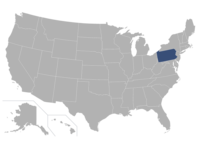
Harrisburg, PA